I have been enjoying all my classes so far.
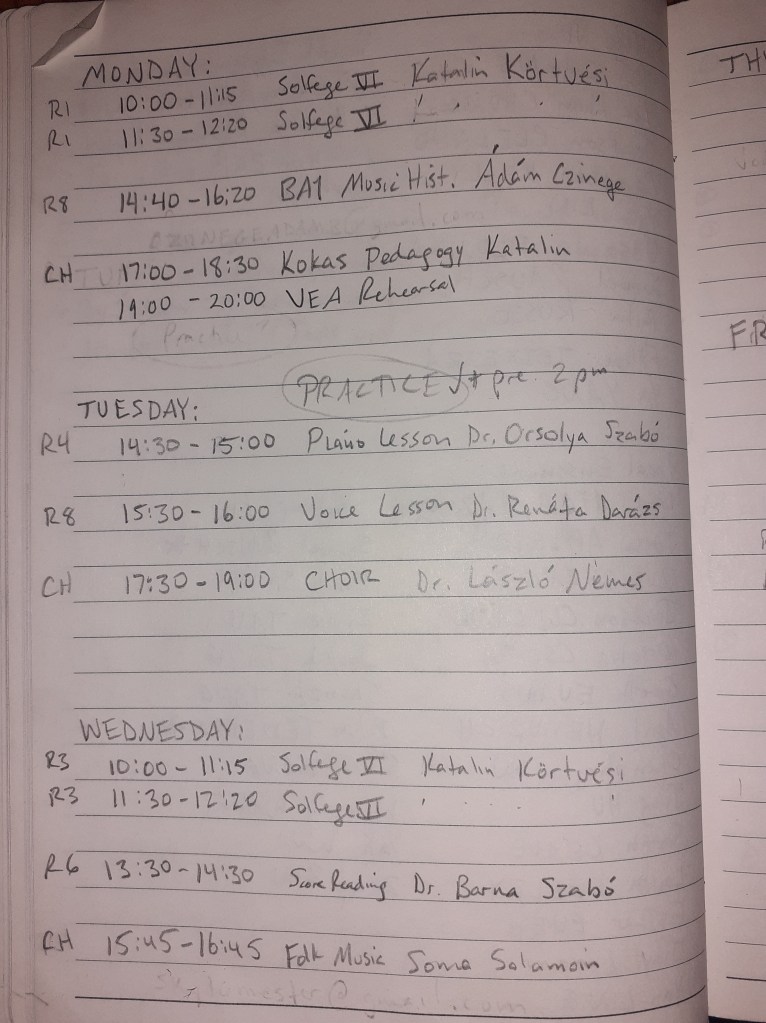
I placed into Solfege VI, which is the highest regular solfege class this quarter. There are six level, but Solfege V is specially for the Chinese students, and is taught in Chinese. It is nice because two of my roommates placed into Solfege VI as well, and the third moved up this past week, so all four of us are going to be doing the same things there. There are 11 students in the class, and it’s fun to think that our flat makes up a third of that. I’m glad that I’ve gotten roommates who are at a similar level as me.
We have 5 hours of Solfege every week. Of all the classes it is probably the most overarching musicianship development class, with many threads woven together. It is impressive to see how every part of Katalin’s lessons fit with all the other parts, and seamlessly build and transition from beginning to end. In the Institute I think it is relatively common for the more senior students to sit in on a class just to observe the teaching style of the professor. There are definitely some very good role models on the faculty.
I think homework assignments tell a lot about a class, so I’ll include some of mine here.
- Sing and play a canon learned in class in canon with yourself, in solfege syllables (do, re, mi, etc.) and then letter names (C, Cis, D, Dis, etc.). Do this in the original major key, then in minor, then in locrian (the mode that practically no one composes in because it sounds unstable). Do this all 2-3 times, with the same starting pitch for each set. Be musical
- Record the vocal parts of Schubert’s 4-part Litanei. Play three of the lines, sing alto or tenor. (as you can see here, the music for the class is excellent in its own right: https://open.spotify.com/search/Litanei schubert ralph allwood (favourite classics by chopin)
- Play the beginning chord progression of the Schubert in several keys in both major and minor
- Sing and play the first page of the Pergolesi Stabat Mater by memory (just the two vocal lines with the chord outline in the bass), and then continue by playing the walking bass and soprano lines on the second page while singing the alto part.
European Music History class with Ádám Czinege is very good. Although there is a similar class with a larger group of the diploma students, I have one with just the other two BA1 students, Teresa (Portugal) and Jae-eun (South Korea). Ádám has said that we will do a sort of spiral learning: we’ll go over the history timeline several times, each time with greater definition. I think this structure will be very good for getting an understanding of the overall progression into long term memory.
- Listen to two pieces of music per week and write up a short response to each. The purpose of this is largely just to develop a broad palette of repertoire. (This brings to mind all the professional musicians I have known to say how important active listening is)
- Give an end of the semester presentation–topics TBD
Kokas is fascinating, and a bit crazy compared to the other classes–it is a method to interact with music and develop creativity (among other things) in a largely kinesthetic way. I’ll post my homework for that in a separate post (a reflection on the first class). Katalin (my solfege teacher) is the teacher for this.
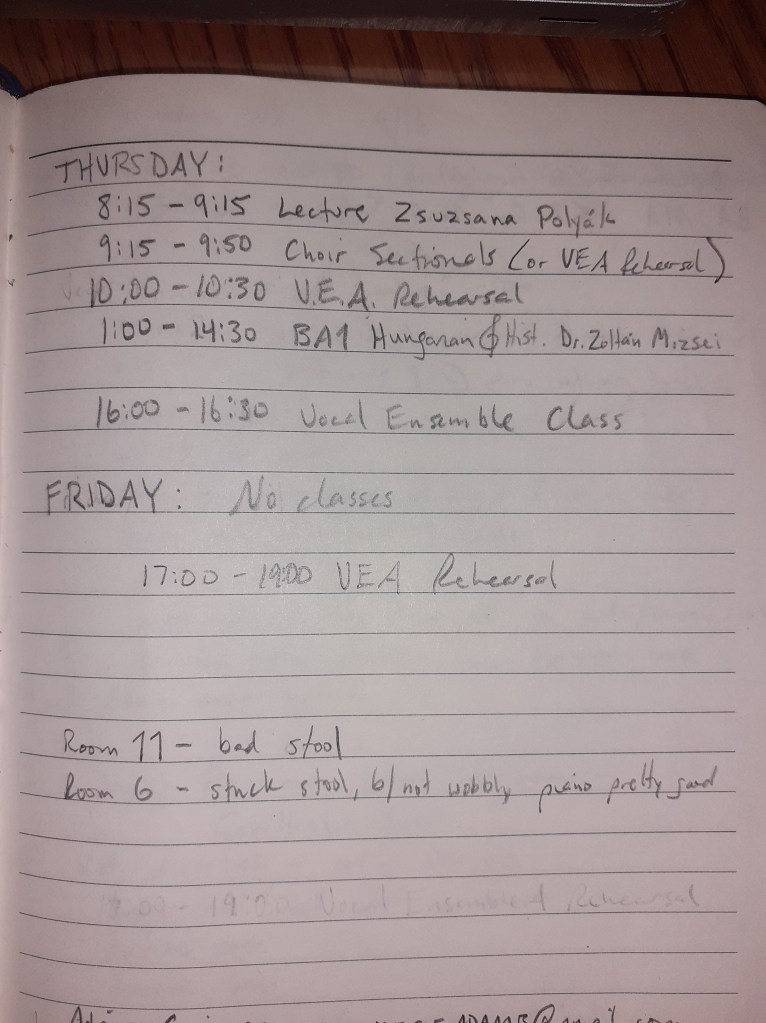
“VEA” stands for “Vocal Ensemble A”. I’m in a group of 5 (SSATB): we were the first group to get put together on the first day (hence, VEA). We set up a few hours of rehearsal every week, and then have 30 minutes of training with the wonderfully energetic and eager Dr. Árpád Tóth. This has already been a lot of fun, especially because all our five voices fit together well, and we all are able to handle the music. It was funny because Árpád told us right away that he could tell we had all pretty much just sung in choirs, just by each of our approaches of where we tried not to breath (i.e. to a certain extent, our attempts to do stagger breathing on an individual basis!). We sound good already, he said, and I am really looking forward to learning more and more about the stylistic aspects of good ensemble singing.
Another thing when we were rehearsing on our own: we confirmed a suspicion that not all of our tuning forks matched. Our tenor had an A442 (what?!), instead of the regular A440. Of course the first thing we did on finding this out was to stick both up to our ears at the same time and cringe.
My piano lesson is fantastic. The slightly eccentric Orsolya Szabó is wonderful at creating a focused but non-stressful atmosphere to her teaching. I’ve memorized Il Penseroso (Liszt), have started in on Bach’s 3-part invention No. 2 in C minor, and also have the Beethoven Sonata in c-minor, Bartók Hungarian Dance No. 1, and a Kodály piece on the list.
The “projects for the semester” in choir are a Christmas concert, and Faure’s Requiem. It has been interesting and informative to see how Laszlo Nemes applies solfege to the score. One of the purposes of “movable-do” solfege is to inherently reveal the harmonic structure of the piece, and Laszlo’s way of applying the solfege does this better than anything else I’ve done.
Score reading is an individual lesson: it is not easy, but so far the most fun. My assignment this week was to read through 30 excerpts of music that use at least one C clef (to learn the clef), and to play BWV 628 (Bach), but with the alto and tenor lines switched: alto line played down an octave in the same hand as the bass, and tenor played up an octave in the same hand as the soprano. It’s a very satisfying mind game.
That’s all for now! The folk music class had an amount of tangents in the discussion that require more time, and another post. Also, there’s the class on Zoltan Kodaly and his philosophy.
Also, there’s the non-academic things that have been going on, including a folk music festival!
All to come shortly.
Sincerely,
Samuel Rausch
 Hungary4Harmony