Finally another post!
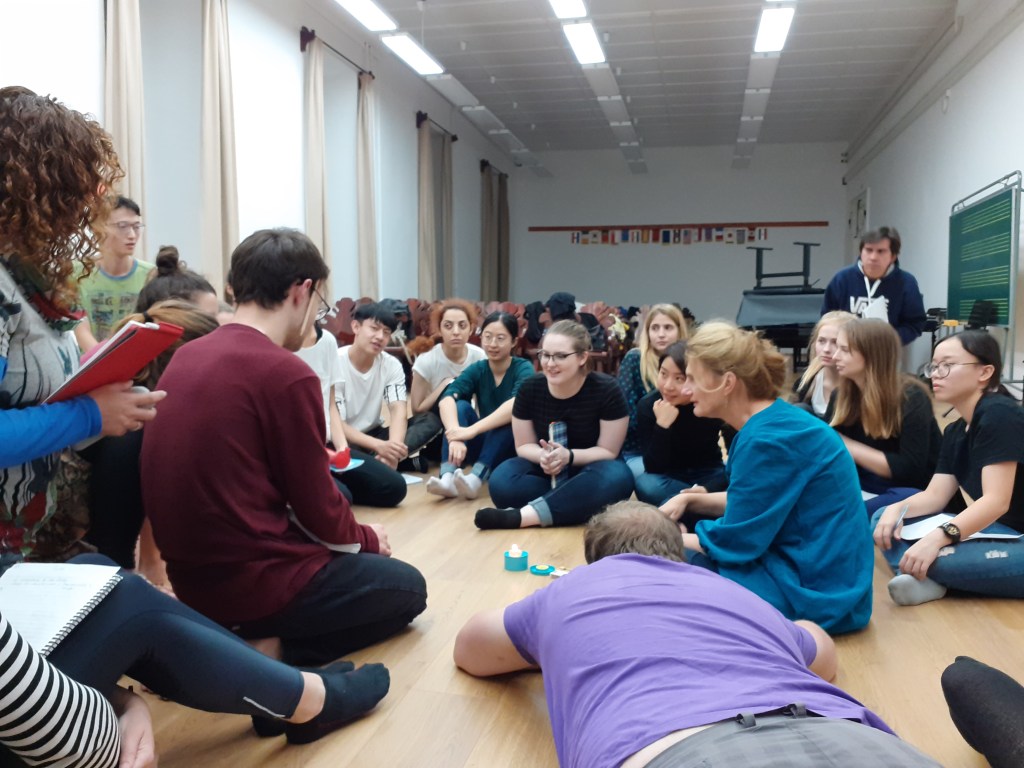
Every Monday at 5pm about twenty-five of us gather in the Concert Hall, take our shoes off, and spend an hour and a half with Katalin Körtvési (also my Solfege teacher) immersed in Kokas pedagogy. What is “Kokas”? Klára Kokas, one of Kodály’s students, “saw the need of children for movement and self expression” in the music education programs she saw. She developed a mode of interacting with music that for us has melded spontaneous creativity, music listening, free improvised movements, and profound self expression, all generally through the underrated avenues of non-verbal communication. Kokas said “I could use the children’s imagination to help their movement…the movement is a tool [that] helps us to absorb the music. You can observe the deepest, heaviest music if you listen to it that way.” Specifically, she was looking for movement not for the “beauty of the move or look of the movement,” but for “the wish, the dream, the longing for self expression.”
When I was asking one of the second-year students about Kokas, she said that it is not uncommon for people to drop the class in the second semester, from something like “creativity overload.” The class definitely doesn’t allow for any sort of calcified grownup-ism (I think of The Little Prince by Antoine de Saint-Exupéry). I think it is brilliant.
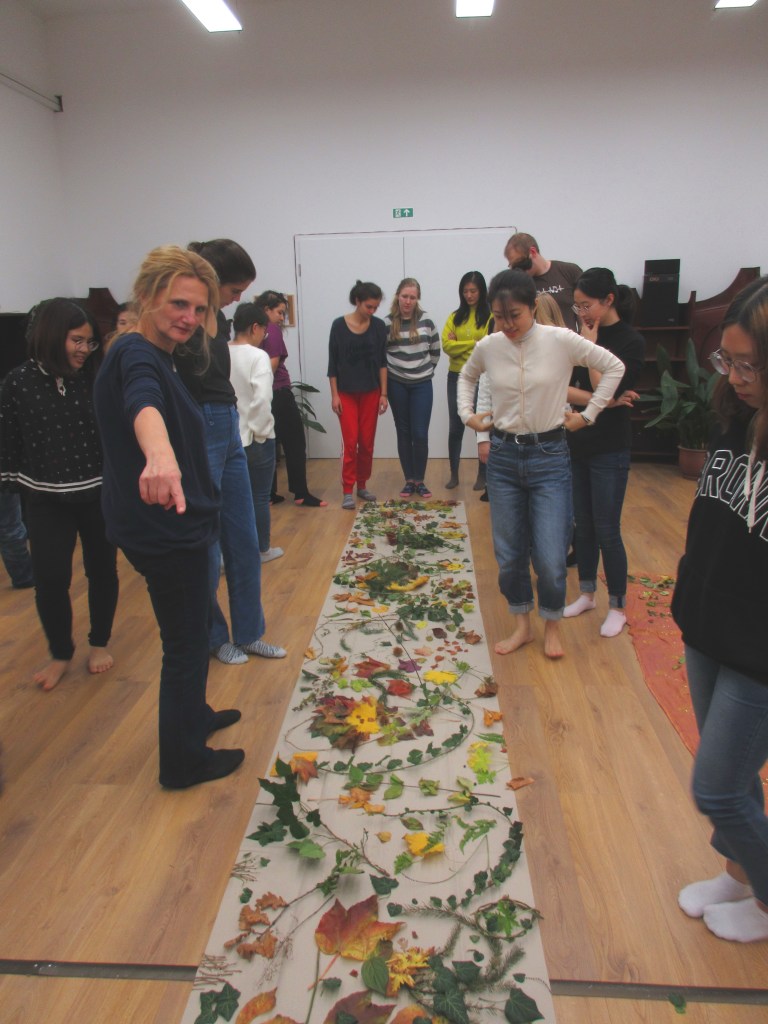
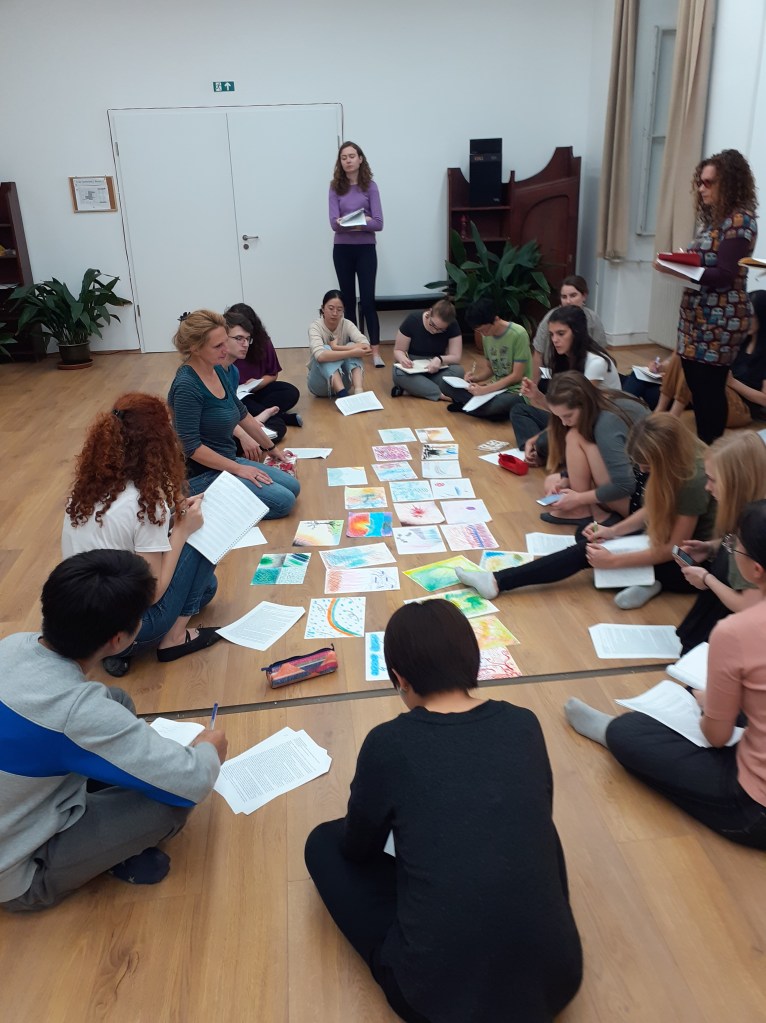
Here are a few stories of the classes from the summaries I’ve submitted, and a few pictures.
7 October 2019
“We came together as a class physically at the beginning with the Bluebird Through the Window song, during which we joined hands and created a “snake” that wrapped in and out of itself. We all got tied up in a knot, which then gave us all the opportunity to solve the puzzle together and unwind the knot.
For the second part of the lesson we played another naming game, where each person spoke their name in whatever character and with whatever movement that they chose. It was impressive to see how perfect the connection was between the person and the performance of their name. Each seemed like a symbol that encapsulated the essence of each person. After one person spoke their name, everyone else would repeat it as accurately as possible. We were practicing putting on another character, as well as appreciating each individual through their name. Kata emphasized the importance of imitating the facial expression as well as the sound of the name and the movement of the body. We were encouraged to notice every detail that made up the aura of the person. When I think about it, this sort of game is a profound way of getting to know other people, because instead of labeling ourselves with words after words, and facts about ourselves, the form of self-expression through one’s name gives a window straight into who a person is. Each name is like an excellently written short story.
After one time around doing this with the names, we continued around again, but this time all silently, and replicating each person’s name by memory. Considering how appropriate to each person their “name” was, perhaps I should not have been surprised at how easily we had immediately memorized the “name” of each of the 25 or so people around the circle. In the next two repetitions (an important element in each of the classes), we played around with different ways that we could change the expression of the “names” while still keeping the character: faster and slower tempos, and silently. For this Kata instructed us to do our name at whatever was the natural ending transition point of the previous person’s. We were not to explicitly change our “name” to pass it along to the next person, but just be aware of the people around us, and connect the continuity of their name to the continuity of our own.
The last segment of the class was of course music listening with movement. For this Kata told us all to find a partner and choose an “A” person and “B” person. The excerpt of the music was repeated several times as usual with occasional changes of Kata’s input for our movements. First the instructions were for the “A” person to lead, and then the “B” person the next time. As Kata reminded us, leading did not have to mean mirroring. Then over a few more repetitions it was for both people to lead and follow each other in an organic way. For the last times Kata opened up the parameters so that we could either choose to stay with our partner or move to others as we pleased. All of this for us was done without language, so all our communication was based on a heightened sensitivity and awareness of ourselves and of the intents of those around us.
Afterwards, Kata put forward several ideas and questions inspired by the exercise. Really, they were questions that each of us had engaged with and come to terms with just by participating. In my opinion, to have such profound questions at the core of something is a testament to its value. What we were doing in Kokas was not just music listening or moving, but in many ways an exploration of philosophy and self knowledge.
Which is better for you, to be a leader or to be led, or to lead and follow together with another person?
How well are you able to give up the leadership role or remain always the boss?
How well can you change yourself in this way and remain confident?
Were you really able to listen to the music with your whole body, or just come up with a movement and stick to it?
Did you build your movement to to music yourself, or just imitate someone else?
Which is better, to be with one person (lead & follow), or to work with others?
Were you able to lead someone without touch?
What does it mean to touch someone? With your soul, heart, eyes?
Are your fingers, hands, eyes, head, etc. strong enough to lead someone? Even without physical touch?
Which is stronger: physical touch, or the non-physical ways of touching?”
14 October 2019
“As so many of the Kokas classes have begun, this one started organically with no explicit directions. Without language, we all simply saw what Kata was doing, and followed all the non-verbal cues. It is a good reminder of all that can be “said” and done even without, or better without speaking. We were all in a circle, with Kata in the middle. She began walking around and got one person to join her. Gradually those in the middle drew in more and more people from the outer ring until the whole group turned upon the last few that remained and engulfed them. The activity had developed and formed an identity in the way that the first few people walked, looked, and expressed themselves in the center. First it was two or three doing the same thing, and as Kata and the others added little impulses and motifs into the drama, more complex relationships and unspoken narratives appeared. These included the expression of many emotions, moods, body percussion, singing, etc.
Once this all had run its course and everyone was milling about in the room, Kata began singing, and transitioned everything over to “Oh how Lovely is the Evening.” As she teaches the song, she plays around with what character she (and then we) sing the phrases in. We are constantly molding ourselves into different characters and exploring how these different characters shape what we are doing. In a very short time we had all learned the song, and were singing it together. We all began to walk in a big circle, with nearly all of the people going the same way. It was interesting to see who were the small minority that walked the opposite direction, or even sometimes moved outside the circle pattern. Kata initiated canon singing be starting in canon herself, upon which a subset of the students joined her. An even smaller subset started and sang a third part to the canon.
As this reached a point of completion (with us all following Kata’s lead as she slowed and quieted her singing), Kata began a naming game, where she performed her name in both speech and action. Soon we all were doing the same with our names, at which point she added the impulse of sometimes imitating someone else’s name. This developed through all the students. As we ended, there were 4-5 “name” groups of varying sizes. Again, it was interesting to see whose names these were centered on, as well as the kind of expression that each had. Kata mentioned that it was “good that it wasn’t just one” group!
Kata asked what kind of building would go with the song, and after someone said “church!” we incrementally built one with ourselves. Some were the doors, some chairs, some windows, some the organ, alter, etc. Both Kata and students suggested what they could be, and once everything was in place she brought in every character set by set until we all were singing (in some cases characters were shifted: chairs to congregation, etc., so that they could sing). We then sat down, and had an imaginary meal, food suggested by all. It was a very realistic representation. Some people wouldn’t have liked the food in real life, or would have been allergic to it, so they acted accordingly. The fish chowder put forward by Lara got mixed reviews, even by Kata. We stayed authentically ourselves.
Then, we had to form a bridge because Kata looked out the doors, and “saw” that we were surrounded by water (instantly populated by some students as alligators as soon as they heard this). We all had turns going under this bridge, where we sang the song again in the way that each person went through.
At the end, music listening and dramatization. As usual, we listened to the segment multiple times, and had several “goes” at it. However, the instructions from Kata were to move opposite to the music, and then after a few repetitions, that we could choose to move with it or still against. At the end, Kata observed how some experimented with different kinds of opposition that paired with different aspects of the piece, and that moving contrary to the music really required us to concentrate it, to determine its particular aspects to go against. We “maybe don’t have to focus so much on what is in the music when we move with it,” said Kata. I found it in many ways easier than moving with the music, although this also depended which section of the music I was in. I found that the calm section was easier to pick up and appose than the second bit, which was quicker and had more moving parts, and more possibilities for segmentation.
A few student “performance” of what they had done concluded this session of Kokas.
Theresa and Despina were polar opposites, one calmly apathetic and the other frantic, who switched roles when the music changed in the middle.
Clodagh and April found themselves shut in glass boxes, and tried to get out. Clodagh broke out, but neither she or April combined could open the box that April was in. Clodagh tried an ax and a key, but neither worked. However, April eventually stopped struggling to get out and fell asleep, upon which the box became unlocked. The symbolism here is interesting to consider. The drama ended with a tea party.
I (Samuel) had the last performance. To the pacific music at the beginning, I acted contrary as an awakening butler of sorts who briskly and bruskly prepared my toilet and dressed. As the music changed to a faster tempo, I became calm and in my element, unlocking doors and straightening curtains: I was preparing the room. However, near the end I realized that something was wrong with my shirt, and after much debate with myself, hid behind a floor plant.
16 September 2019
Reflection on four open expression dances
While the subject matter in each of the dances performed at the first Kokas class was varied, each seemed to have similar thematic complexity as those in folk stories. The psychologist Carl Jung believed in a “collective subconscious,” and I would argue that as we put on our “childish skin again” (Kokas) and reconnected with our innate creativity, the motifs of our humanity from this so called “collective subconscious” rose to the surface in the same way that they did for folk tales.
In Teresa’s dance, she appeared to take out materials for food, and to start mixing the ingredients together on the ground, while showing another girl how to help. This transitioned into motions like kneading dough. The climax of the music was reflected as the two attempted to carry the huge weight of what they had been making. They seemed to have created more than they could handle, because there was a degree of tension over the division of the labor, and in the end their level of cooperation could not really match the weight of their load.
In his dance, Gareth appeared to wake up into consciousness in a world of fantasy, with a few sprites moving around him, blowing something sparkling out of their hands and then eagerly watching it as it floated away on the air. Gareth’s character appeared at first to be glad to join the sprites, but his joy in what they all were doing seemed to transition into selfishness. He seemed to want to keep some of that beautiful material all to himself, although it was not his to keep to himself but only to enjoy without ownership. The climax in the music coincided with his efforts to snatch the spangles from the other sprites as they continued playing with it.
In my dance, my character woke to consciousness in a strange and empty room, without any sense of the time or place, and with his feet stuck to the floor. After struggling to free himself on his own and calling for help, Despina arrived to the rescue. With our combined efforts she was able to help me out of the area where I was stuck. Although my feet were then free, my hands had become stuck to hers while we worked together. At the last moment, we pulled apart from each other.
In Franklin’s dance, his character met Alvaro’s. They shook hands and were very cordial to each other. However, they shifted over to the window, where it soon became clear that Franklin’s character was trying to get behind Alvaro without his knowing it, to push him out. Alvaro began to sense something wrong, and as the climax of the music got closer and closer, they both began to try to slyly push the other out of the window. The other would look back at just the wrong moment, and so the antagonist would put on a sweet face and pretend nothing was happening. This dance of dishonesty continued until finally at the end of the piece, Franklin indicated that he had successfully pushed Alvaro out the window, to his apparent death.
Each of these dances dealt with different forms of human relationships and how they play out. The situations were different as well as the outcomes, but the core to each story was the interaction between the central individual and the secondary character. The representations of these interactions were surprisingly complex and true to real life. The solo beginnings (and often endings) to the dances portrayed the isolation for individual that exists even through cooperation. Theresa never could perfectly meld with her partner to equally cooperate in carrying the load. Gareth was born into a peaceful, wonderful world, but this was ultimately corrupted by individual selfishness. In my dance I was alone in the beginning but was only able to move through the relationship with Despina: “No man is an island entire of itself” (John Donne). Relationships were necessary for each of the stories, but for each there was the complexity in the interaction of individuality and cooperation.
TILL NEXT TIME! (Expect lots of good pictures from Budapest and Croatia)
 Hungary4Harmony