I have the understanding that many of you are very curious as to what I’ve been up to here in Europe, and I realize how long it’s been without an update. I want to make sure I can keep you all in the loop of not only the big events, but also the interesting little daily details of life in Hungary. I also have wished I could share videos and audio with you all.
SO! I have a solution.
I will be switching over in large part to a WHATSAPP GROUP! I use Whatsapp for a lot of communication with my classmates and family already, so I am 100% sure that this format will work for me to keep you all regularly updated. I hope this will not be a hindrance but a convenience for you all, too.
I would kindly request those of you who do not already have Whatsapp to set up a free account with your phone number (I in fact did not use my “real” phone number, but a google voice number that I set up, also for free). There is a Whatsapp app for smartphones, as well as an application for your desktop computer that can also be downloaded and used.
This is the link to the group chat, by which you can join. The chat is called “Hungary4Harmony: Samuel R.” You are more than welcome to share the link with anyone you know who would be interested!
I have set it up so that only I and a few select admin are able to post directly, so that the chat stays centered around my updates without becoming a spam source for you. If you have comments or questions, please DO message me directly on Whatsapp and I will reply as soon as I can, and perhaps even add my reply to the group chat if it makes sense.
My Whatsapp number is (+1) 321-754-3212, or rather (+1) 321-7-54321-2 😉
If you would like to join but are having technical issues troubles, please reach out to me or even better someone techy who’s closer to you. 🙂 I want to make sure I can share what I’m up to with each of you!
Also, I can imagine that in some family situations where some are less comfortable with the technology side, it might be most convenient for one person to set up an account on their phone, and then have multiple other people use that number/account to access the group chat on their own computers. Just a suggestion.
I hope to see you there! Let me know if there are any problems on my end I need to fix.
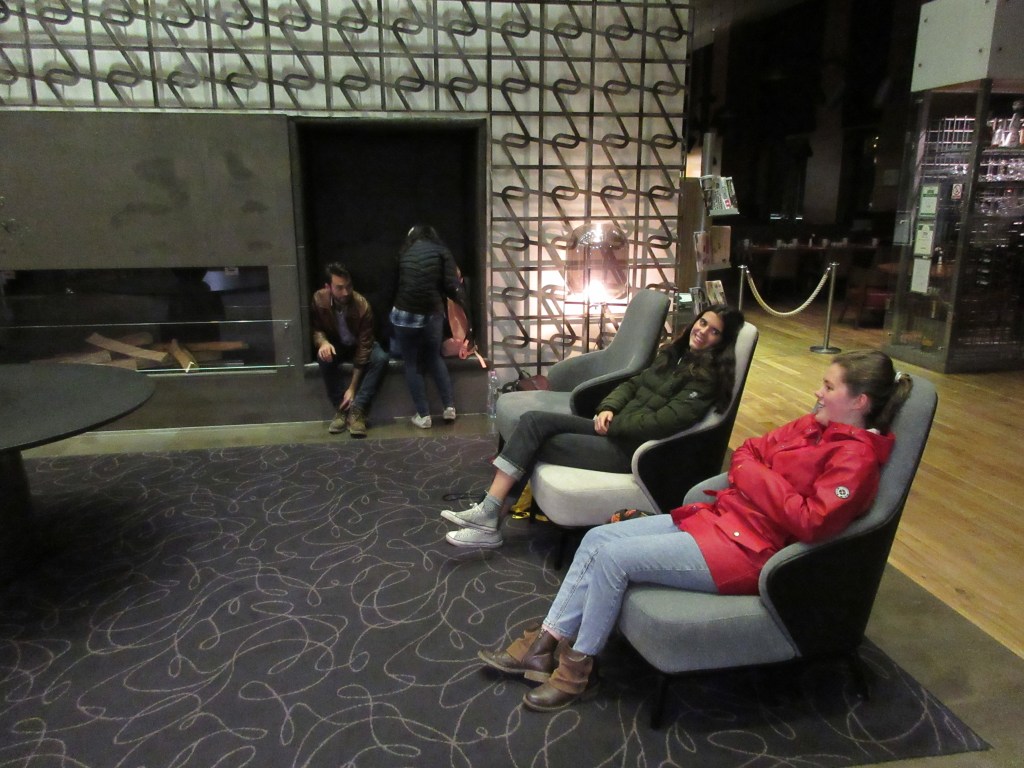
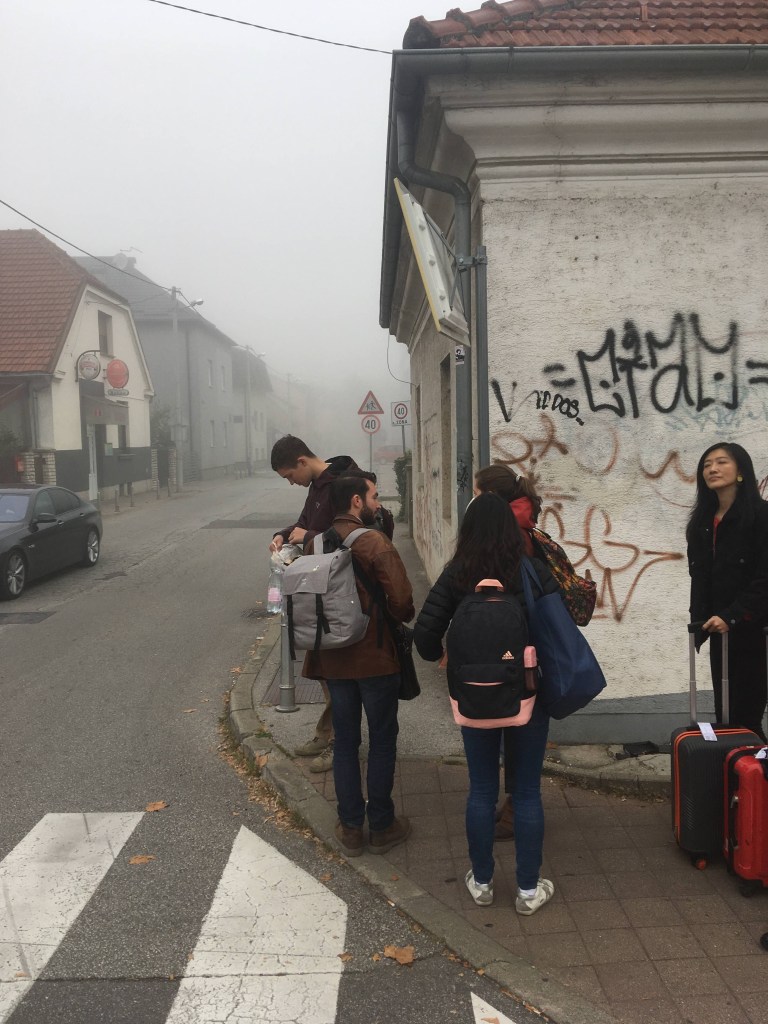
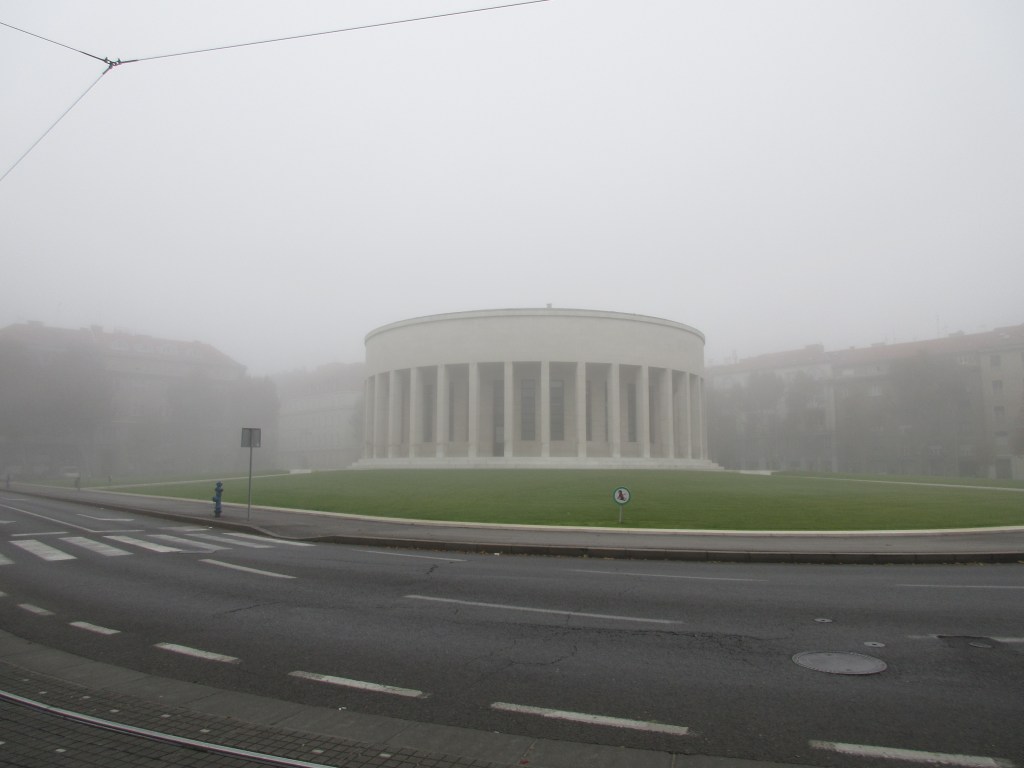
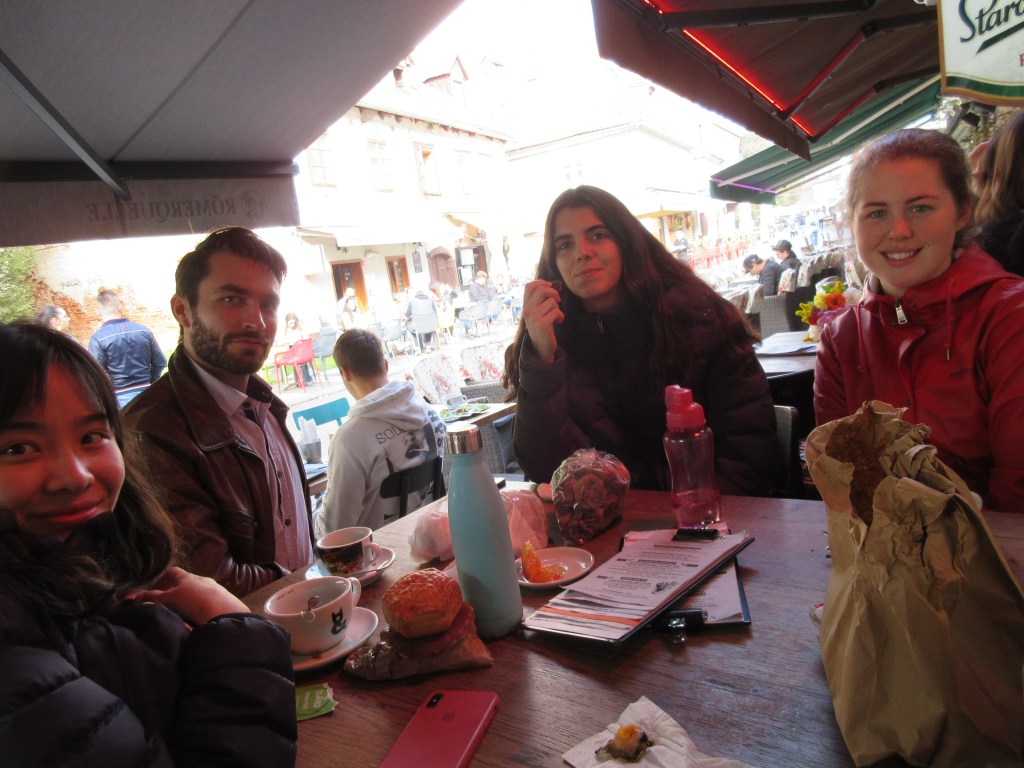
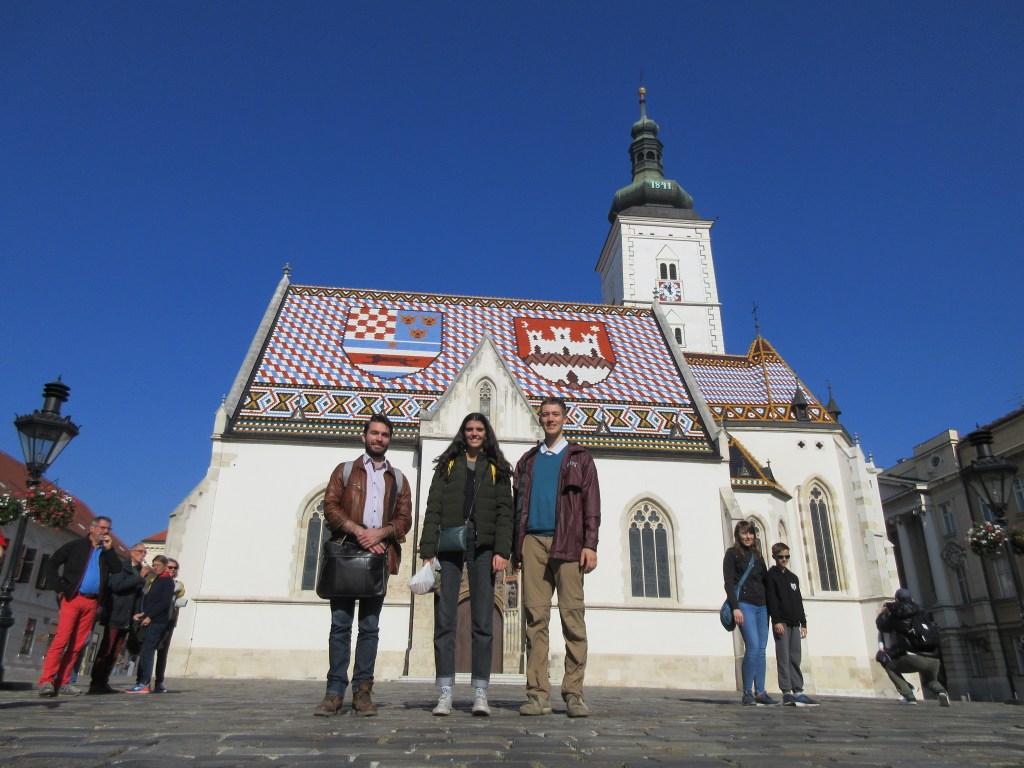
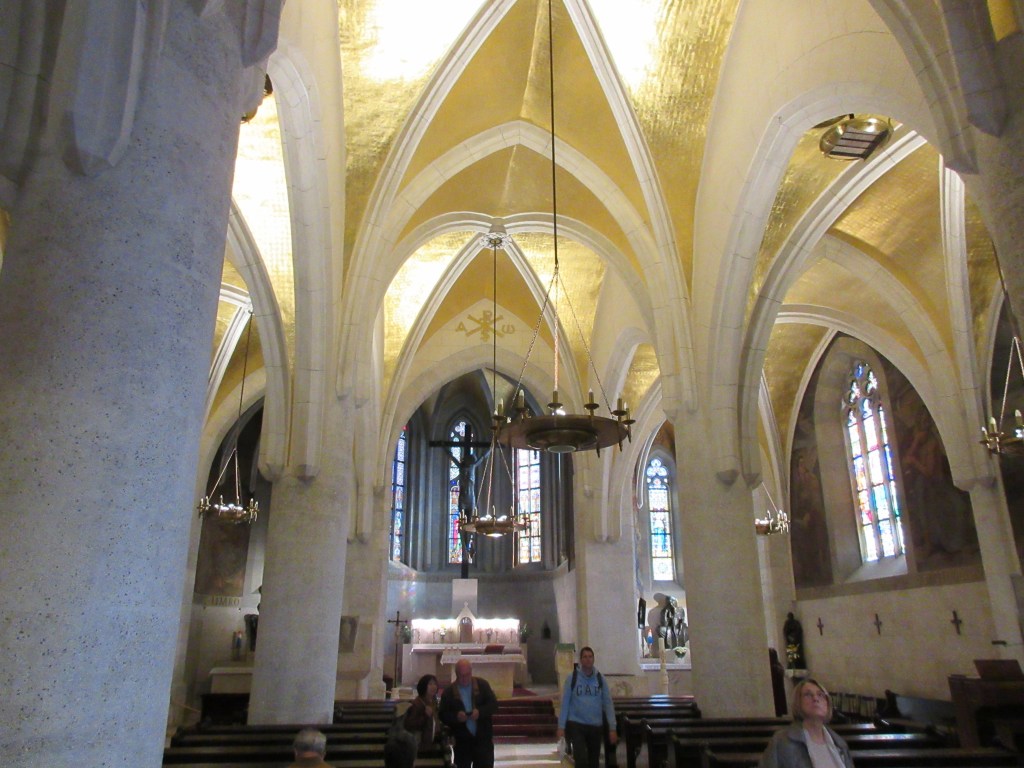
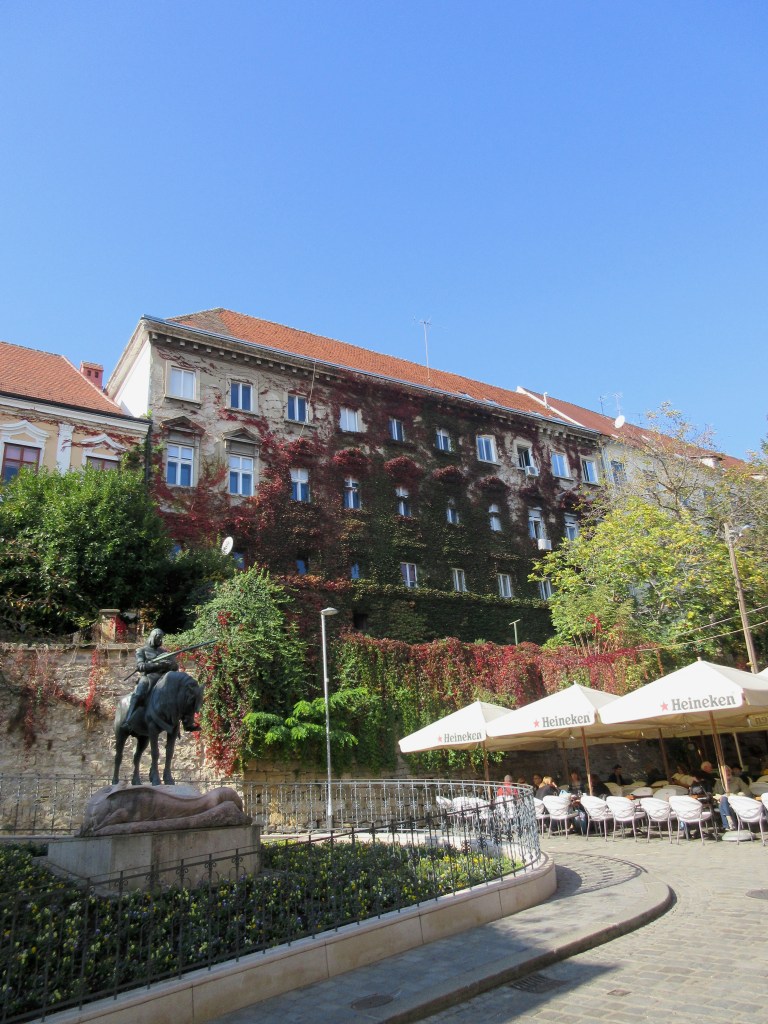
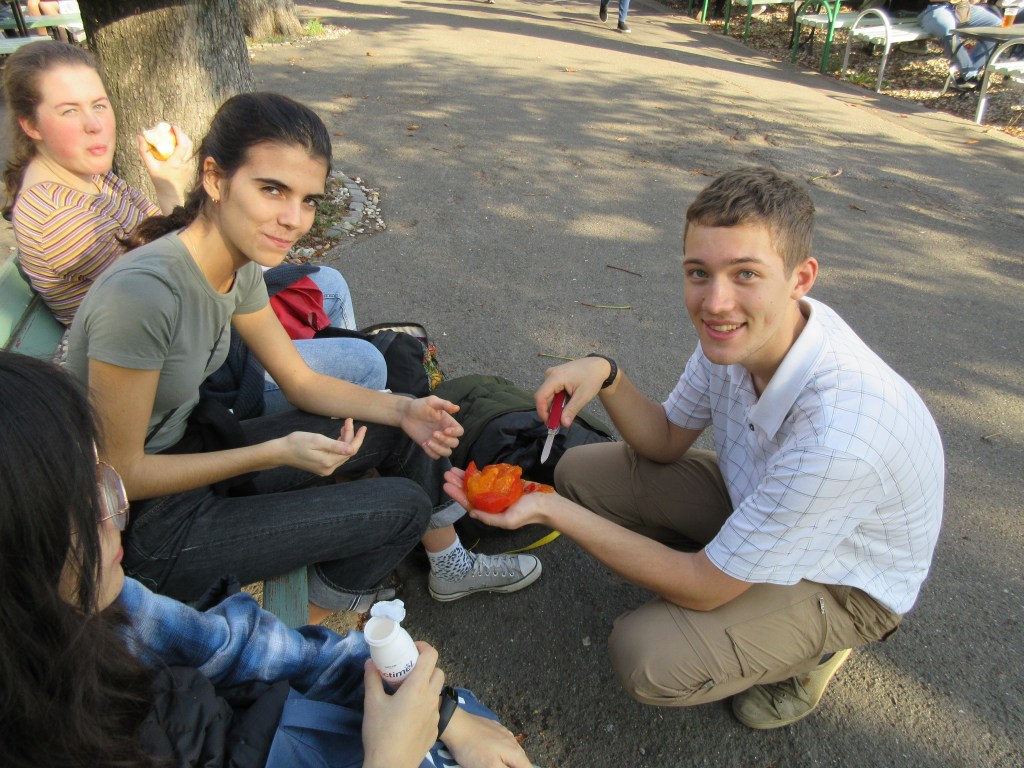
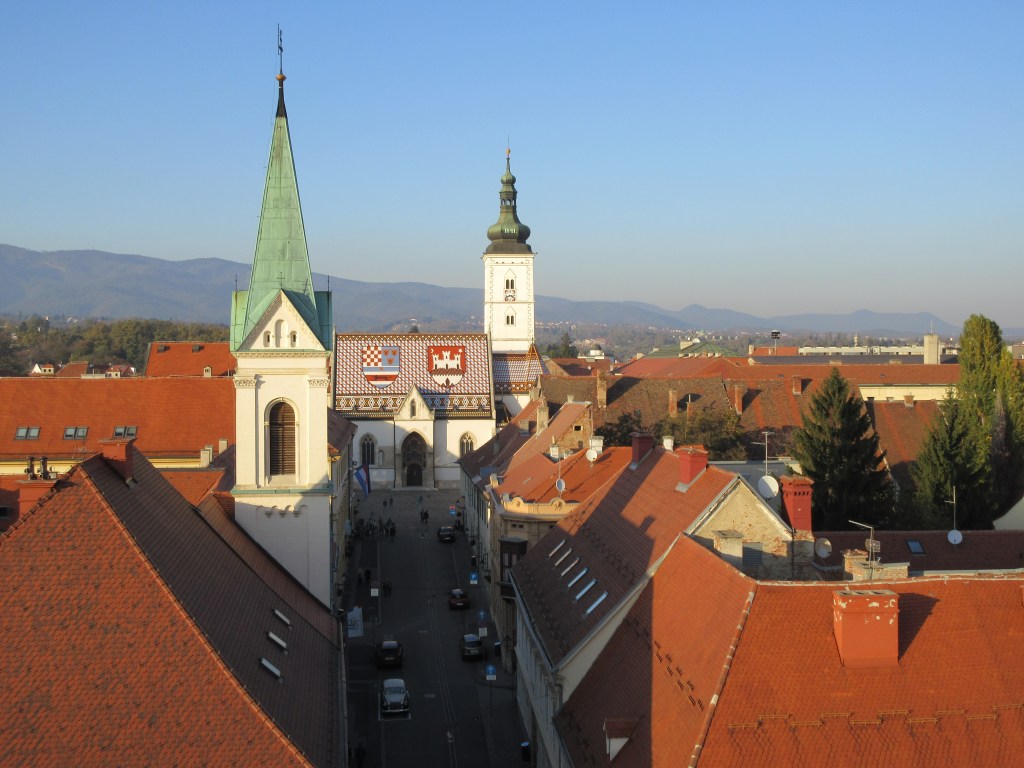
We struck gold right when we got into Zagreb. Despite a delay at the Croatian border while the guards eventually decided that the two Georgian girls on the bus DID have all the necessary documents to pass through Croatia, we arrived safely shortly after 4am. However, we looked up and then walked to the nearest big chain hotel and I went in and asked whether we could sit in their entry lounge for a few hours. “When does the cafe open?” They let us crash there in the chairs and get to sleep for a few hours more, which really made the difference for the rest of the day. We all got drinks from the cafe when it opened at 7 feeling very lucky, and had some fun with the waiter who seemed to know “Good morning” in every language — he’d ask us where each of us were from, and follow that up with something short in the correct language!“One misty moisty morning…”We got food for breakfast at the central open market and bakery, those wonderful European venues: home-dried figs with bay leaves stuck in the bag, RIPE PERSIMMONS (!!!), smoked young cheese from one of the old ladies’ tables, grapes… Campbell and I asked the lady behind the counter at the bakery what was the best, and so we ended up copying many of the locals and leaving with cheese Burek, a very filling savory pastry with cottage cheese inside a flaky crust.Since is was a Sunday, Campbell, Teresa, and I went to the church service at St. Mark’s, which was well worth it for many reasons: visiting a live church is a totally different thing than viewing static architecture. There was a choir that sang throughout the mass, and the organ extended the postlude into what really was a mini concert. Just like the hotel that morning, everything had lined up perfectly for us.The ivy was changing colors behind St. George on the way down from the church. This is not a Heineken ad…While we waited for the tower to open (see the next picture taken from the top), we claimed a bench with a view; jazz background music playing to set a mood. We finished the last of the persimmons, which soon turned to an orange puddle in my hands after I cut in, it was so ripe and good.
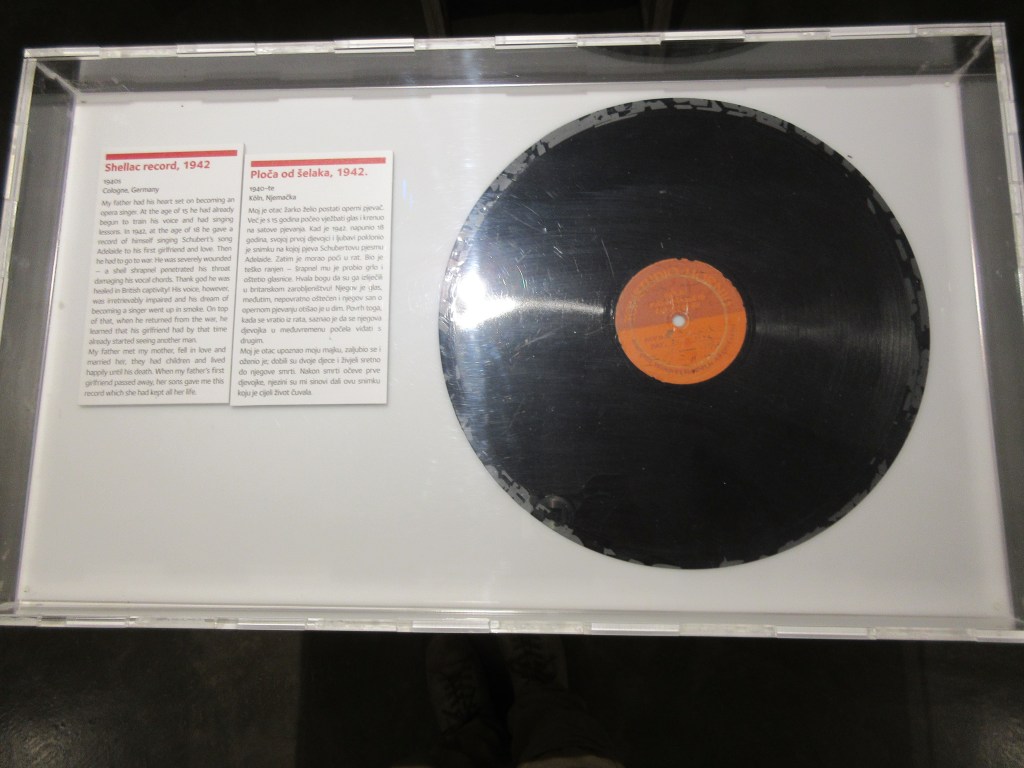
One of the places we figured we should go to while in Zagreb was the Museum of Broken Relationships, which features many and varied items donated by many and varied people, telling many and varied stories in line with the theme. It’s something you wouldn’t find anywhere else. I’d didn’t get too much out of the visit, but I did like the following items. Shellac record, 1942 1940s Cologne, Germany
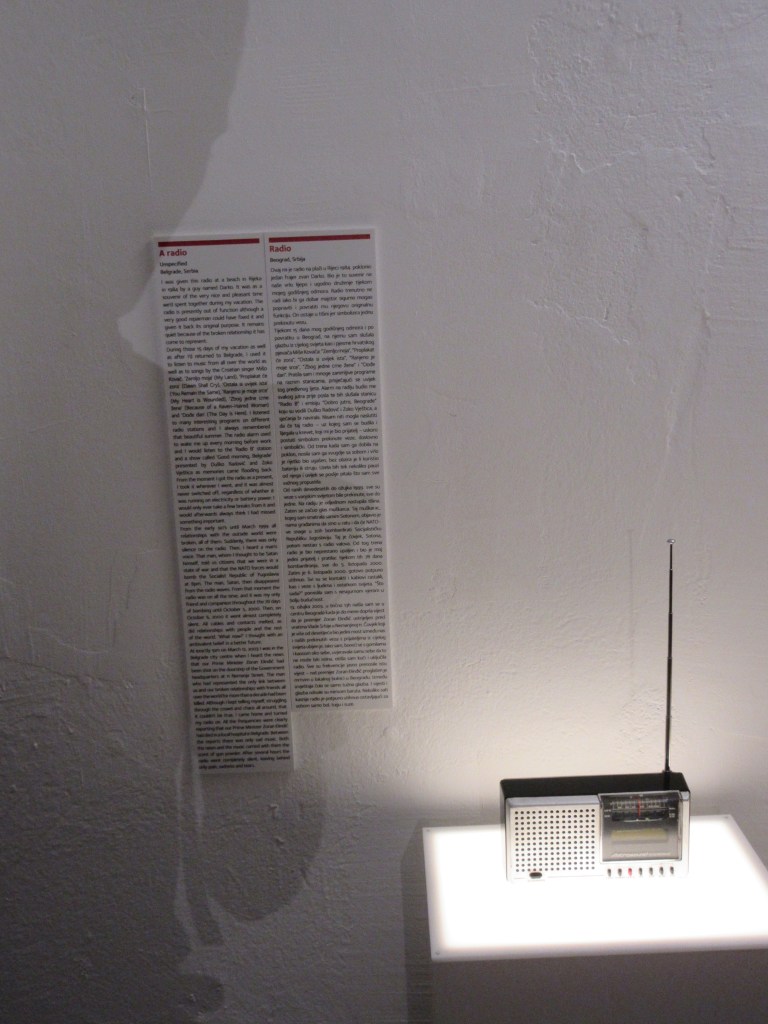
“My father had his heart set on becoming an opera singer. At the age of 15 he had already begun to train his voice and had singing lessons. In 1942, at the age of 18 he gave a record of himself singing Schubert’s song Adelaide to his first girlfriend and love. Then he had to go to war. He was severely wounded – a shell shrapnel penetrated his throat damaging his vocal chords. Thank God he was healed in British captivity! His voice, however, was irretrievably impaired and his dream of becoming a singer went up in smoke. On top of that, when he returned from the war, he learned that his girlfriend had by that time already started seeing another man. My father met my mother, fell in love and married her, they had children and lived happily until his death. When my father’s first girlfriend passed away, her sons gave me this record which she had kept all her life.” A radio Unspecified Belgrade, Serbia
“I was given this radio at a beach in Rijeka in 1984 by a guy named Darko. It was as a souvenir of the very nice and pleasant time we’d spent together during my vacation. The radio is presently out of function although a very good repairman could have fixed it and given it back its original purpose. It remains quiet because of the broken relationship it has come to represent. During those 15 days of my vacation as well as after I’d returned to Belgrade, I used it to listen to music from all over the world as well as to songs by the Croatian singer Mišo Kovač: ‘Zemljo moja’ (My Land), ‘Proplakat će zora’ (Dawn Shall Cry), ‘Ostala si uvijek ista’ (You Remain the Same), ‘Ranjeno je moje srce’ (My Heart is Wounded), ‘Zbog jedne crne žene’ (Because of the Raven-Haired Woman) and ‘Dode dan’ (The Day is Here). I listened to many interesting programs on different radio stations and I always remembered that beautiful summer. The radio alarm used to wake me up every morning before work and I would listen to the ‘Radio B’ station and a show called ‘Good morning, Belgrade’ presented by Duško Radović and Zoko Vještica as memories came flooding back. From the moment I got the radio as a present, I took it wherever I went, and it was almost never switched off, regardless of whether it was running on electricity or battery power. I would only ever take a few breaks from it and would only ever take a few breaks from it and would afterwards always think I had missed something important. From the early 90’s until March 1999 all relationships with the outside world were broken, all of them. Suddenly, there was only silence on the radio. Then, I heard a man’s voice. That man, whom I thought to be Satan himself, told us citizens that we were in a state of war and that the NATO forces would bomb the Socialist Republic of Yugoslavia at 8pm. The man, Satan, then disappeared from the radio waves, From that moment the radio was on all the time, and it was my only friend and companion throughout the 78 days of bombing until October 5, 2000. Then, on October 6, 2000 it went almost completely silent. All cables and contacts melted, as did relationships with people and the rest of the world. ‘What now?’ I though with an ambivalent belief in a better future. At exactly 1pm on March 12, 2003 I was in the Belgrade city centre when I heard the news that our Prime Minister Zoran Đinđić had been shot on the doorstep of the Government headquarters at 11 Nemarija Street. The man who had represented the only link between us and our broken relationships with friends all over the world for more than a decade had been killed. Although I kept telling myself, struggling through the crowd and chaos all around, that it couldn’t be true, I came come and turned my radio on. All the frequencies were clearly reporting that our Prime Minister Zoran Đinđić had died in a local hospital in Belgrade. Between the reports there was only sad music. Both the news and the music carried with them the scent of gunpowder. After several hours the radio went completely silent, leaving behind only pain, sadness and tears.”
———————————————————————————————————————-
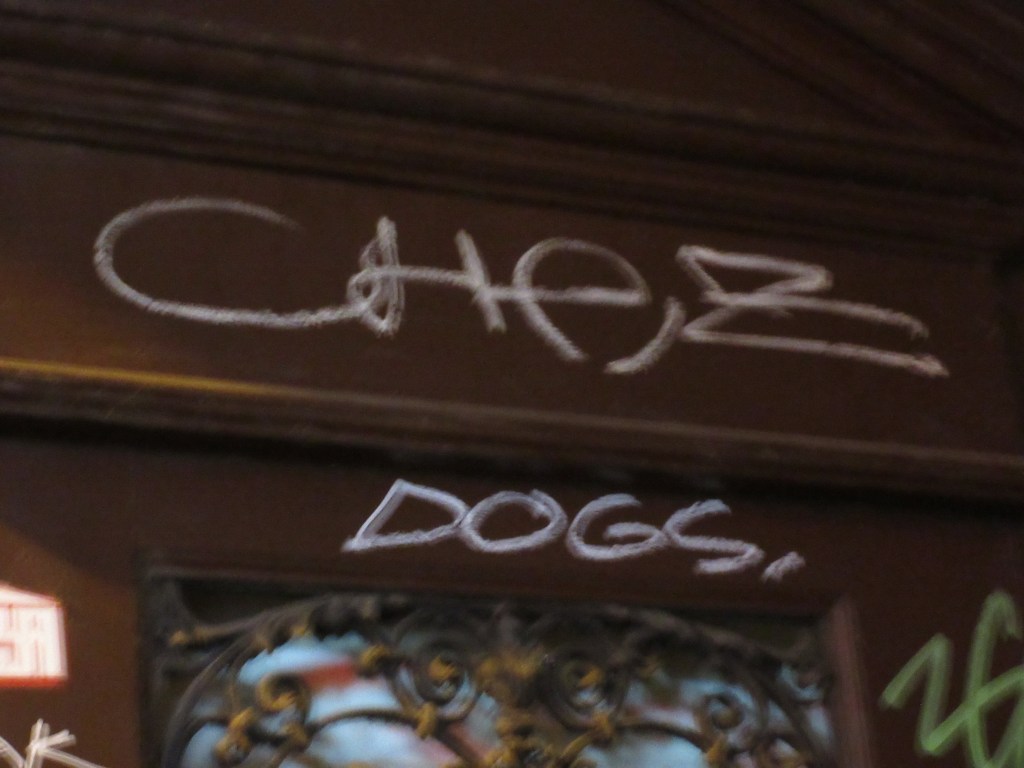
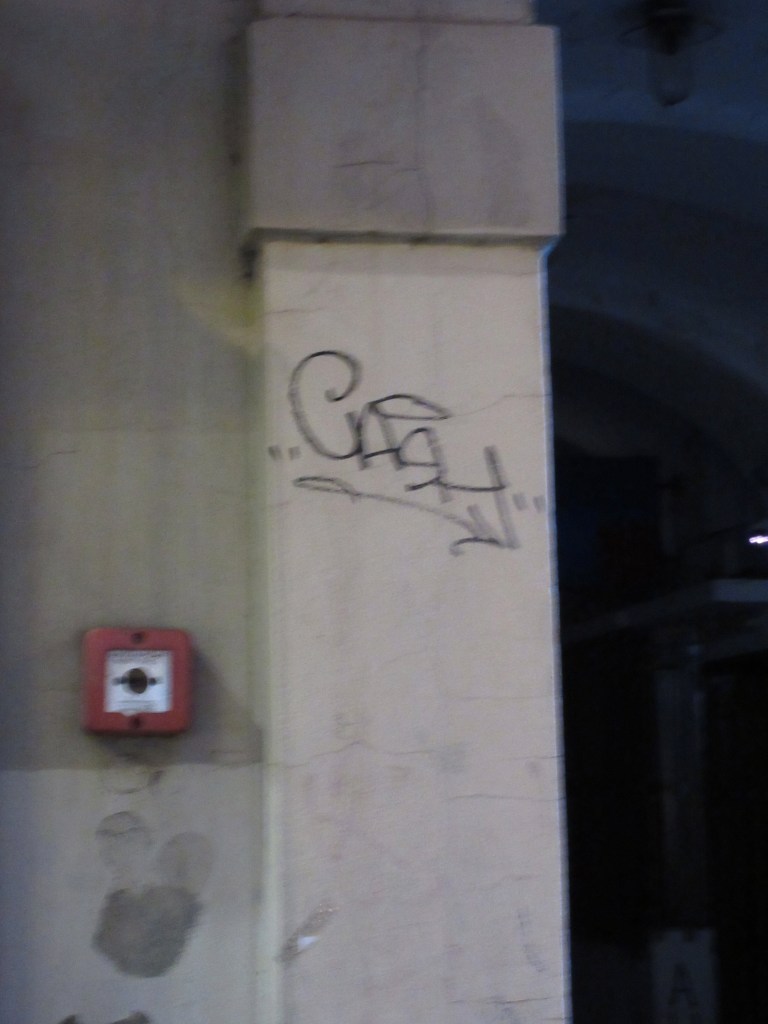
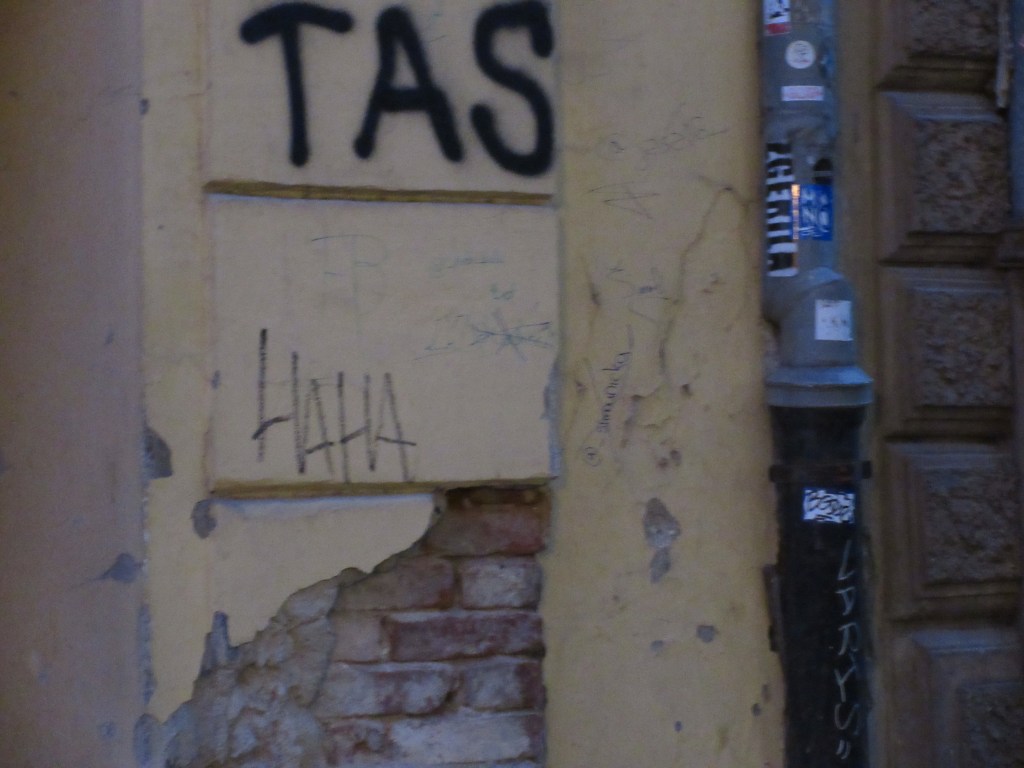
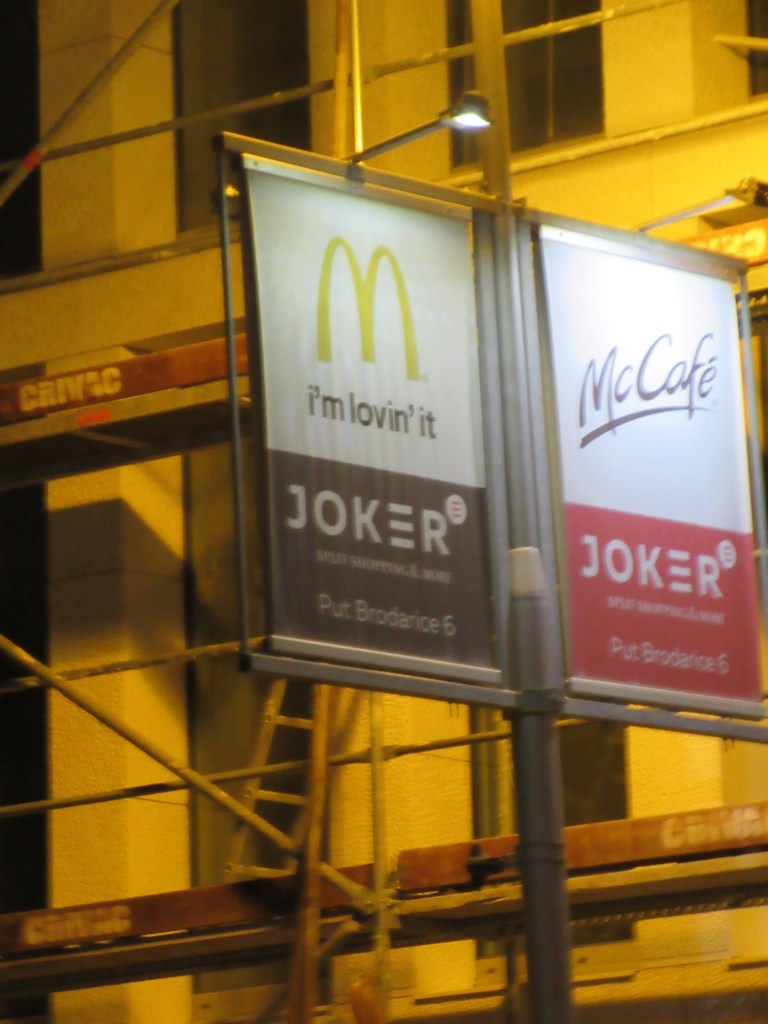
We were not very impressed with Zagreb taken as a whole although it had its good spots, and agreed that in the future we wouldn’t need to visit again: unlike Budapest or Split I didn’t feel a character of the city. The mix of old and new buildings didn’t seem cohesive, and unlike some other European cities the new developments in Zagreb seemed to have lost touch with its heritage. However, I REALLY enjoyed the graffiti, which certainly had the unique flavor of the city that mixed and contrasted with the other beauty and quirks (St. Mark’s Church and the Museum of Broken Relationships). Most graffiti is see is either illegible or profane. In ZAGREB, however, the tables are turned! I couldn’t help but smile when I saw such dark and dingy vandalism as “Haha,” “Mario!” “FLAP”! “Cash,” and “Chez Dogs”! Also, I think McDonalds didn’t realize the irony of “-Joker” being right underneath their quote: I certainly did.
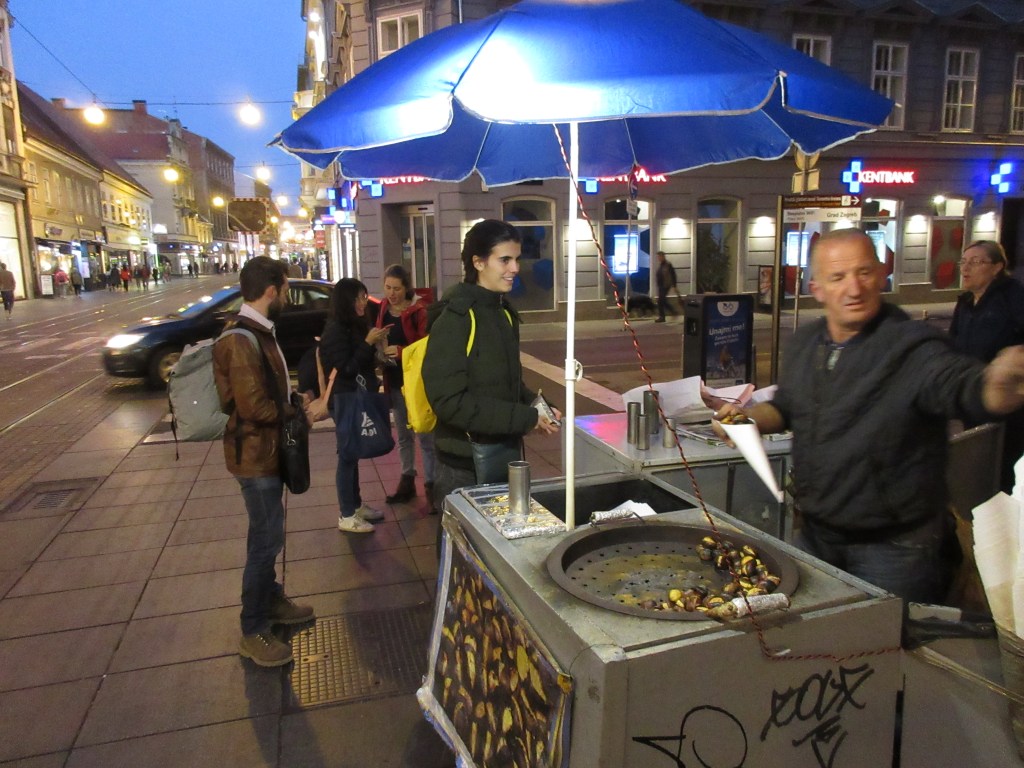
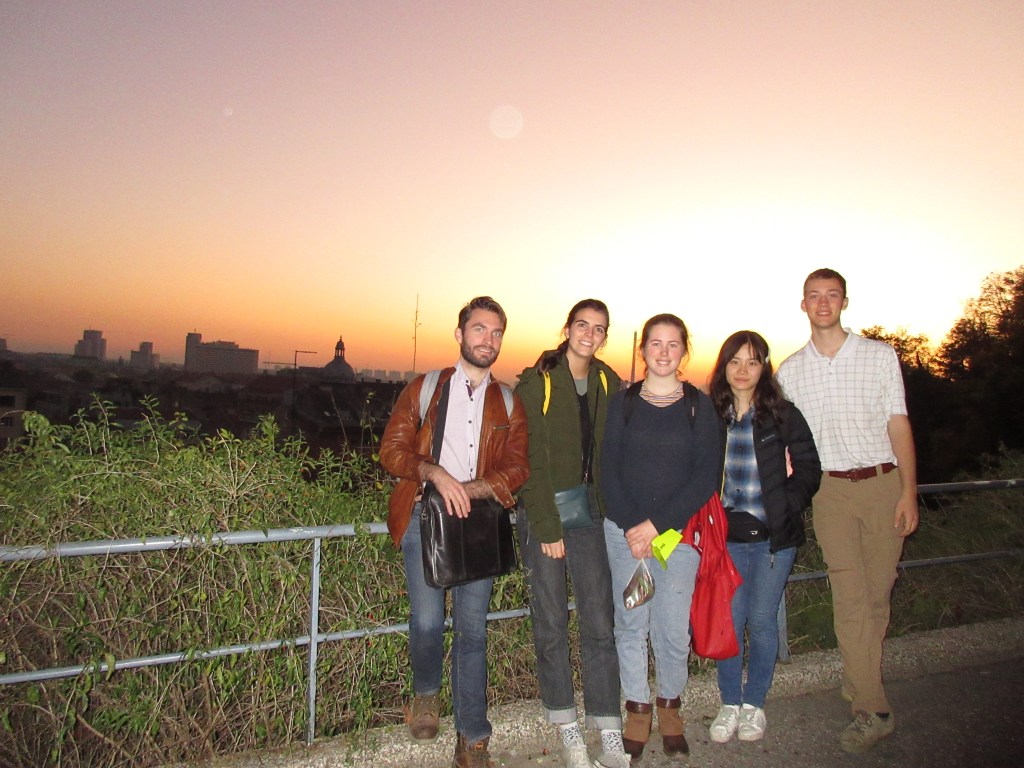
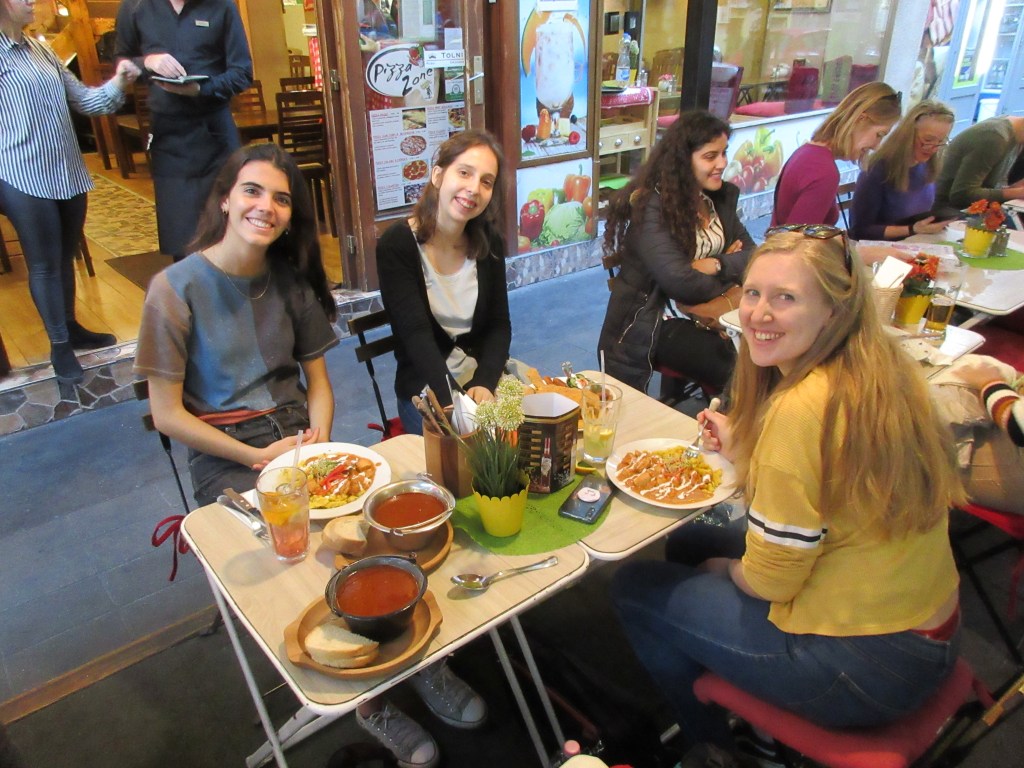
I was excited that we got a few roast chestnuts from a street vendor. I’ve never seen this in the US, and so for me this was fulfilling something straight out of a book.Sunset: Cambell, Teresa, Sarah, Kiki, and myself. What a great group of people to travel with and get to know better. One of the best aspects of the trip was simply the good conversations we had with each other. One of these would be that night at an outdoor cafe while we waited for our bus. We were also impressed then at Kiki’s ability to fall straight into deep phase sleep while still sitting with perfect posture–she told us that she’d actually had a dream during one of those 5 minute snoozes. We left at midnight again on a Flixbus headed for Split, and although I think we all managed to sleep some, I for one was happy to have even more time in nice conversation before I got my 40 winks.
It’s been a while now, but for the autumn holiday I and a few other classmates planned and went on a six day trip to Croatia: a day and a half in Budapest, a day in Zagreb, a day and a half in Split, a day at the Plitvice Lakes, and then back through Budapest again to Kecskemét! Special thanks to Beth Hermann, Kate Kogler, Anja Sorsak, and my Uncle Jonathan for giving input and advice!
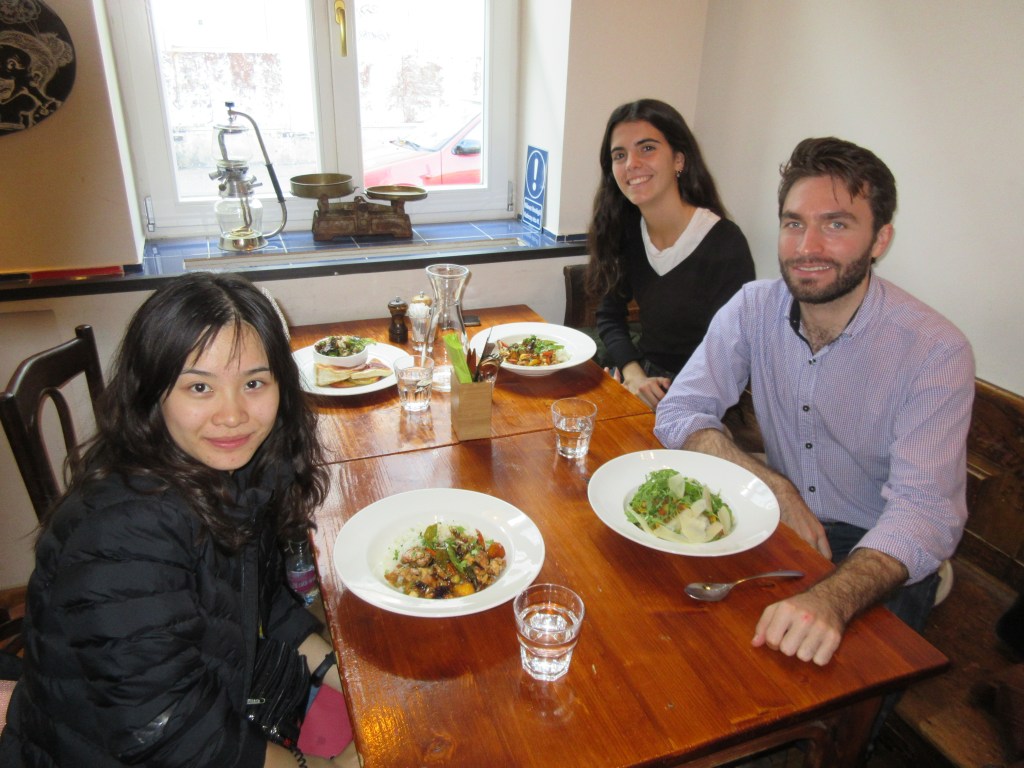
After taking the 1 hr 20 min train from Kecskemét* to Budapest*, we checked into our hostel and then had an early dinner at the Drum Cafe, recommended by our host. From left to right: Teresa (Portugal), Rita (Portugal), Clodagh (Ireland. pronounced “Clo-da”). The waiter was quite skeptical when I ordered TWO bowls of beef goulash–(I did in fact expect them to be slightly smaller) but I finished them with no hitch! It was very good, and I didn’t get hungry until lunch the next day. 🙂
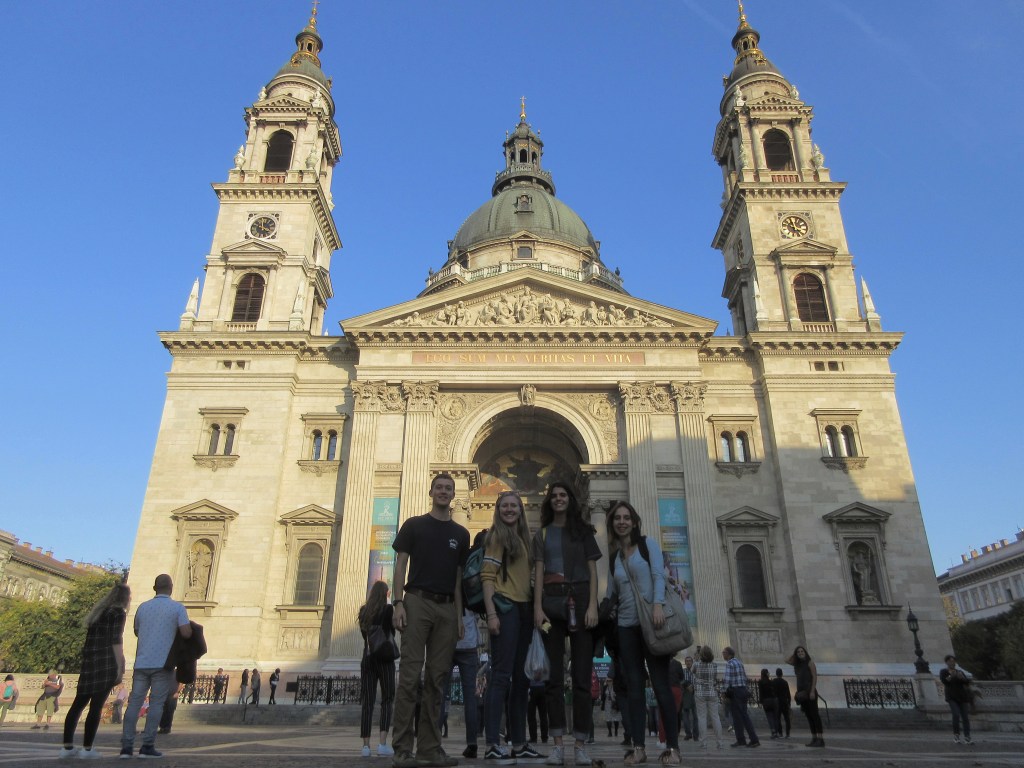
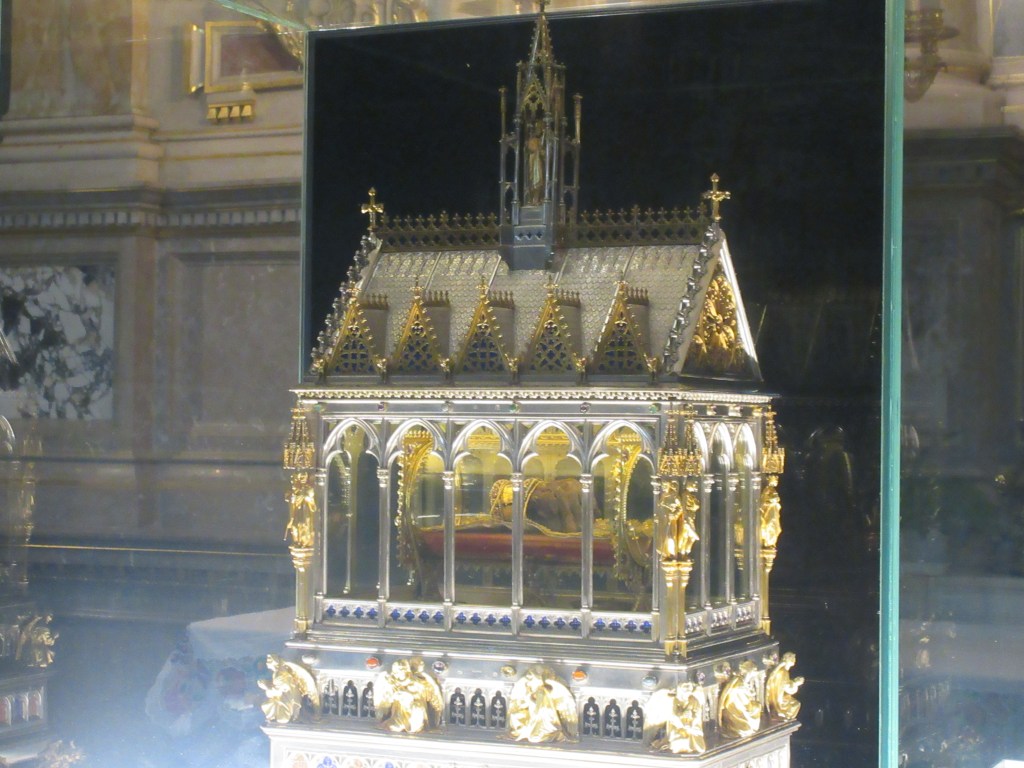
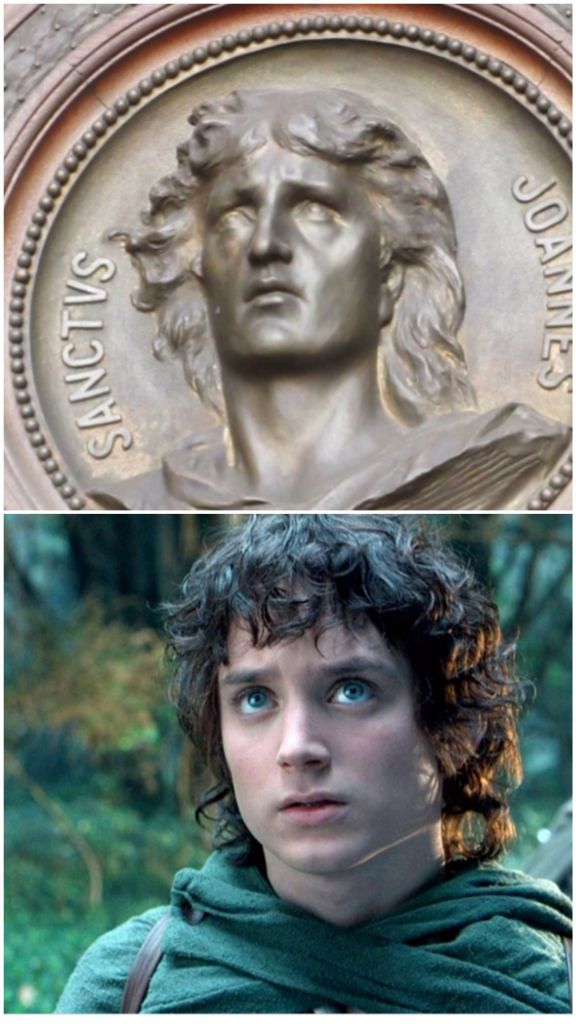
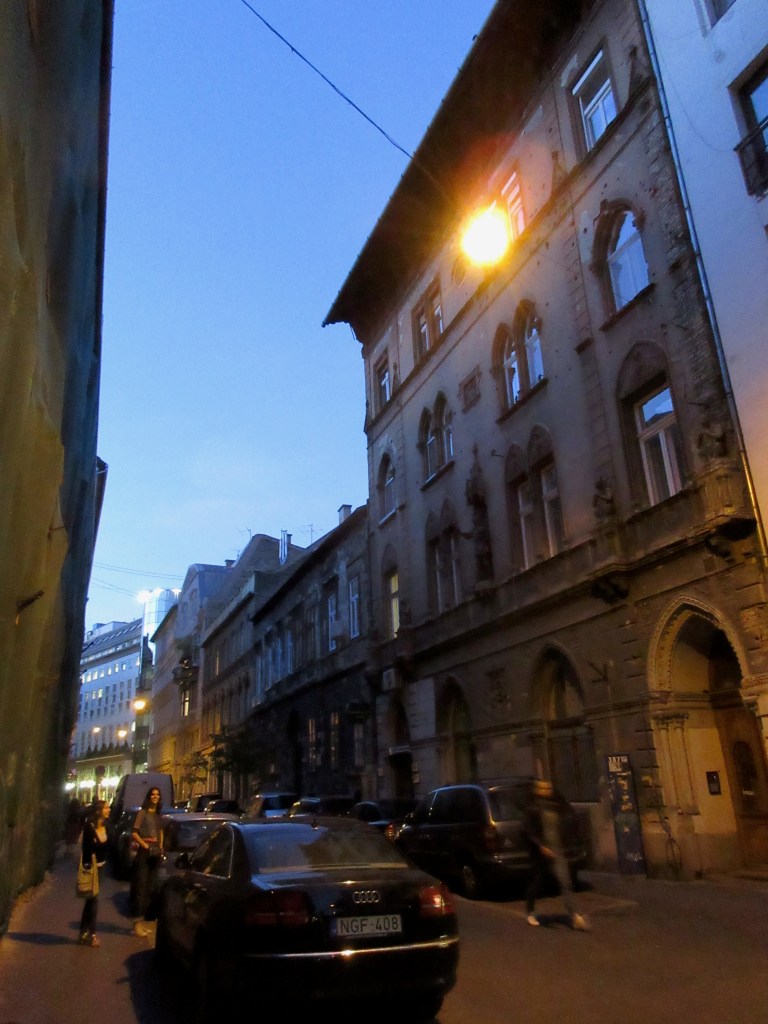
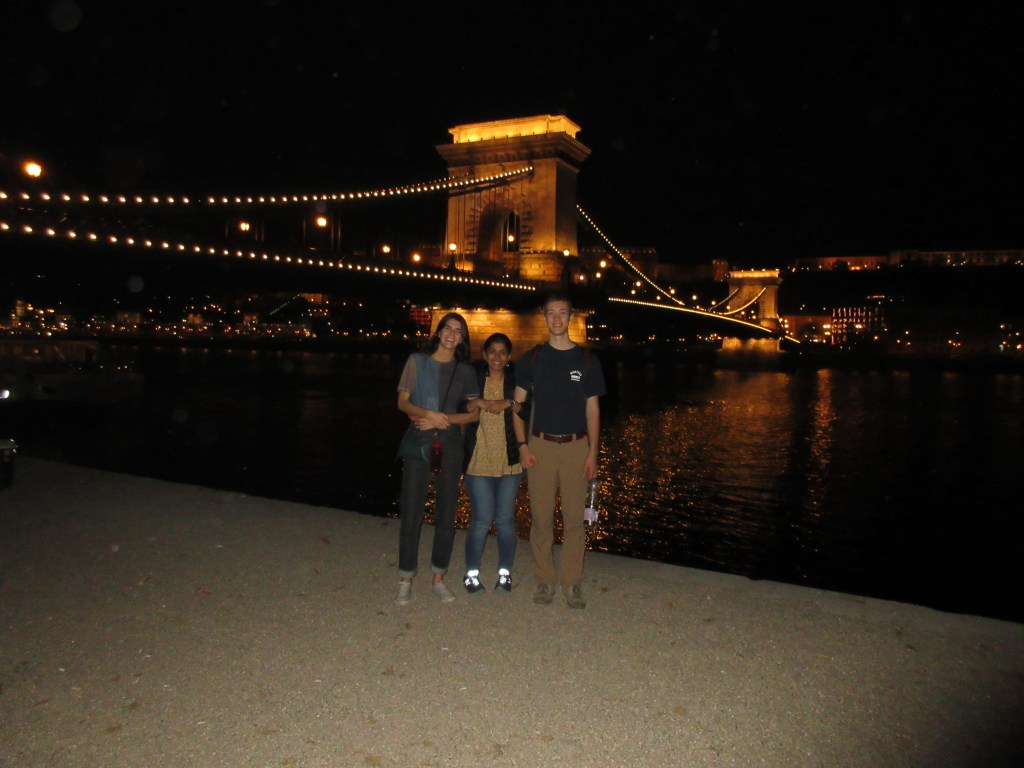
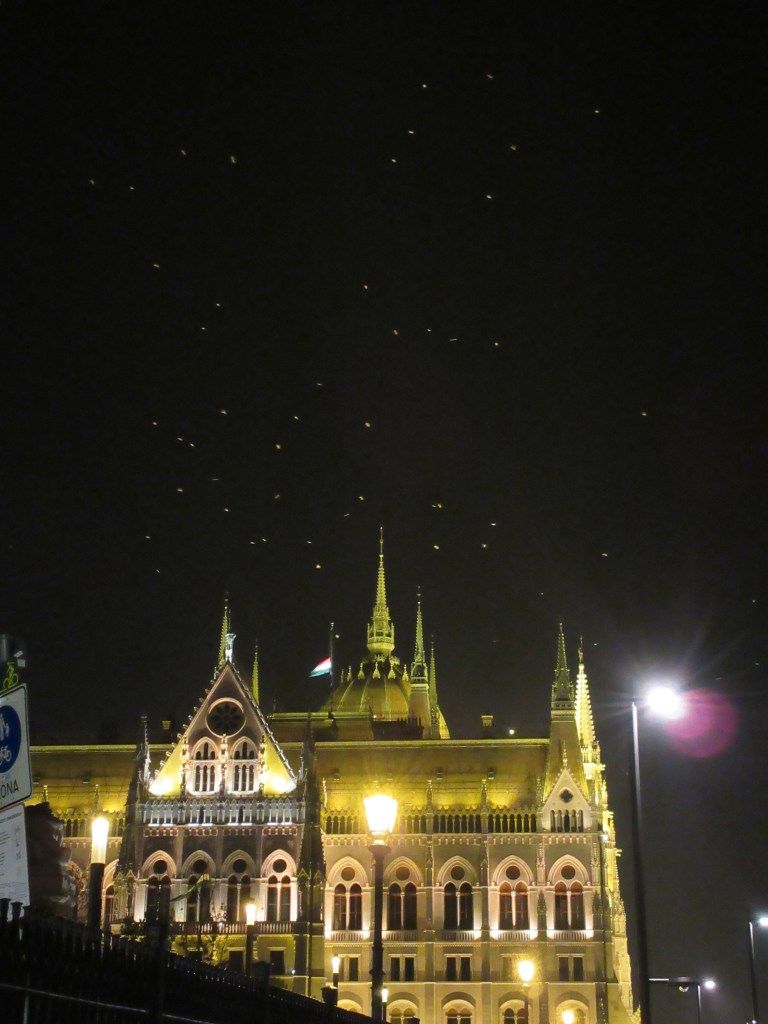
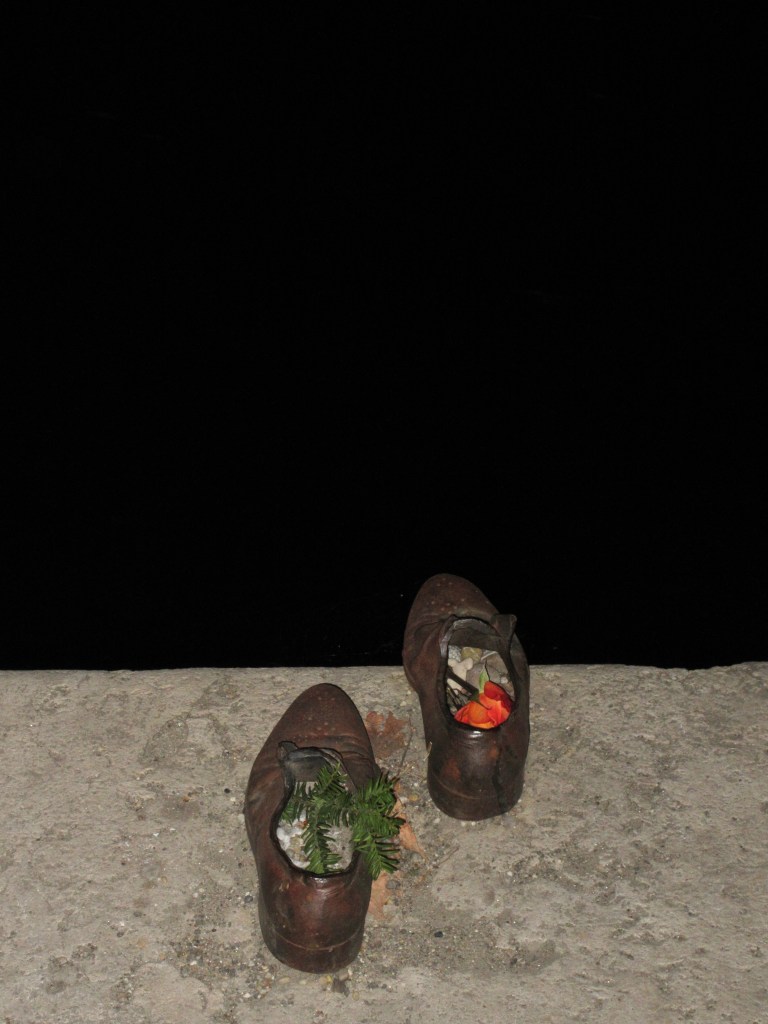
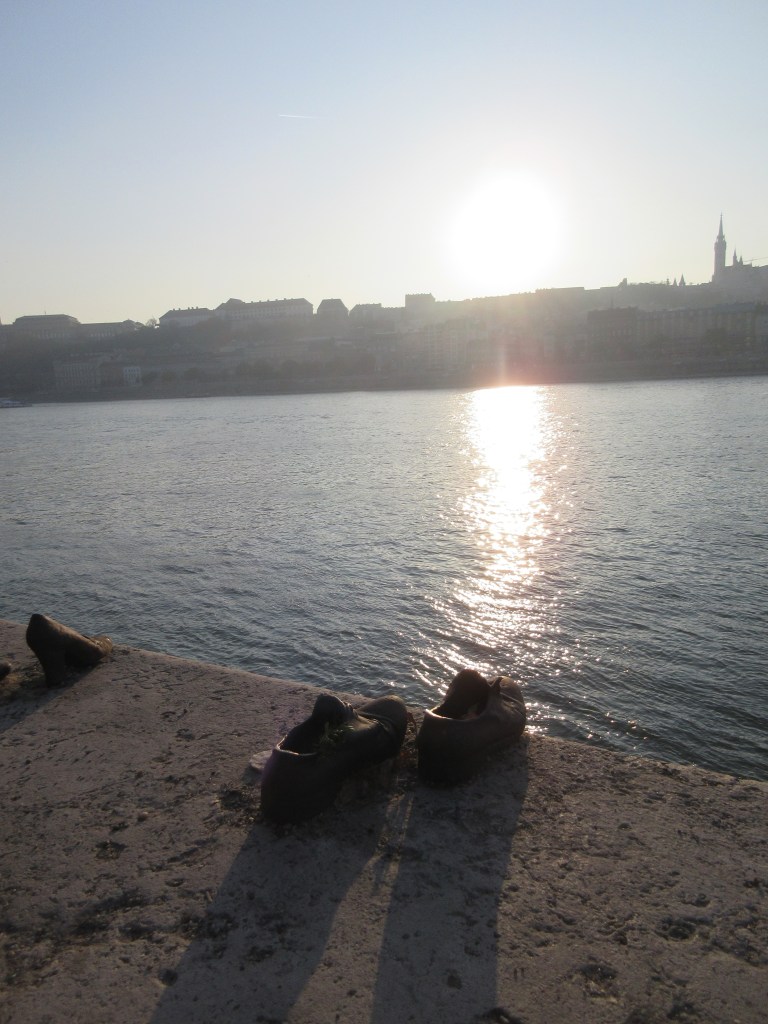
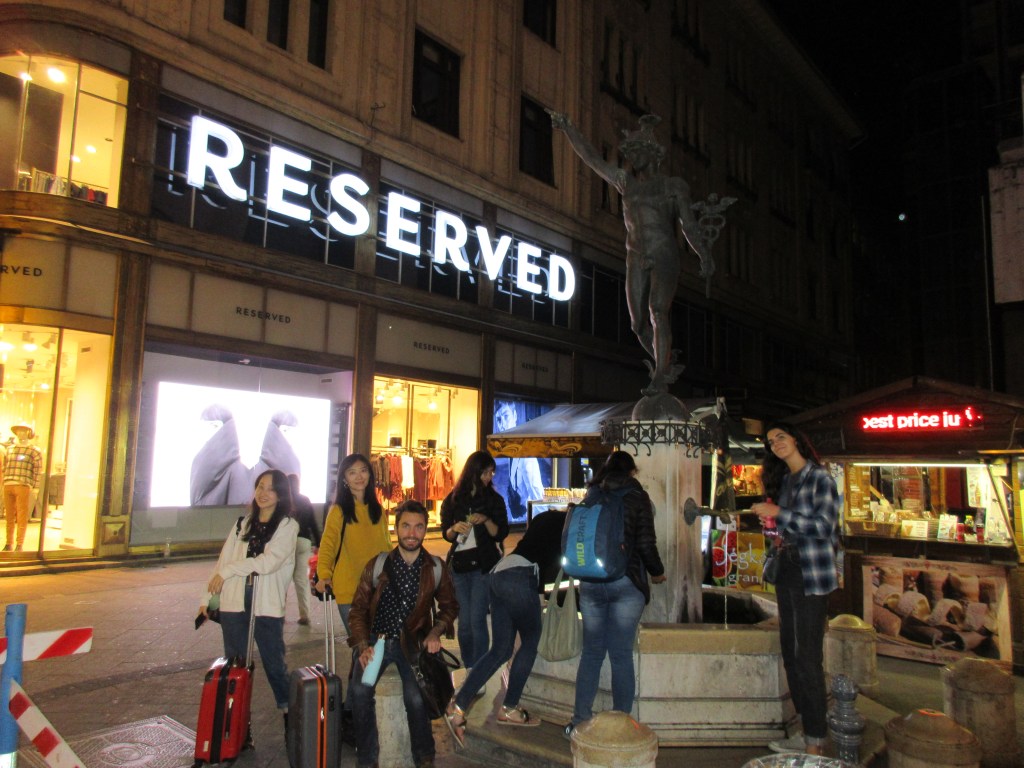
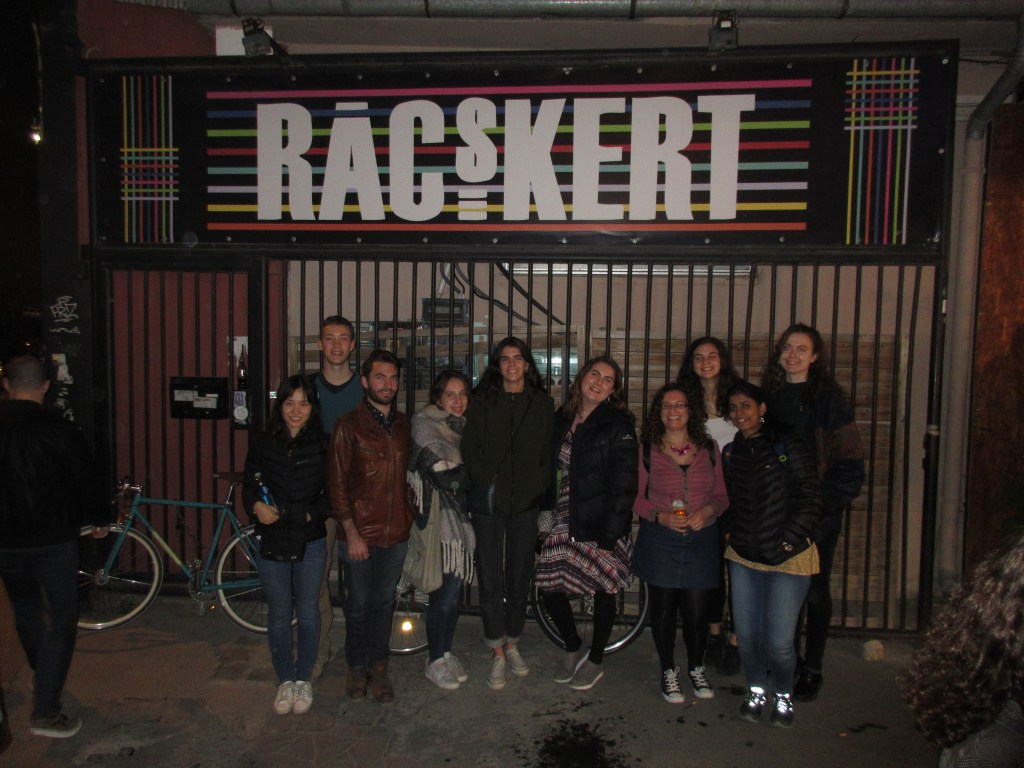
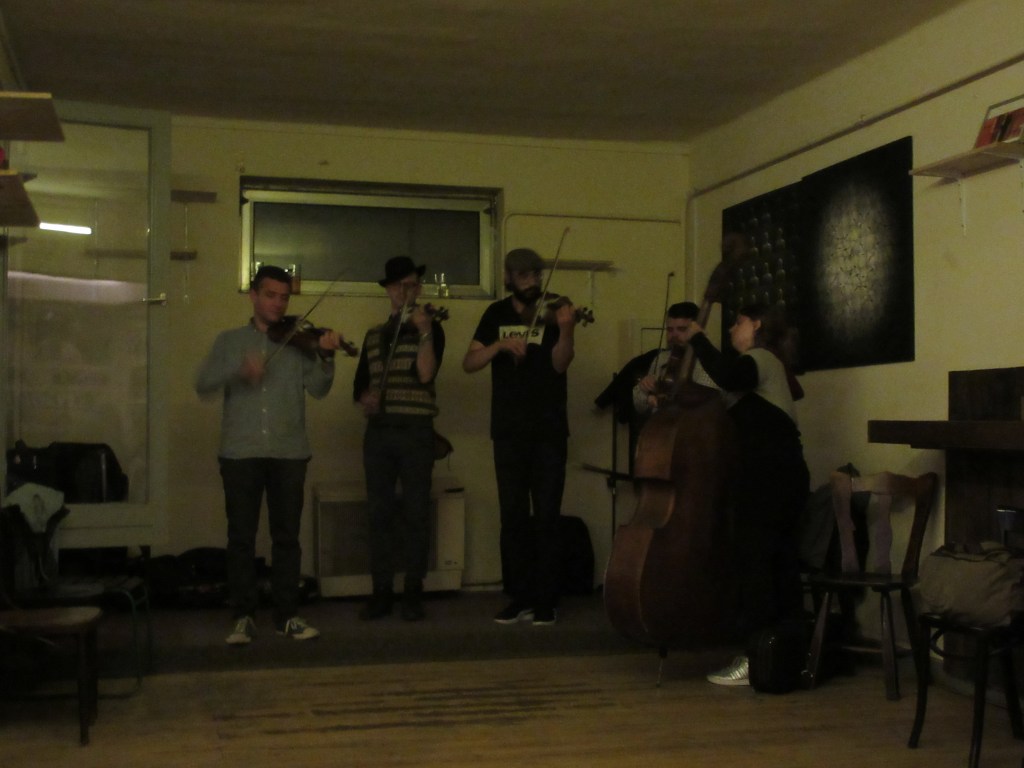
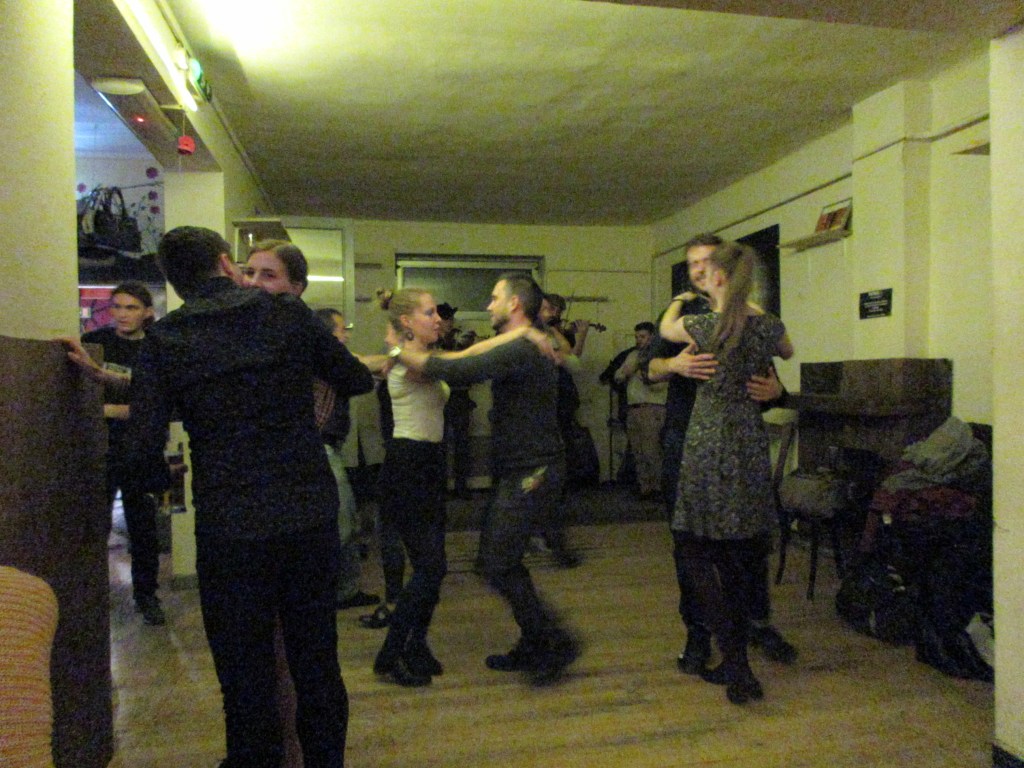
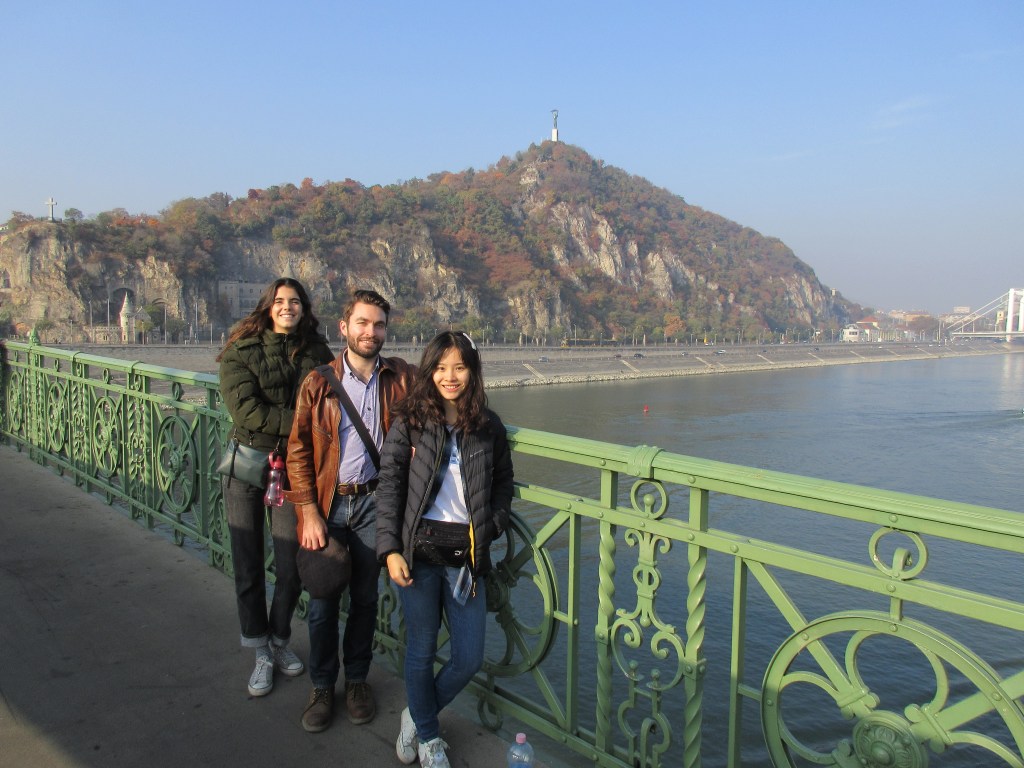
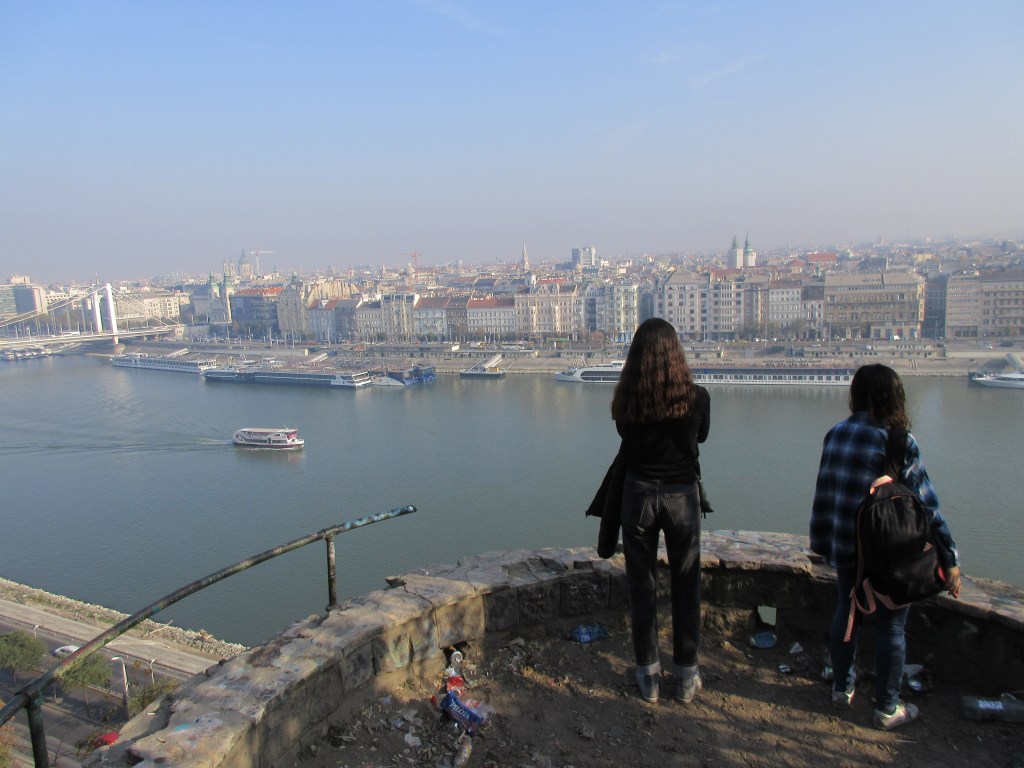
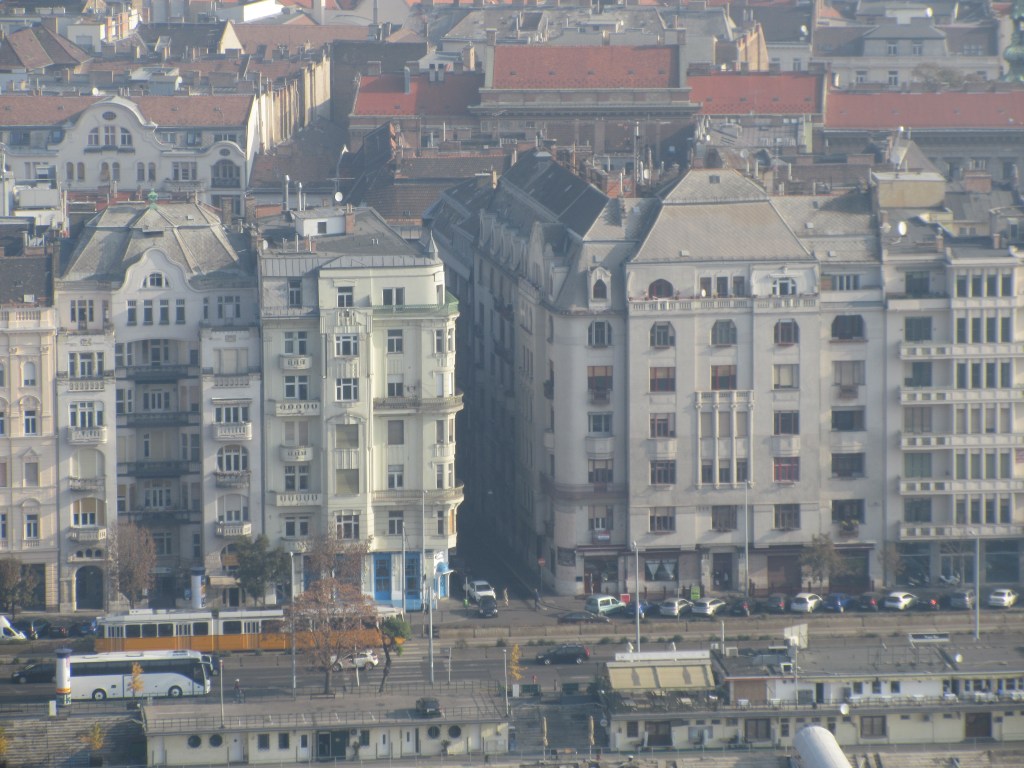
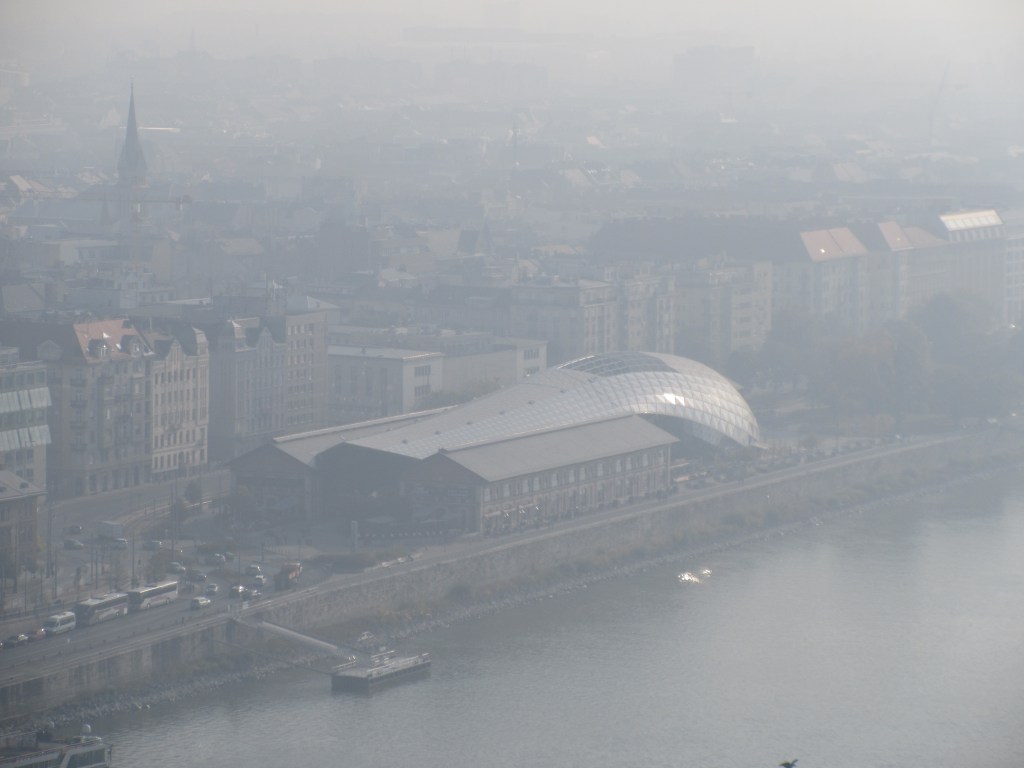
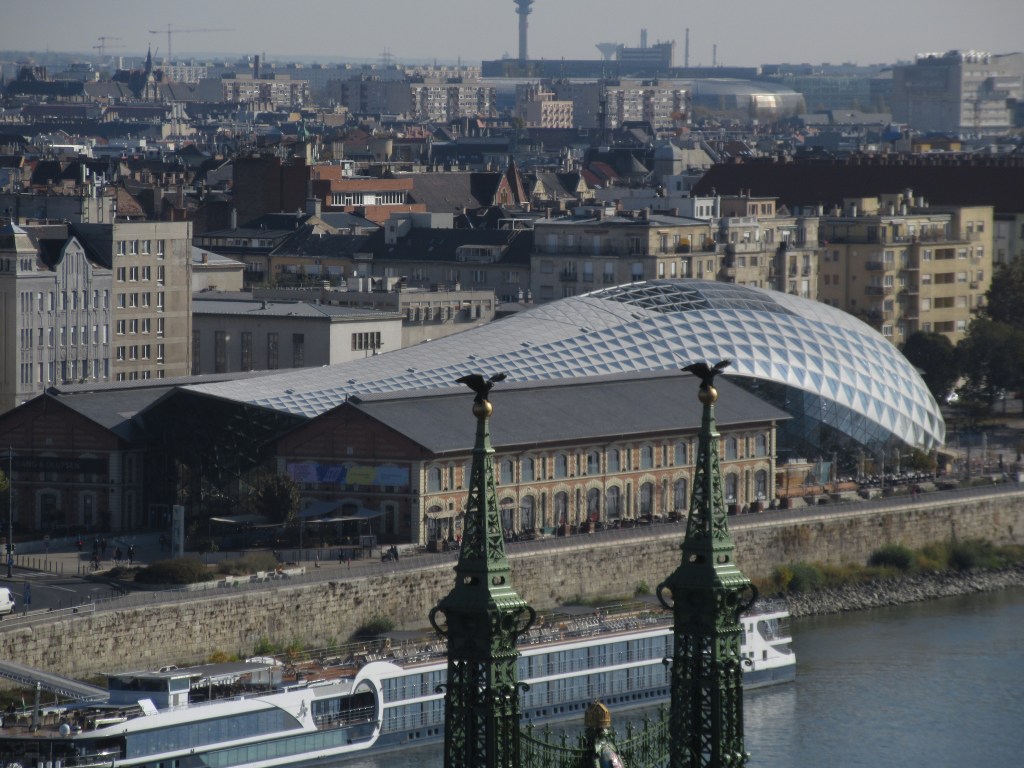
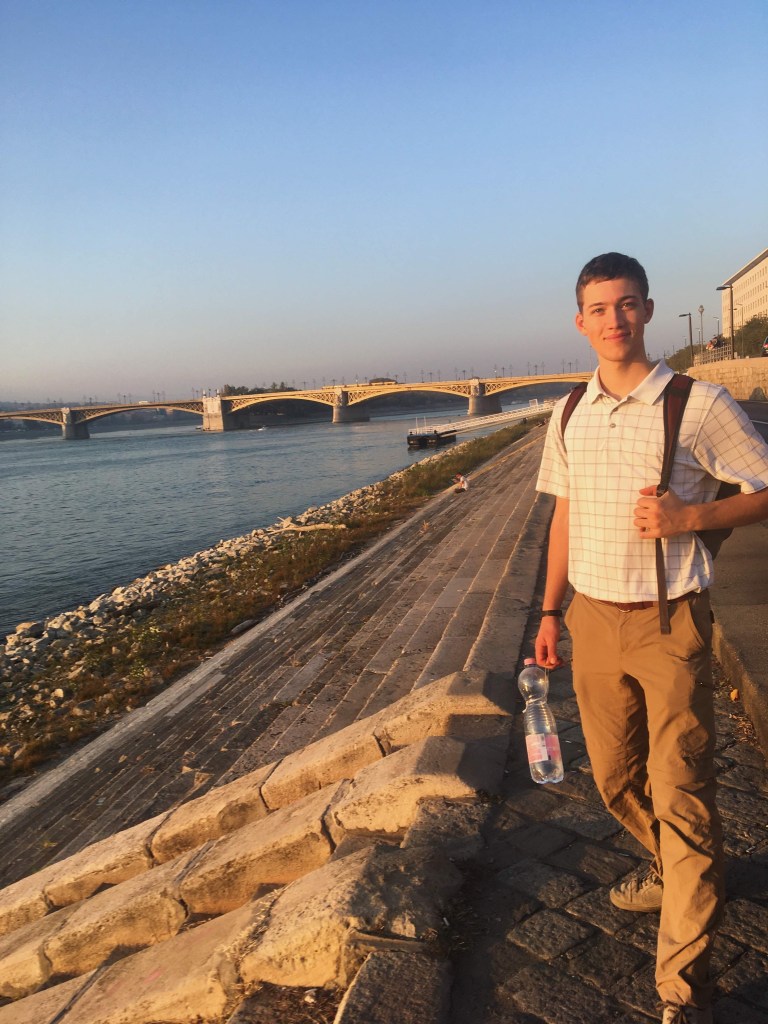
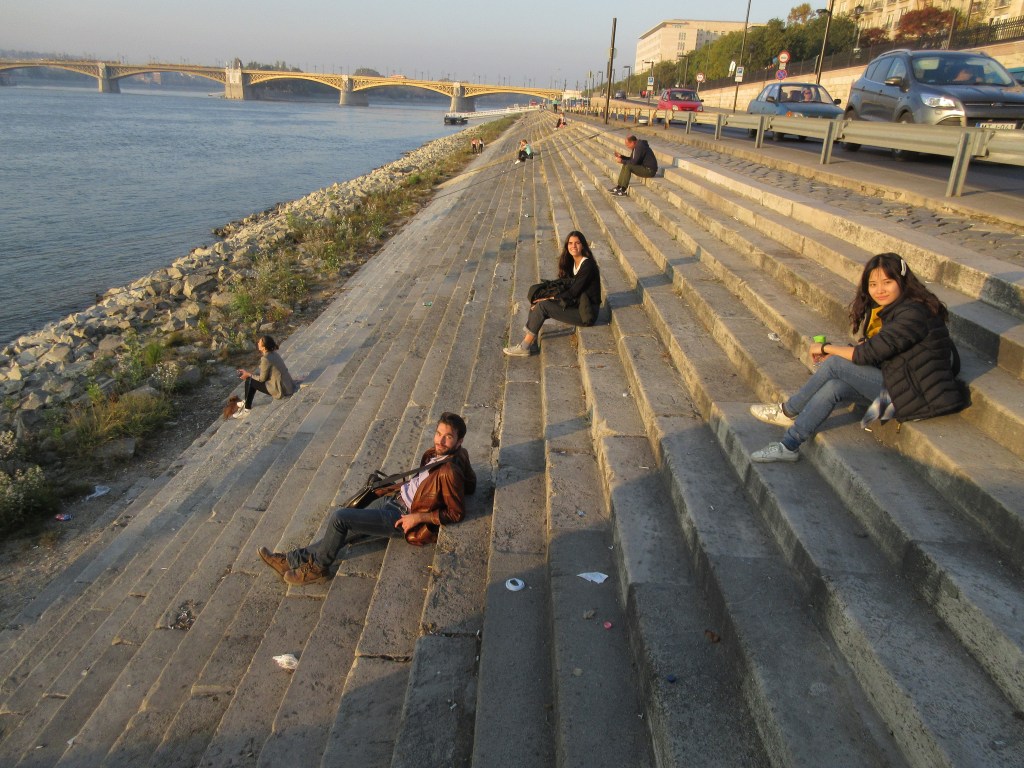
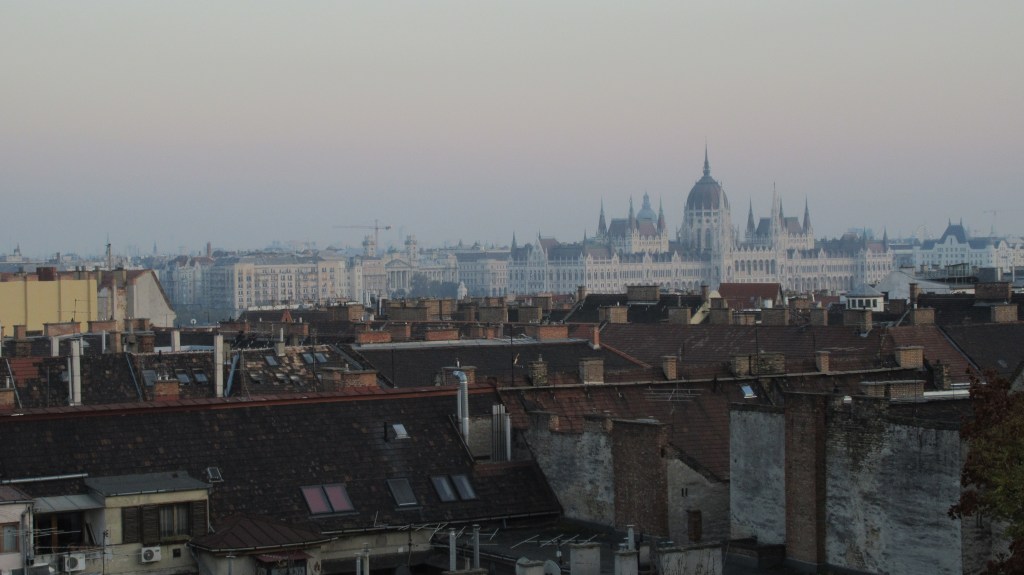
* Kecskemét = “keCH-ke-meyt” Budapest = “Buda-peSHt”This is the St. Stephen’s Basilica in Budapest: one massive block of stone in the center of downtown PestWithin the basilica is the 1000 year old mummified hand of King St. Stephen himself, the first king of “Hungary,” who converted the country over to Christianity in what was largely a diplomatic move to create stability and acceptance within the rest of Europe. The Hungarians had first been pillaging marauders so much so that there are Latin prayers from that period praying to “deliver us from the arrows of the Hungarians.” Once the Magyars began to settle down in the Carpathian basin and think more long term, even the rest of Europe was impressed at how quickly they assimilated. A later Latin text describes the Hungarians as a lion with honey now dripping from its mouth. This honey at least in part referred to the high music culture that developed practically instantaneously in Hungary, with music literacy being relatively common among even lay people thanks to the church schools. The giant metal front doors to the basilica are covered by the faces of the apostles. I couldn’t help noticing the uncanny resemblance between Saint John and Frodo from the Lord of the Rings!While we waited for several other classmates to arrive, Rita, Teresa, and I explored the old Jewish quarter of the city by the Synagogue. This narrow street at dusk seemed to come right out of a book: hedged by towering black walls, and illuminated by a single flickering lamp strung by wires across the street, one looks up at the pockmarked wall and notices gargoyles sitting up on ledges grimacing down. Another glance picks out the figure of a lone, visored knight in armor, keeping watch with his spear over the whole scene from his vantage point up in the middle of the wall.After meeting Aditi (India) we all walked along the waterfront upstream past the Széchenyi Chain Bridge, to ultimately intersect with Mila (China), Ruyu (China), Campbell (Australia) and Kiki (China), who came across from the Nyugati central train station. Teresa, Aditi, and I often find ourselves walking together to and from the same places (such as folk dancing. Our flats are also close together), and Aditi has noticed we nearly always walk in the same formation. Since Teresa and I are both tall, Aditi says she feels as if she’s a child walking between “mom and dad,” so we figured this picture, in formation, was required! As you can see, there is no guard rail whatsoever at the edge of the Danube (which is not in fact exactly”blue”). What you can’t see is the 15 foot drop-off down to the rocks that make up the bank. With the path along the river the view is great; we just made sure not to fall off.From father off I was confused as to what all the white hovering dots above the Parliament building were. It seemed almost like a bunch of little drones until we got closer and could see the flapping wings of the seagulls that were circling in the spotlights. We were going to folk dancing later that night, so I figured maybe this was just the seagull’s version of a night outing.We stopped at the shoe memorial just downstream of the Parliament building: “To the memory of the victims shot into the Danube by Arrow Cross militiamen in 1944–45.” The metal sculpture is 60 sets of shoes, where people had been lined up, shot, and then had fallen over the edge. There are the men’s shoes, women’s shoes, children’s shoes, single shoes, shoes with their toes sticking out over the edge, dress shoes, work shoes: all kinds of people were victims. (I took this the following day)We found this Hermes fountain and filled up on waterThe main feature for the night was going to the folk dancing at Racskert, which had been highly recommended as the best and most authentic venue in Budapest by our Folk Music professor Soma Salamon. The folk band started up around 10pm, and soon the small space was filled by a handful of couples who I think impressed us all with their dancing. I was very happy to have brought my little ZOOM H1n recorder: I stuck it up on a shelf that was near to the musicians and got 40 minutes of the live music! The band was composed of two violins, a viola, and an upright bass. As usual for folk musicians here, the violins and violas had a big white spot of rosin below the strings–this was originally so the players could re-rosin their bows quickly by just sliding them under the strings on the accumulation of rosin. Even if they do that now, I bet that that spot is a point of pride among them! The violinists who looked the most experienced had the biggest spots, and so I think it probably has become a mark of experience too. Our folk music professor had mentioned that the violas have a flat bridge (the thin, upright piece of wood that the strings sit on). Regular bridges have a curve so the each string can be played individually without the bow sliding against the adjacent ones. However, the Hungarian viola is the main harmonic instrument of the folk band, and so they have made the bridge flat so it can play all the strings at once, and thus chords. Both the viola and upright bass also provide the main rhythmic impetus: each bowing is divided into two, slightly swung pulses. This continuous throbbing is the foundation underpinning for the virtuosity of the violins, who carry and ornament the melodic outline. I noticed that the experienced folk violinists have a very loose grip on the bow, almost just a pivot point between two fingers. They can just jiggle their hand and be very, very fast with great dexterity.After all spending the night in the hostel (I’d booked one big room for everyone so we could at least all have just Institute students together), we stocked up for breakfast at the nearest ALDI, and then divided into a few groups to see more of Budapest for the day. Teresa, Campbell, Kiki, and I went together and walked ALL over the place. I think Teresa’s phone said something like 33,000 steps by the end of the day. One of my favorite part of the day was going across to the Buda side and hiking up the hill to the old citadel. Along the way there are several lookout points on the edge of the cliff that we could get down to by some short little trails going through the bushes off the main path that have a better view of the city than the very top. That day there was quite a bit of smog over the city so we couldn’t see far, but when I hiked up again at the end of the Croatia trip with Arne (see “Croatia Trip #4”) it had just rained and so I was able to get some nice clear pictures.From this vantage point, it is as if the Budapest that one walks through is within and underneath the consistent level of the roofs.The smog was quite bad–when we returned it had rained and I got this next picture from nearly the same placeFascinating architecture: this is a mall that I believe is nicknamed the “Whale”This is at the peak of the hill, by the citadel. This picture is one of my favorites that I took during the past semester and I realized after I chose it for my screen backgrounds and some additional thought that this is because it mirrors the image of my endeavor in music here in Hungary.
(Through the Kokas class I’ve realized that the art we express, whether through creation or just preference, can be profoundly autobiographical and illuminate the deepest subconscious veins in the self and others. This capacity is just one part of why music and the other arts are so important. The practical applications and side affects of this makes them unambiguously relevant and valuable for practically all areas of life. The mission needed in many places is to bring back this flame, to unclog the fountainhead. The fact that I have only consciously comprehended this in the last semester is a testament to the music out there that is a candle, but with the flame cut out of the picture, or a watermill, but without the water visible. No wonder it is often under-appreciated and under-funded. At worst it is can even be a candle WITHOUT a flame, and a watermill WITHOUT water.
This taste of what is to be thirsted after, and sight of the fire from which to carry the flame is what I now consider to be the genesis and cornerstone of Zoltan Kodály’s philosophy. This for me is already a significant return on the investment to study music and the Kodály Concept IN HUNGARY.) One guard of the citadel.One rainy night walking through Paris on a high school class trip I was struck looking at the Seine while crossing a bridge because I saw in real life what Van Gogh represented in “Starry Night Over the Rhone” (which I had seen at the Musée d’Orsay earlier that afternoon). I had a parallel moment here at the Citadel in Budapest, when I saw in real life one of the most popular patterns to come out of the Hungarian Porcelain Factory in Herend.
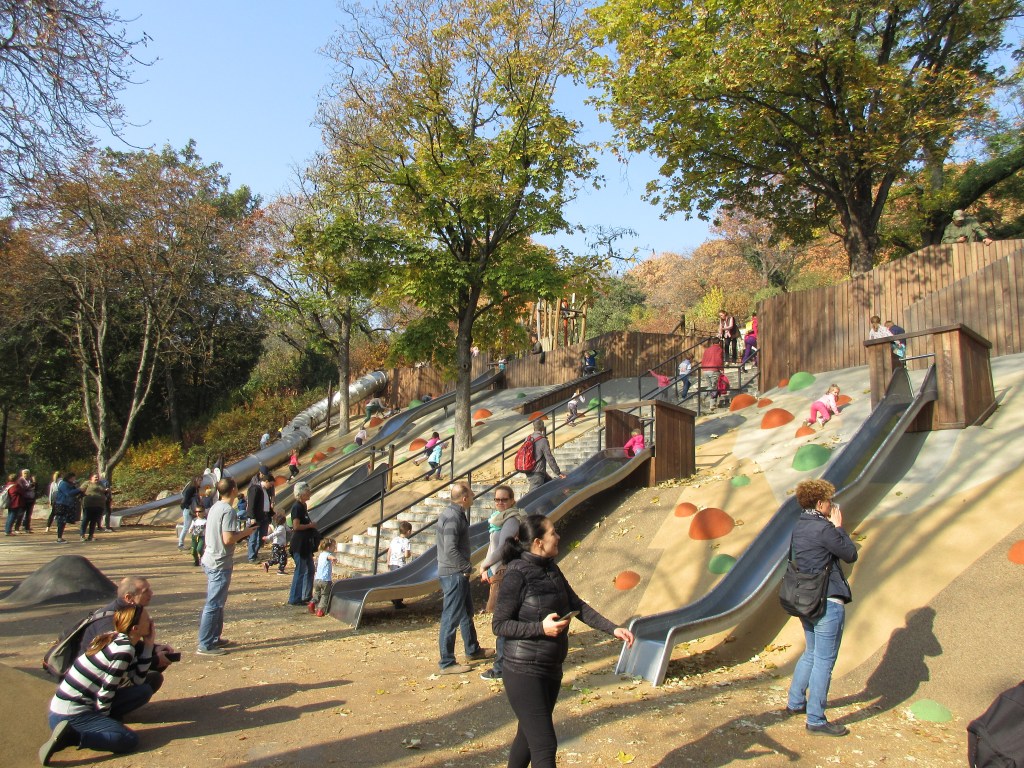
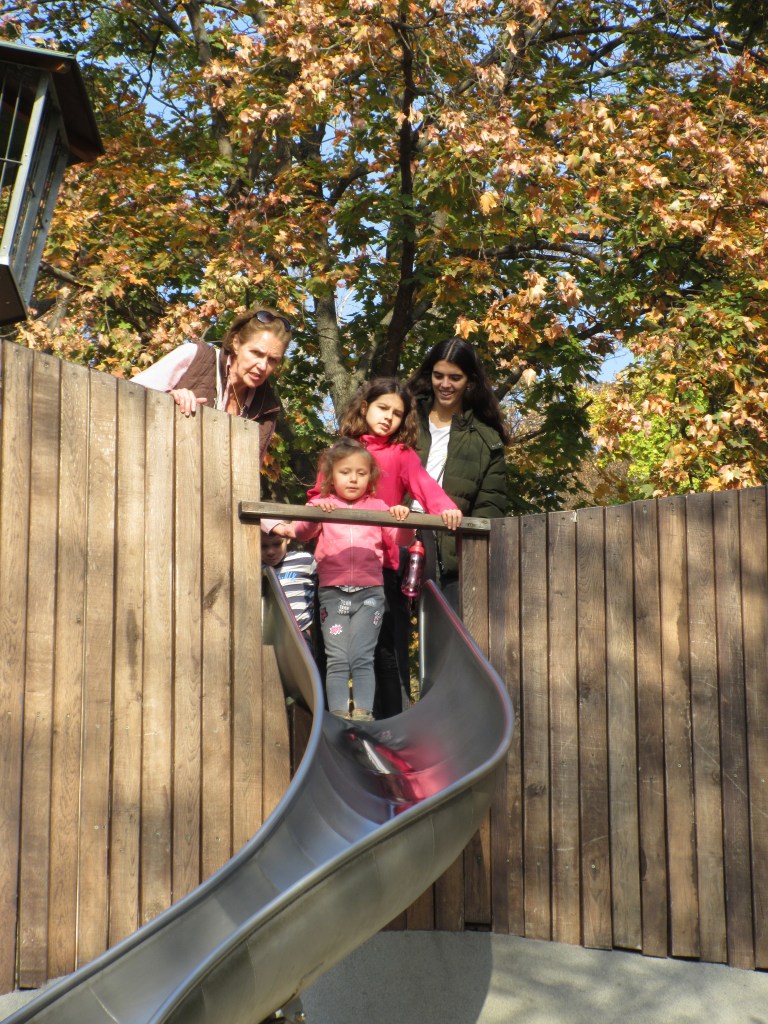
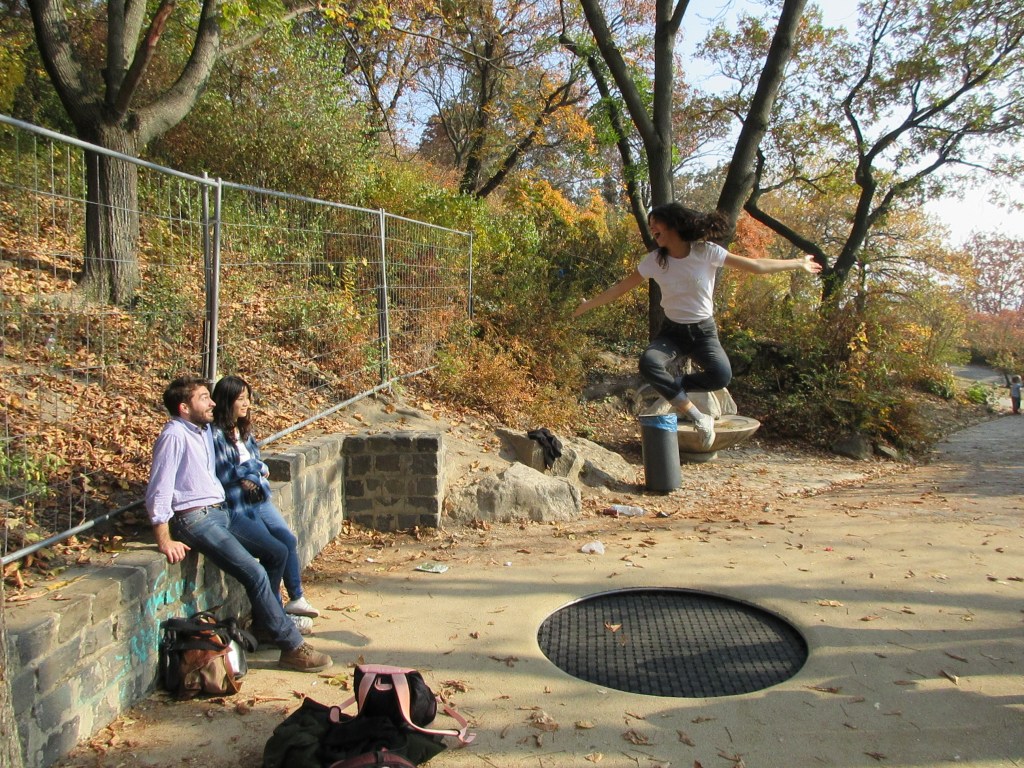
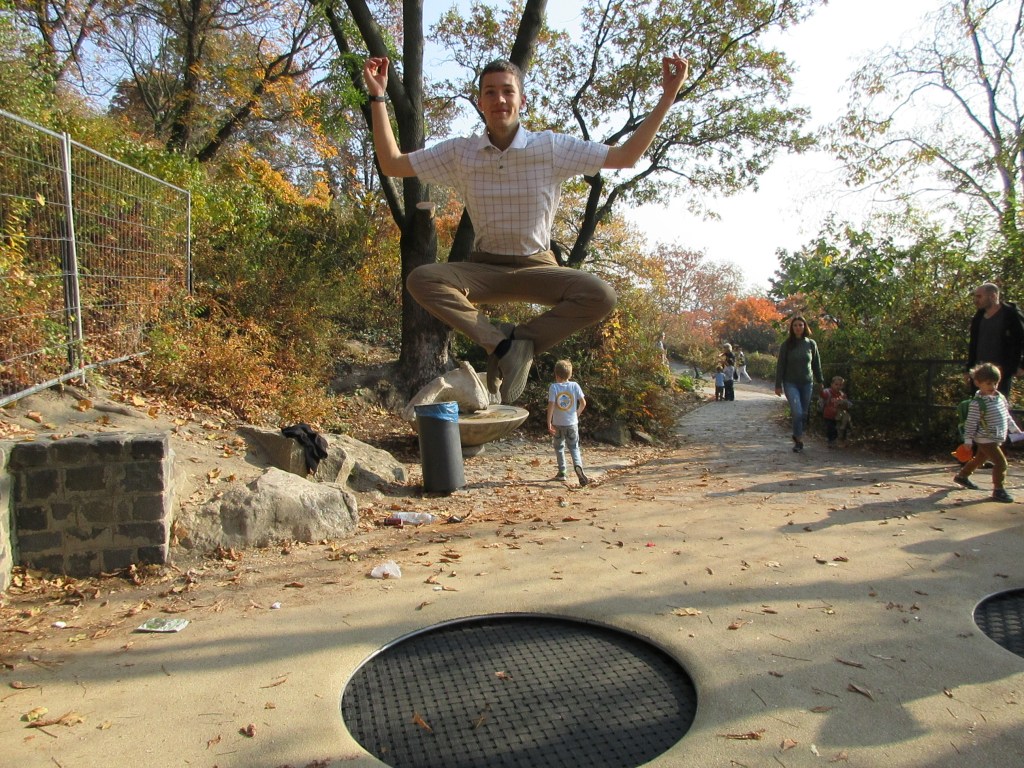
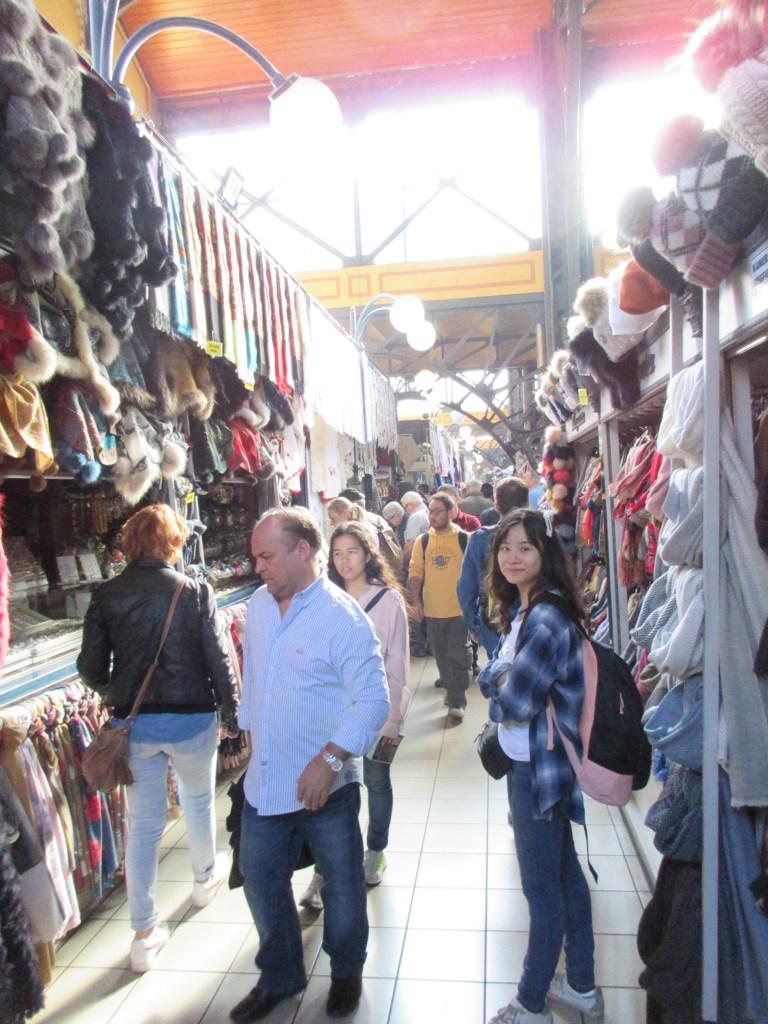
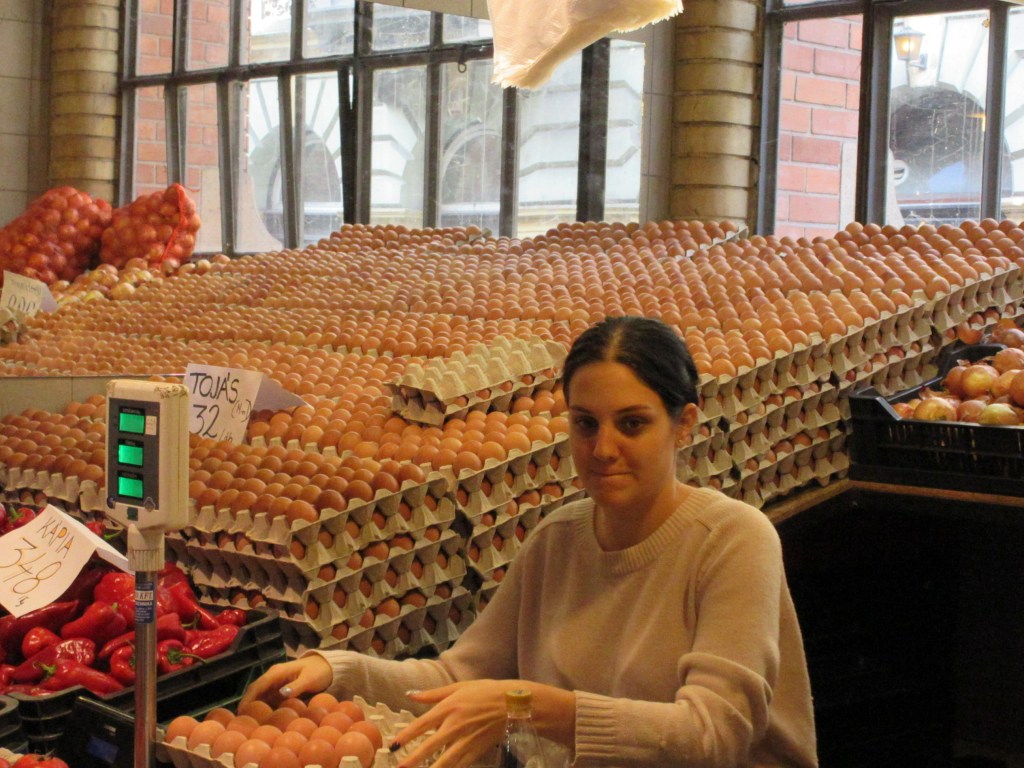
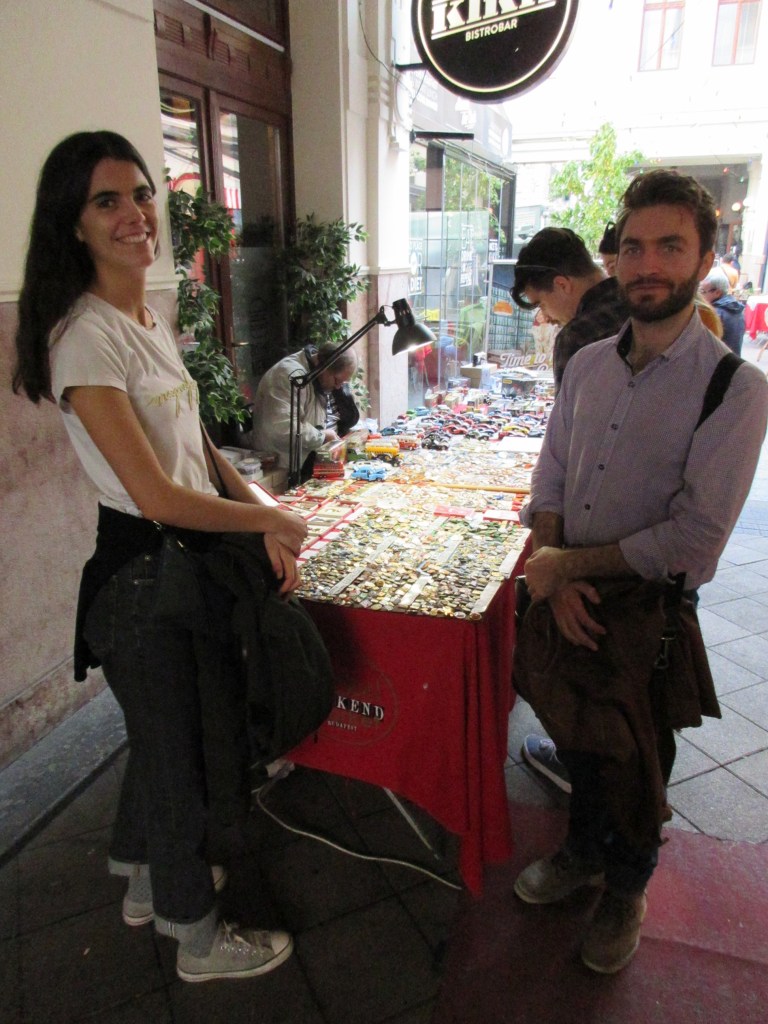
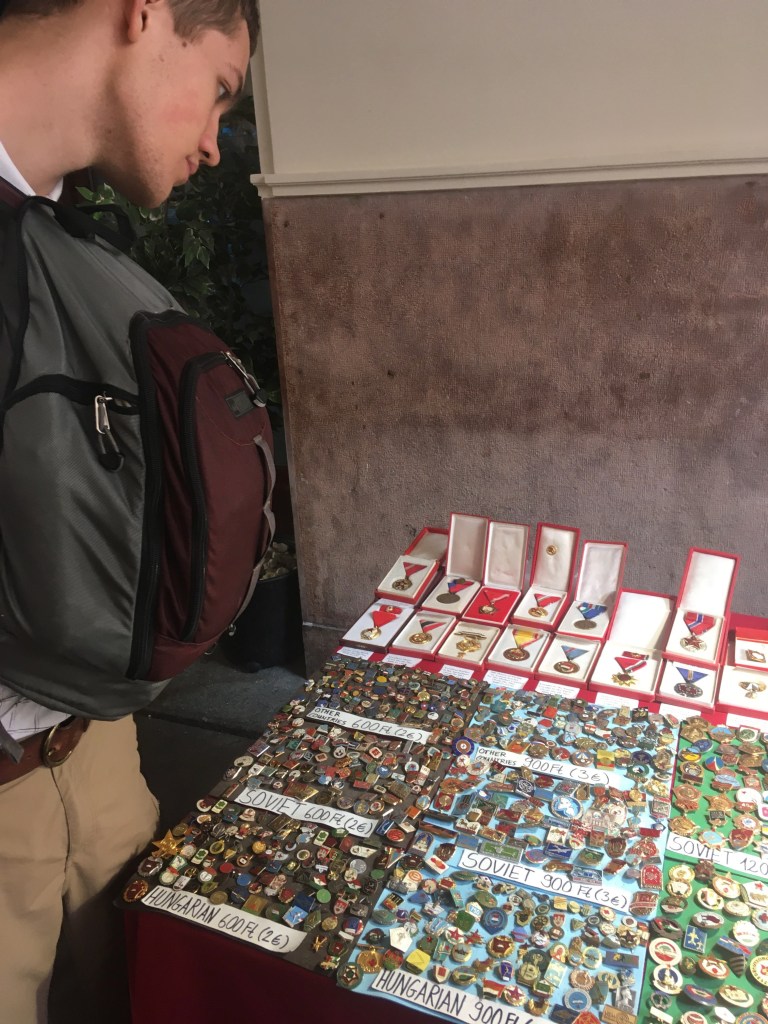
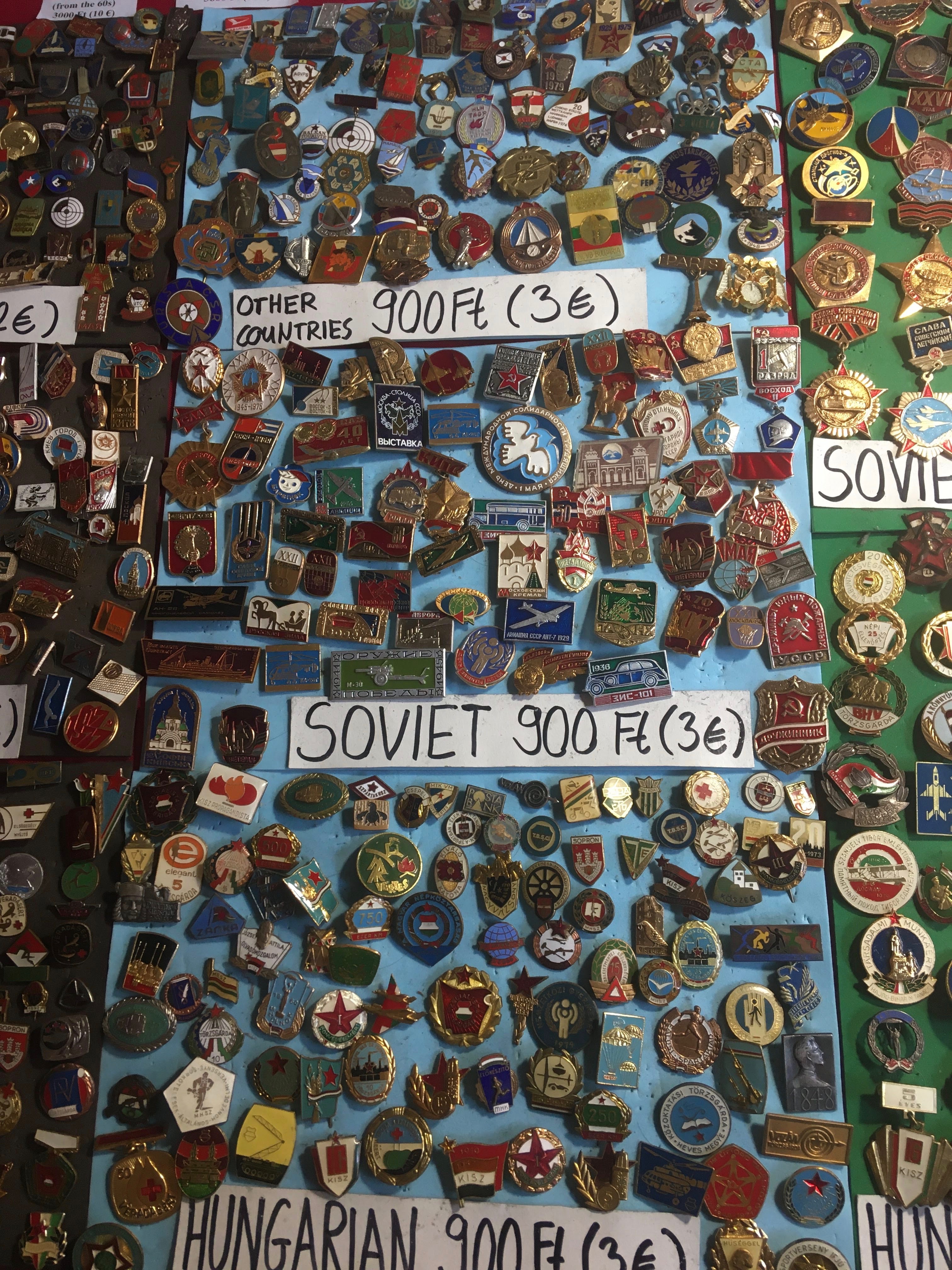
The trip back down the hill was fantastic for a very specific reason. I’d seen this playground with its impressive slides on the way up, and I made sure the four of us crossed paths with it going down. This is one of the very best playgrounds I have been at, after the City Museum in St. Louis, Missouri and trailed by ones with designs along the lines of Grass Lawn Park (Redmond, Washington) and Luther Burbank park (Mercer Island, Washington). This one on the Buda side of the Danube was obviously designed by someone who actually understood childlike parameters for what is fun (not like one of those grotesquely condescending “a-dolt” attempts at a “children’s” playground). This playground has four long slides down a big incline that doubles as a climbing slope, there are swings, a weird triangular structure on springs (that’s the genius key factor), trampolines set into the ground… I highly recommend it for those coming through Budapest who dare. We had quite a bit of fun. No matter that we were over the average age by a LONG shot! (not counting parents of course)After waiting for a space in the line for several minutes and gradually realizing that she wasn’t going to get ANY chance to go next from the little kids lining up without definitely claiming it, Teresa assumed the same stance and came down too!Trampoliiiines!!Here’s a picture trick I figured out with my siblings last summer while we were testing out the small travel camera I’d just got…We went inside the giant market building–tons of commodities on the second floorHere’s is a trick question for at least half: how much eggs are there? (at 32 forints an egg, that’s $1.27 a dozen) From a previous time here Teresa knew about this hidden alley off of Dob utca (“ootsaw”= street), with vendors of many and varied assortments. We came especially to see old Hungarian and Soviet artifacts and memorabilia–it’s fascinating to see this sort of thing first hand in more or less its original environment. I bought a Hungarian school grade-book from 1920-1922 (with the classes for each semester and marks for how well the owner was doing: the one I got was from a good student, with many “jol”s, or “good”s). The address is Dob utca 16 for anyone interested. The alley goes right through the middle of the block.I was especially struck by the back row–these were soviet commendations: “good soviet worker” type awards A very nice lunch at Köleves, recommended by Orsi (“Or-she”), the one Hungarian studying at the Kodály Institute. Although she’s been living abroad for 10 years she still knows where to go in Budapest! My grilled wedges of cheese on baked apple were delicious.going back upstream along the Danube toward the Margaret Bridge, toward a lookout and dessert shop also recommended by OrsiCampbell, Teresa, Kiki. One of the best and most hilarious parts of this whole Croatia trip started shortly after this picture was taken. Campbell and then me, began to teach Kiki English idioms and expressions, and she took to them like a duck takes to water.* Expressions really are such a marker of native speaker that it is hugely satisfying and entertaining to have someone like Kiki tossing them around* comfortably too. It’s not something taken for granted* anymore when that happens, and as most things that we take for granted, they are very rewarding if one is just able to hop out of that rut* and experience them consciously. *We soon realized how much we use them in everyday speech. I honestly did not notice that I was writing these idioms, oh so appropriately, until halfway through writing them)Here is another one of those places of Budapest that seems to come out of a book (or a movie, I thought here, which is why I used the 16:9 aspect ratio for this picture–perhaps something you wouldn’t have noticed otherwise) After watching the sunset up at the lookout, rushing to the dessert shop before it closed, and then going to a park where I also called home and learned about the plethora of kittens and plethora of apples there…we walked back to the Pest (“peSHt”) side. We met up with the rest of our group (Mila, Ruyu, and Sarah), picked up our things from the hostel, and found something to eat before we boarded an overnight Flixbus to Zagreb (which left at midnight).
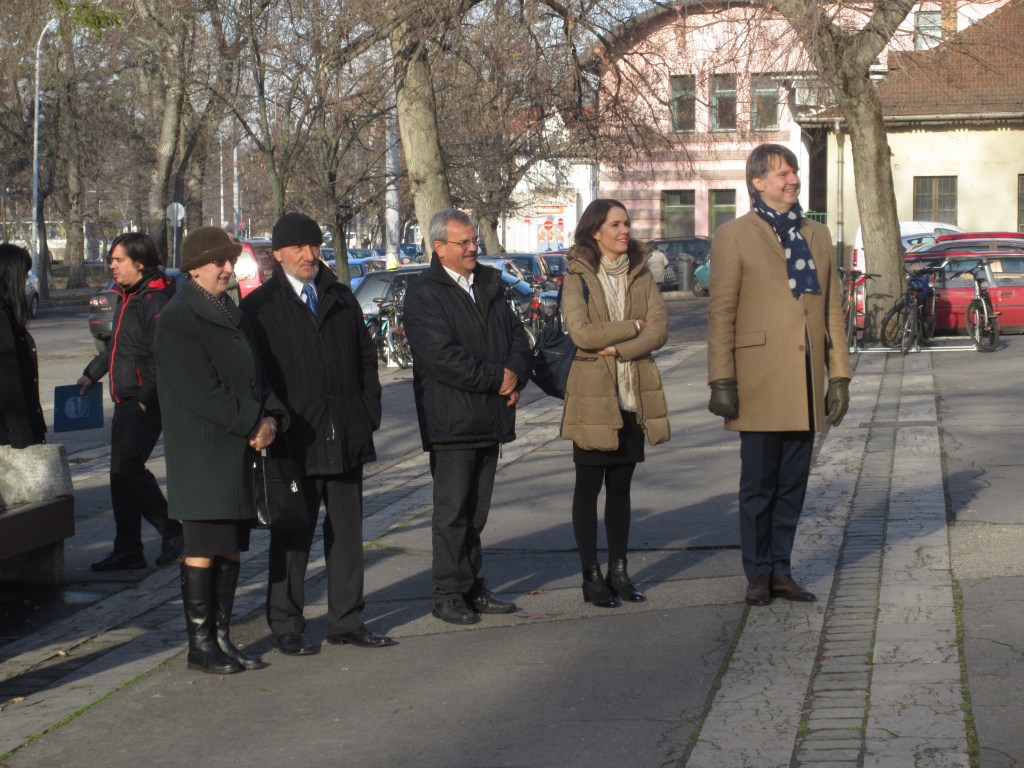
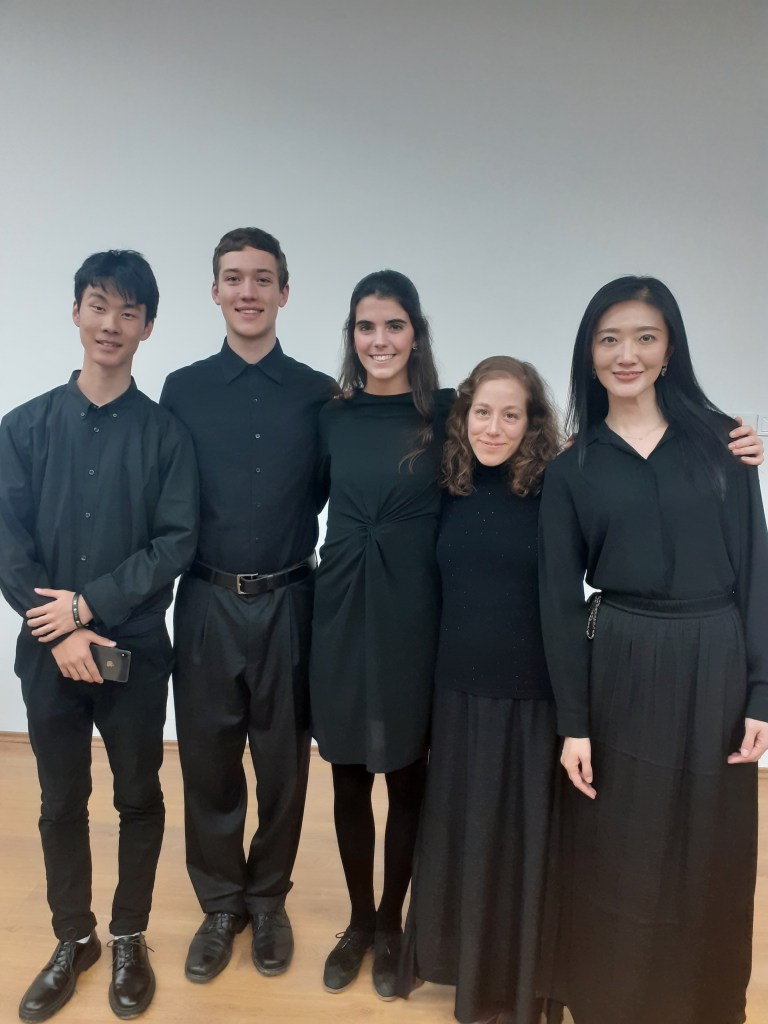
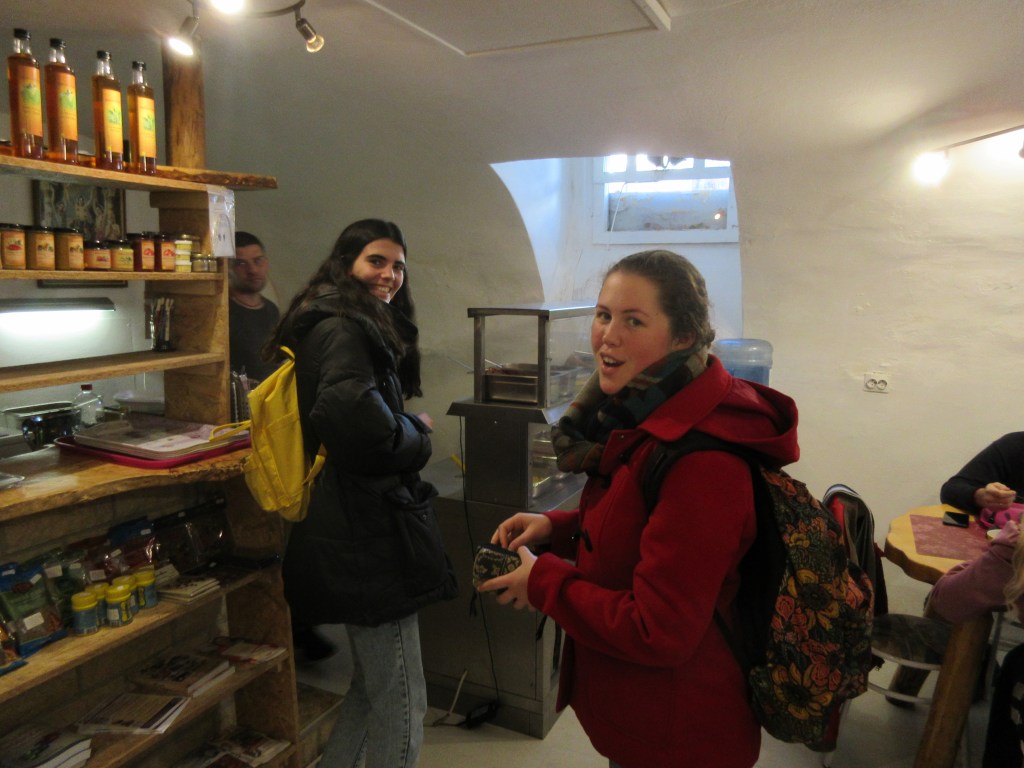
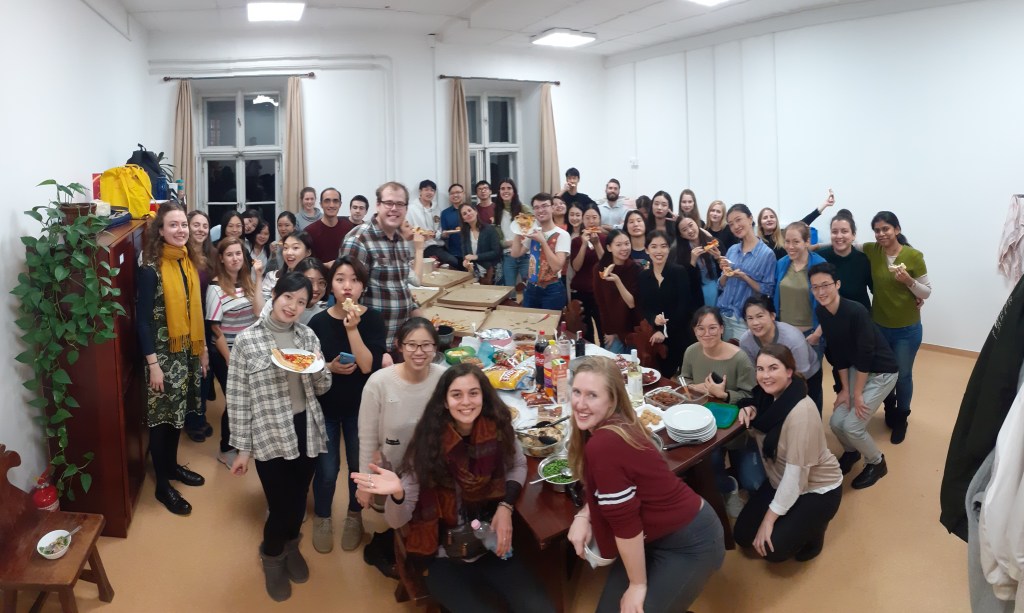
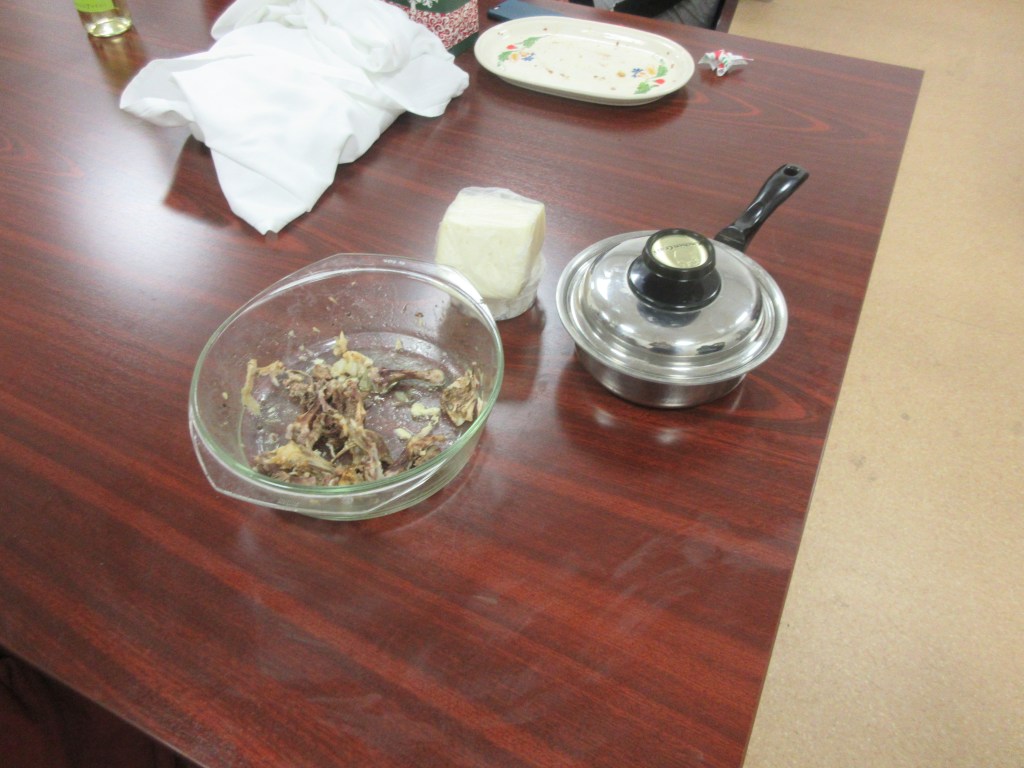
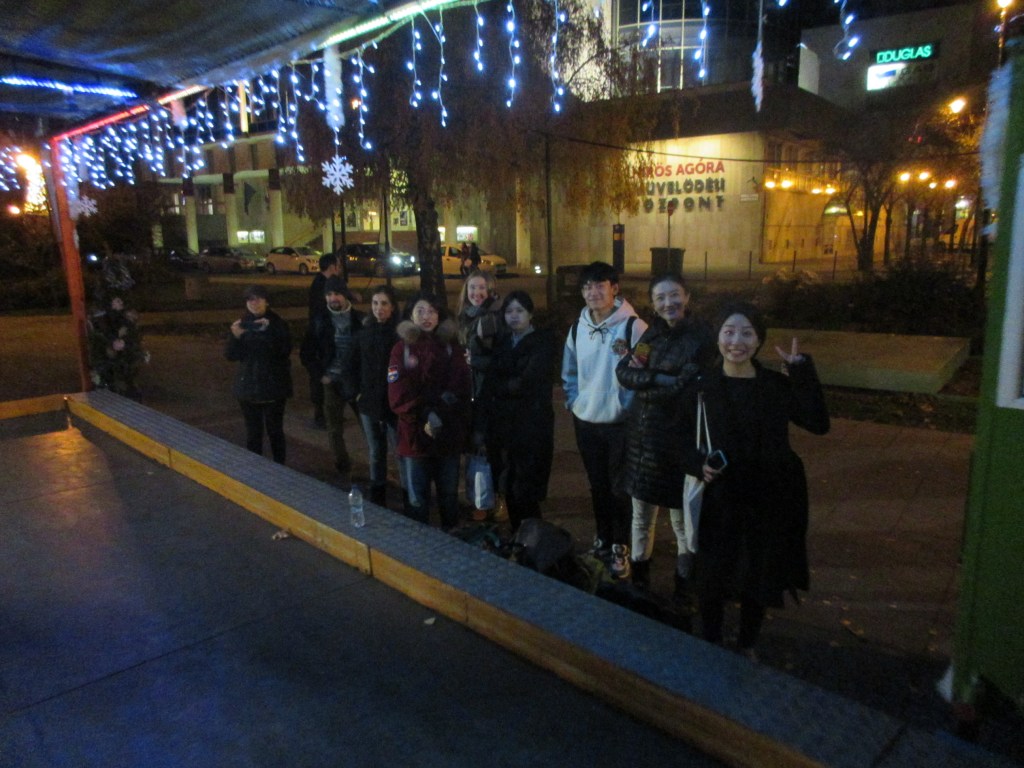
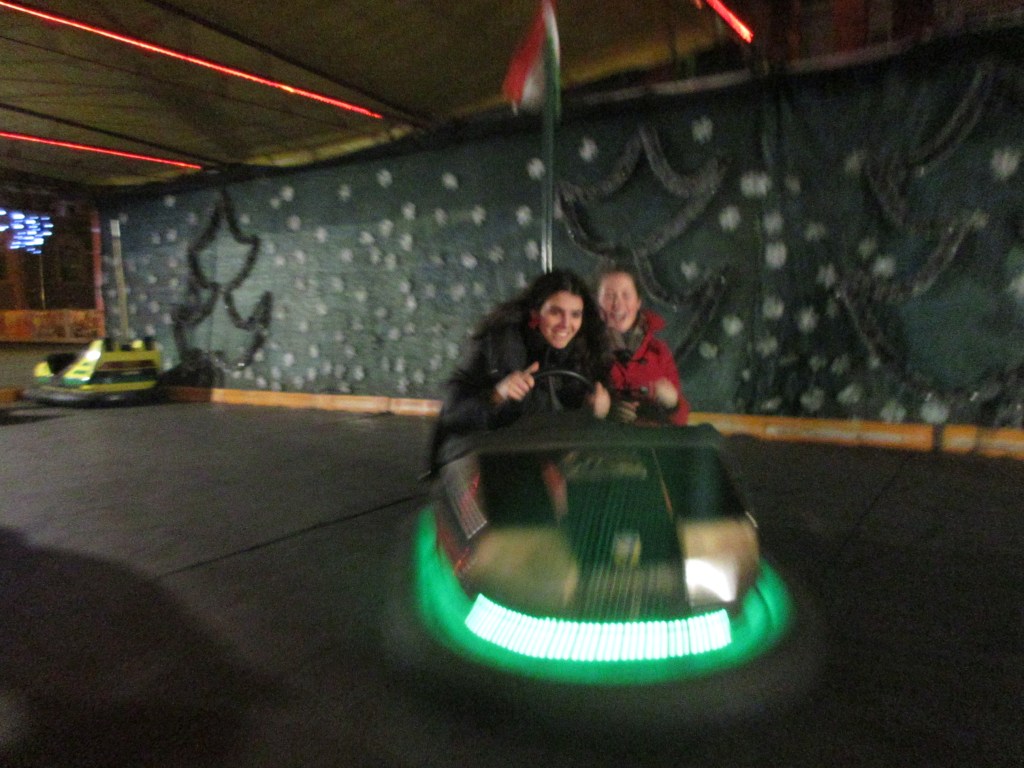
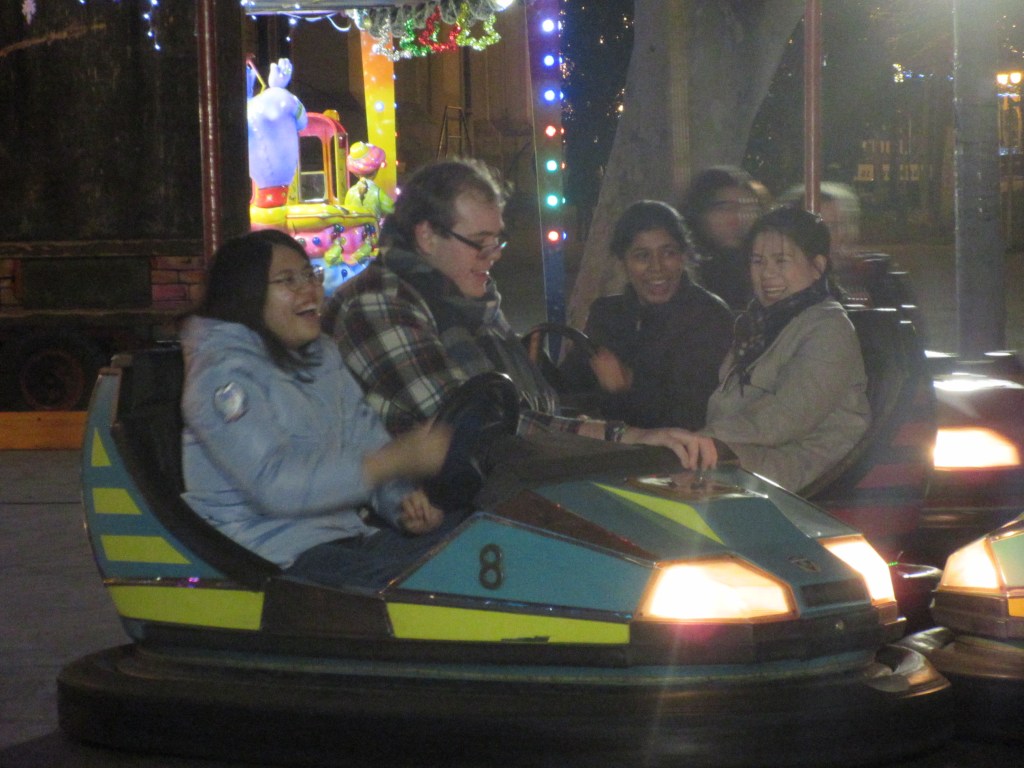
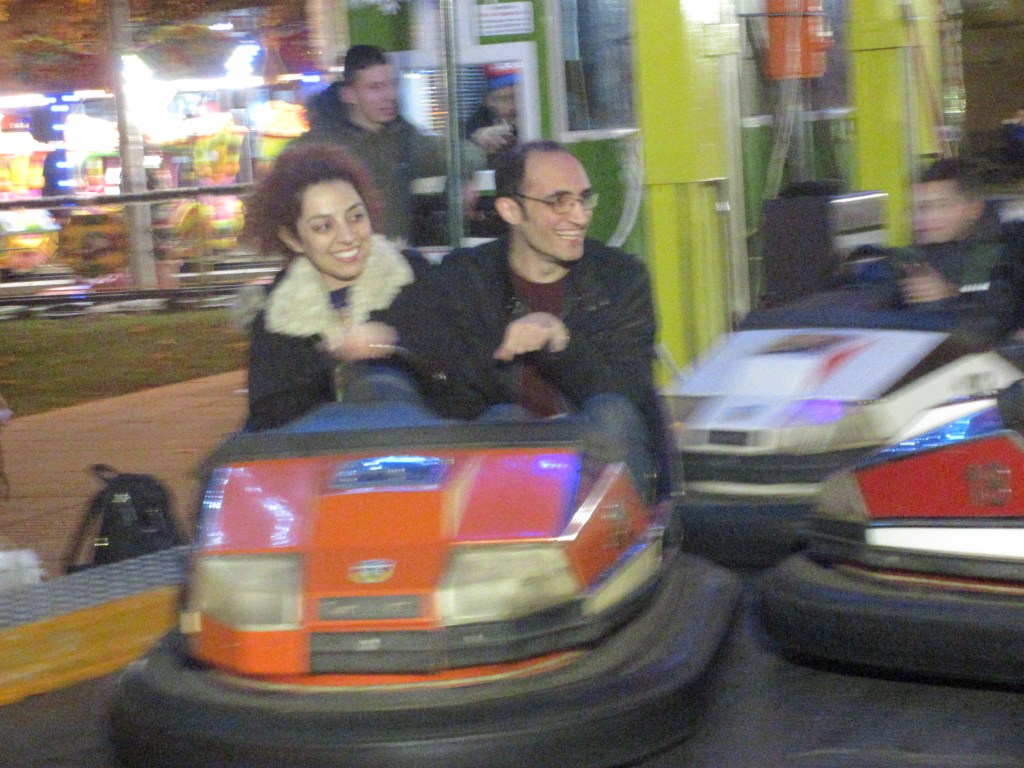
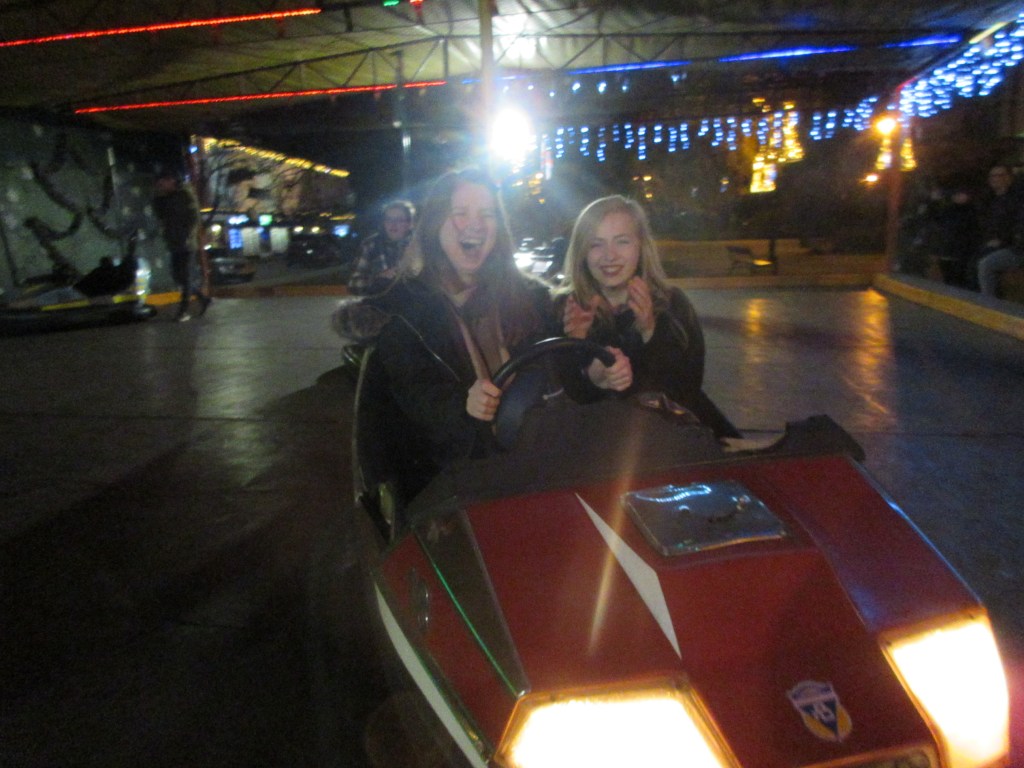
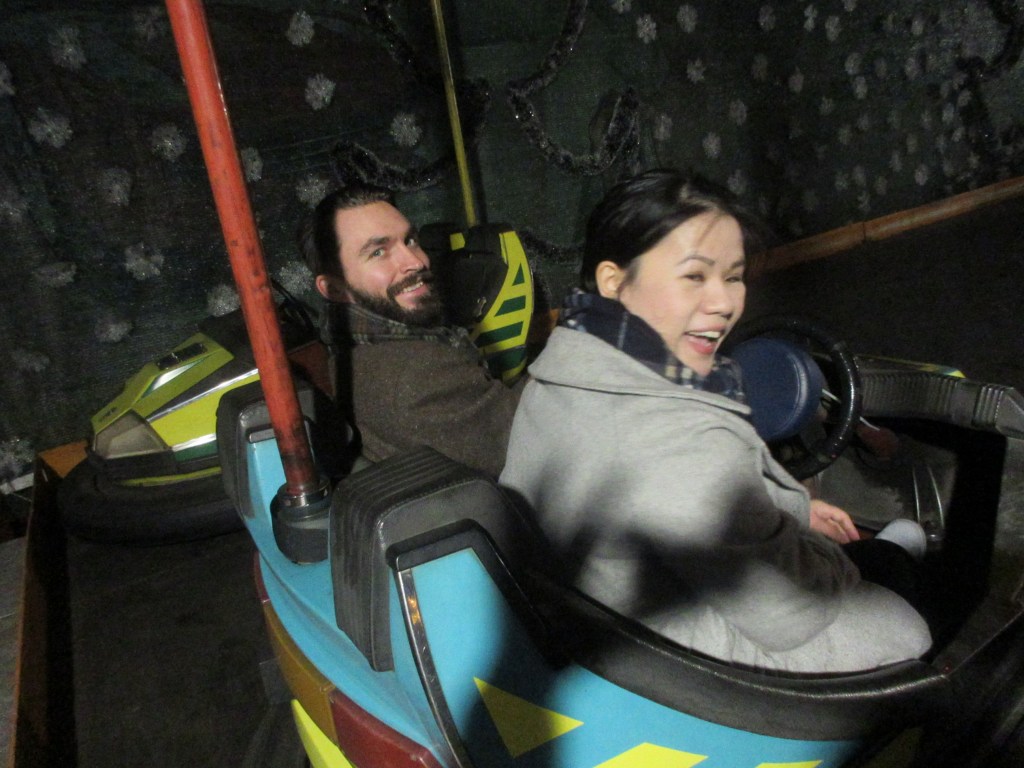
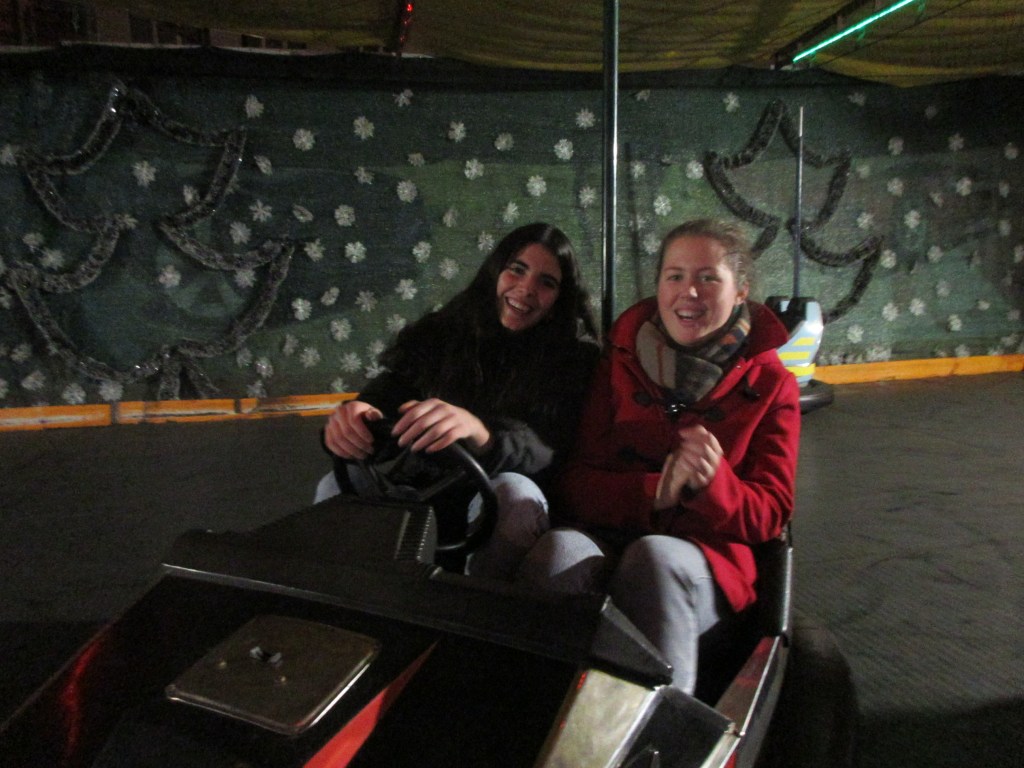
More photos of December 16th, Kodály’s birthday: https://www.baon.hu/galeria/kodaly-szuletesenek-137-evfordulojara-emlekeztek-kecskemeten/9Throughout the day we placed three different wreaths to commemorate Kodály’s birthday, and sang his Hungarian birthday greeting song: https://www.youtube.com/watch?v=n6rjWhatRs4 The Institute’s Deputy director Laura Kéri stands at the left next to Péter Erdei the founding director of the Institute and Hungarian choral directing legend. Current director László Nemes stands at the far right. Later that day we all bused to Budapest to visit Kodály’s old apartment (a museum now), and to attend the Kodály concert at the Liszt Academy that evening. From the vocal ensembles, ours was selected to sing at the student concert on December 15th: we sang “Freue dich des Weibes deiner Jugend” by Schein. It’s a great piece, written right in the transition between the Renaissance and Baroque. (though not us, here’s a recording of the piece: https://www.youtube.com/watch?v=2h7DElTx5gM). We’ve been able to make very good progress as an ensemble this semester, especially since our voices all meld together quite well and we are all capable of our own complex parts. We been invited by our professor Árpád Toth to participate in his huge “night of choirs” event in Budapest in February (a 20 minute set of music for us). He is one of the most popular teachers at the Institute, and with good reason: just see this brief TEDtalk by him and you’ll know what I mean! https://www.youtube.com/watch?v=D_wM8bjQ_KE (there are English subtitles). To the best of my knowledge he is the choral director star in Hungary. From left to right: Shunzhi Tang (China, tenor), me (USA, bass), Teresa Appleton (Portugal, alto; also my fellow BA1 classmate), Orsi Csoma (Hungary, soprano 1), Mila Chen (China, soprano 2)One day that week Teresa Appleton and Sarah Keane (Ireland) showed me a hole-in-the-wall Indian restaurant/canteen: the best thing to do is simply to order “The Menu,” which comes with their offerings for the day.Our end of the semester party after the Secret Santa gift exchange–nearly all the students of the Institute are here. For the exchange we had to describe “our person,” so that they would recognize the match and come up to claim their gift. Sarah Keane probably could have left off any explanation and just have held up what obviously was a wedge of cheese wrapped neatly in used sheet music. My classmates know how much I like cheese! Thanks to how cheap (yet quality) the food is here I’ve been able to add a 1.3kg block of Hungarian Trappista cheese to my weekly shopping list. The roast chicken I brought was one of the most popular dishes, and probably had the most return on investment considering that all did was stick it in the oven with seasoning and a lid for two hours. I started to wonder whether they were eating the bones too! There really weren’t even scraps left at the end. You can also see I’d already started in on my chunk of cheese from the gift exchange.Afterwards we walked through the Christmas market in the middle of town and had a ton of fun with the bumper cars that have been set up for the holidays! I’ll let the following pictures speak for themselves as well as introduce you to many of my classmates. Left to right: Lee Khim–Singapore, Miklos Jr.–Hungary (he and his father, Miklos Sr. are faculty in the library, but we also have fun folk dancing with him at the music cafe on Wednesdays), Marina–Spain, Yan–China, Clodagh–Ireland, Zhequi (?)–China, Haodong–China, Mila–China, Jackie–ChinaTeresa (Portugal, also my fellow BA1 classmate), and Sarah (Ireland)Carmen (Malaysia), Gareth (USA, here for one semester from Ohio; also one of my flatmates this past semester), Aditi (India, Hungarian folk dance enthusiast), Yanjun (Singapore)Paria & Soroush (Iran)Anna and Ula (Poland)Campbell (Australia), Yanjun (Singapore)Teresa (Portugal), Sarah (Ireland)Paria (Iran), Marina (Spain)Mila and Haodong (China)
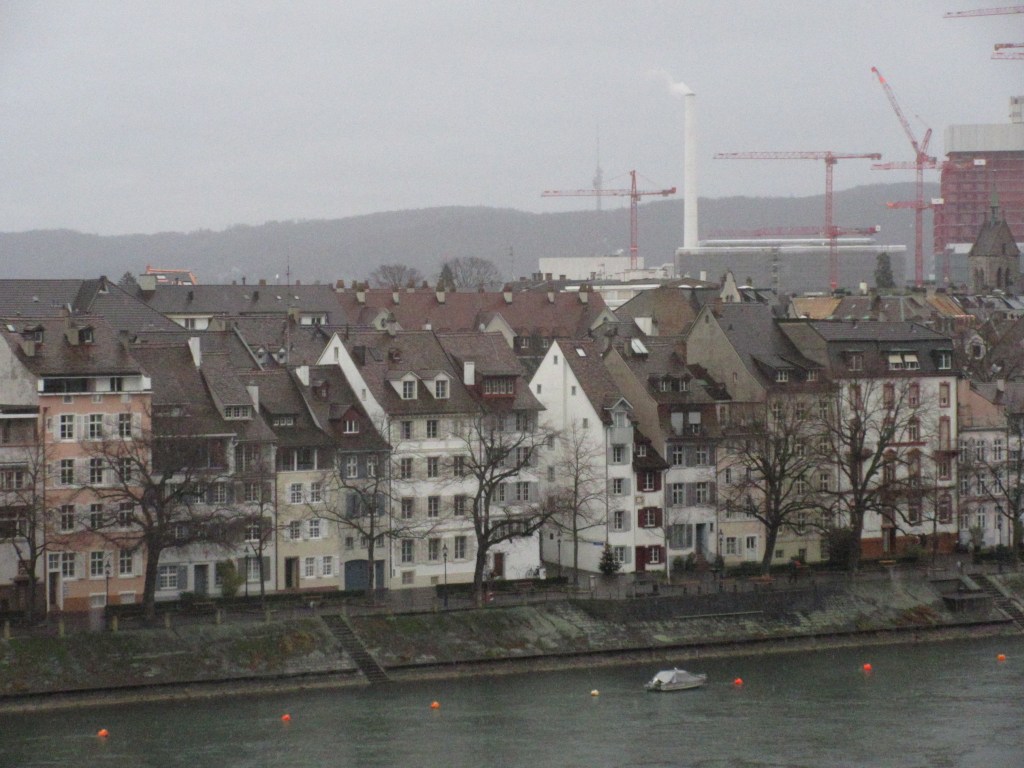
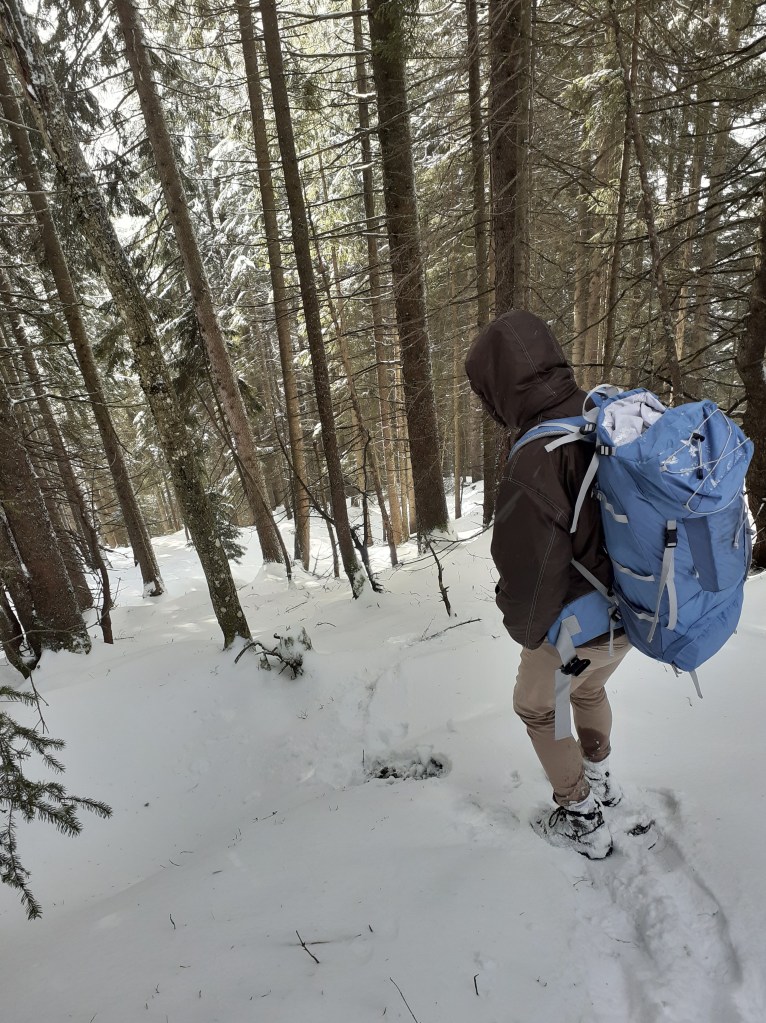
Me making a path above Sarnen.Basel, with characteristic old slices-of-houses
After spending the day walking around Basel (largely in the rain–thankfully I’m definitely the Washington duck!), my former boychoir classmate Anselm and I spent the night at his sister’s for one more night, and then headed out the next morning to the mountains through Lucerne to Langis, up the mountain from Sarnen.
Basel is wealthy from pharmaceutical companies–currently the skyline is being expanded with a complex that will include three more high-rise buildings. I learned that the skyscraper in the background was designed to taper for the sake of where it’s shadow will fall (and NOT fall)
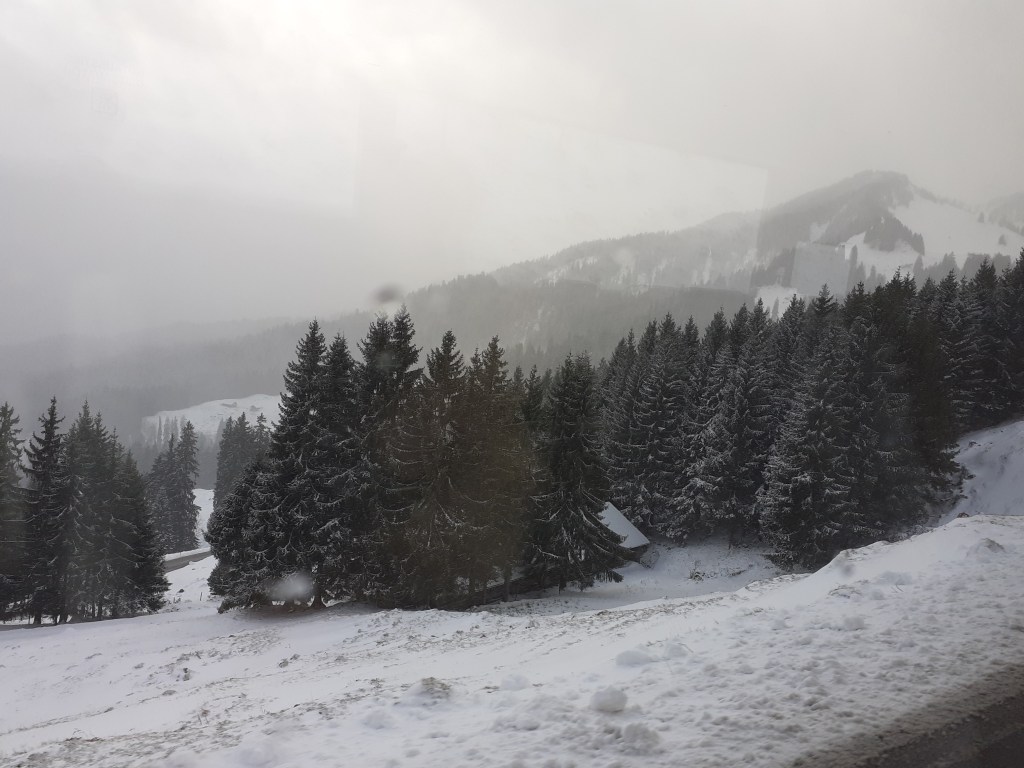
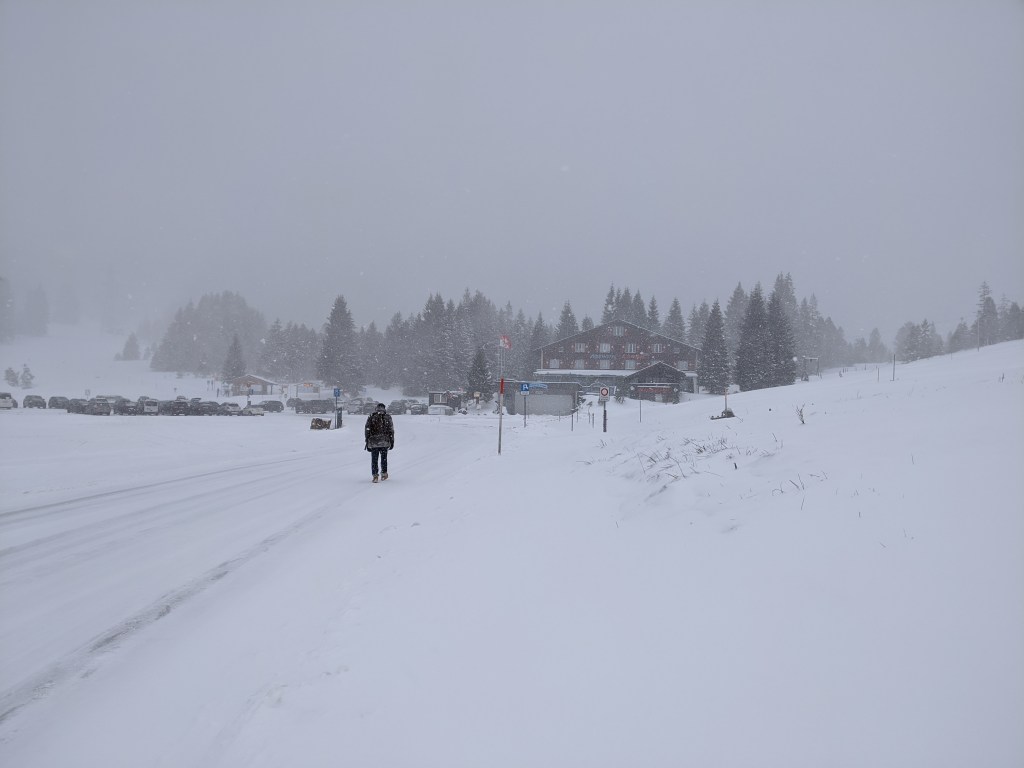
Once we got up past the snow line and to the lodge, the snow cam down hard with quite a bit of wind. I was very glad Anselm had an extra hat, because the train had rolled away with mine on the first day.
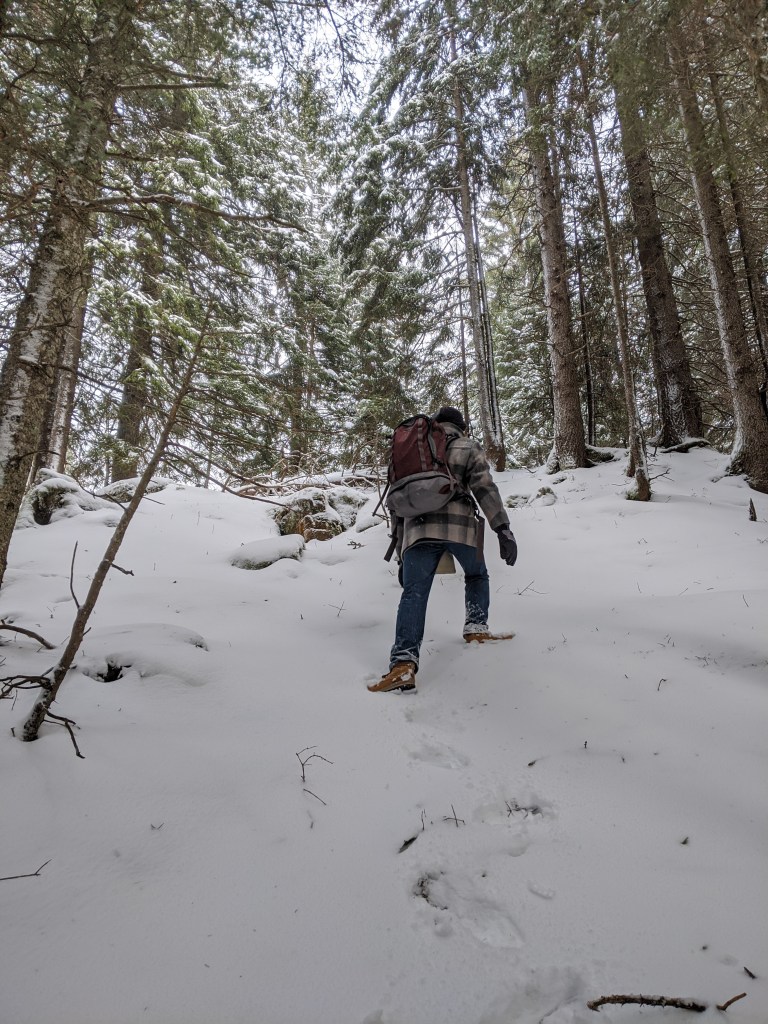
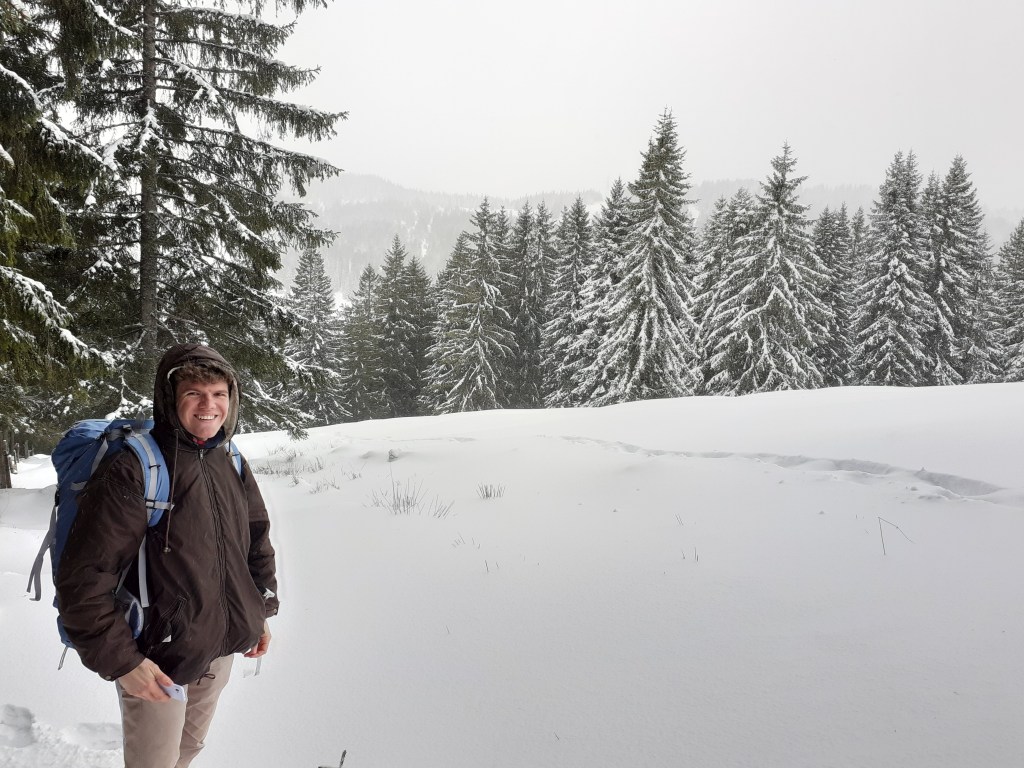
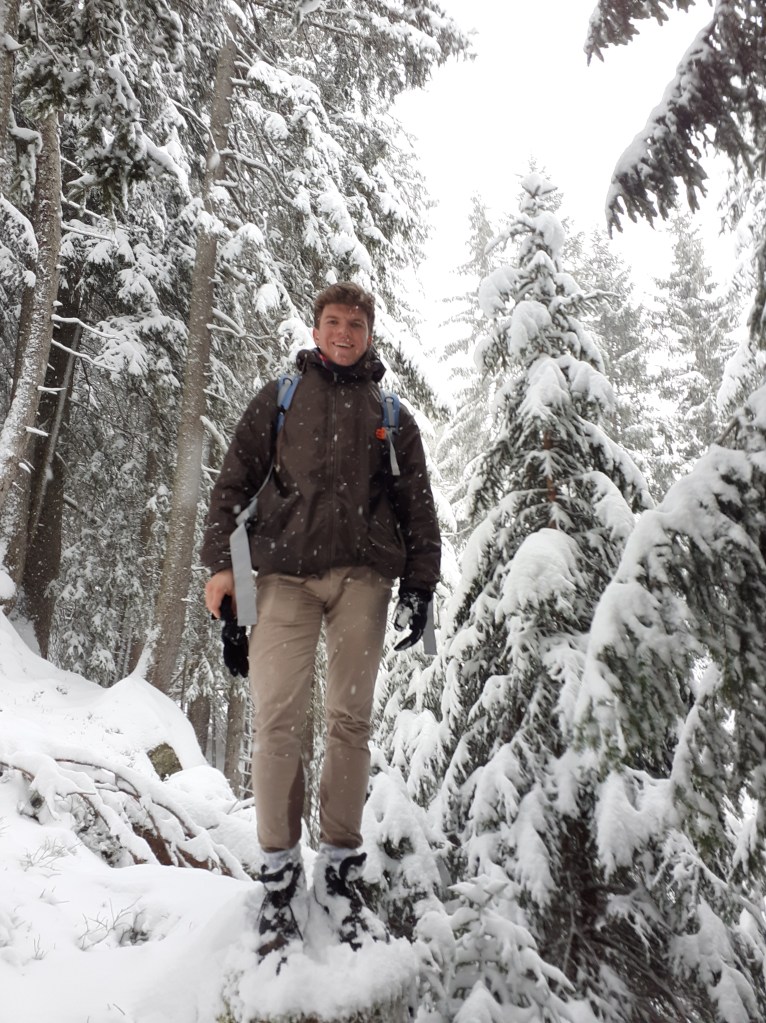
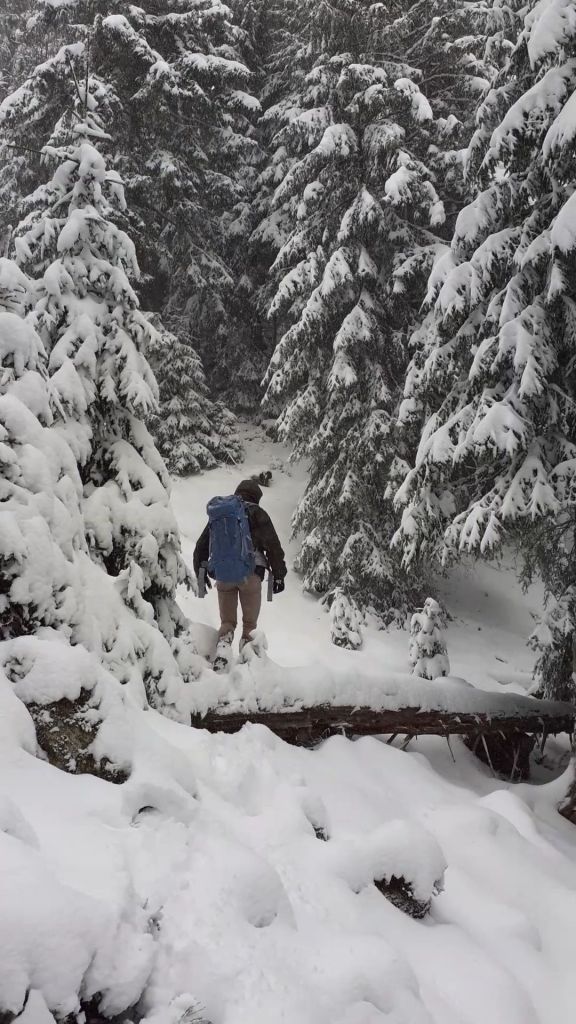
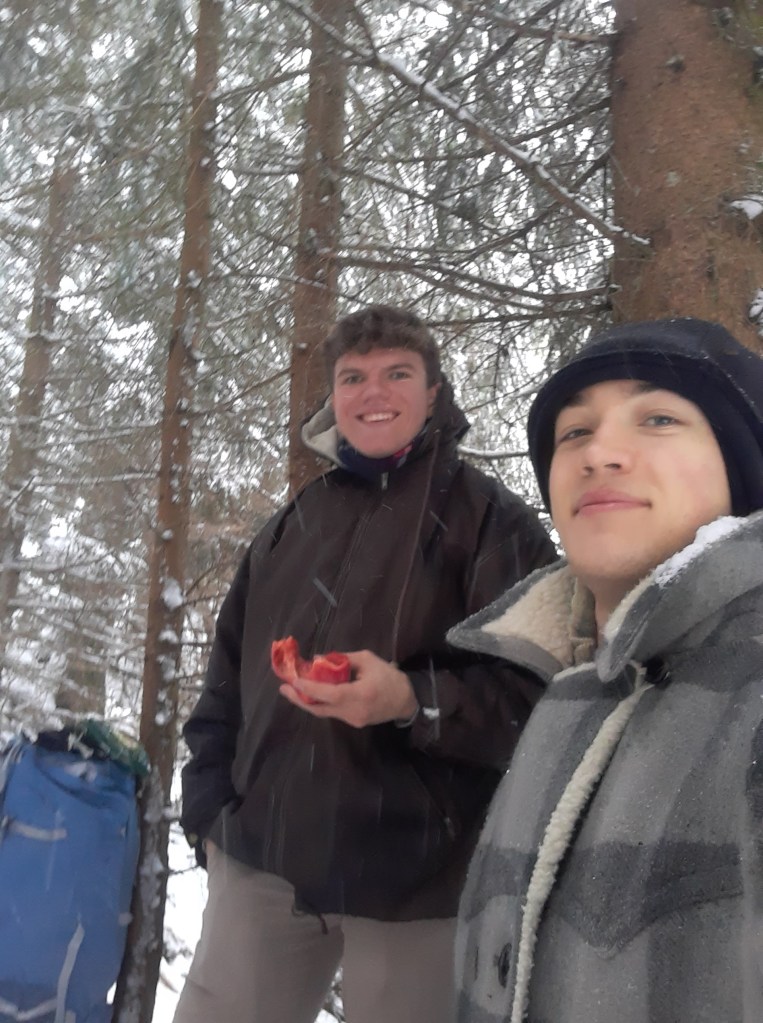
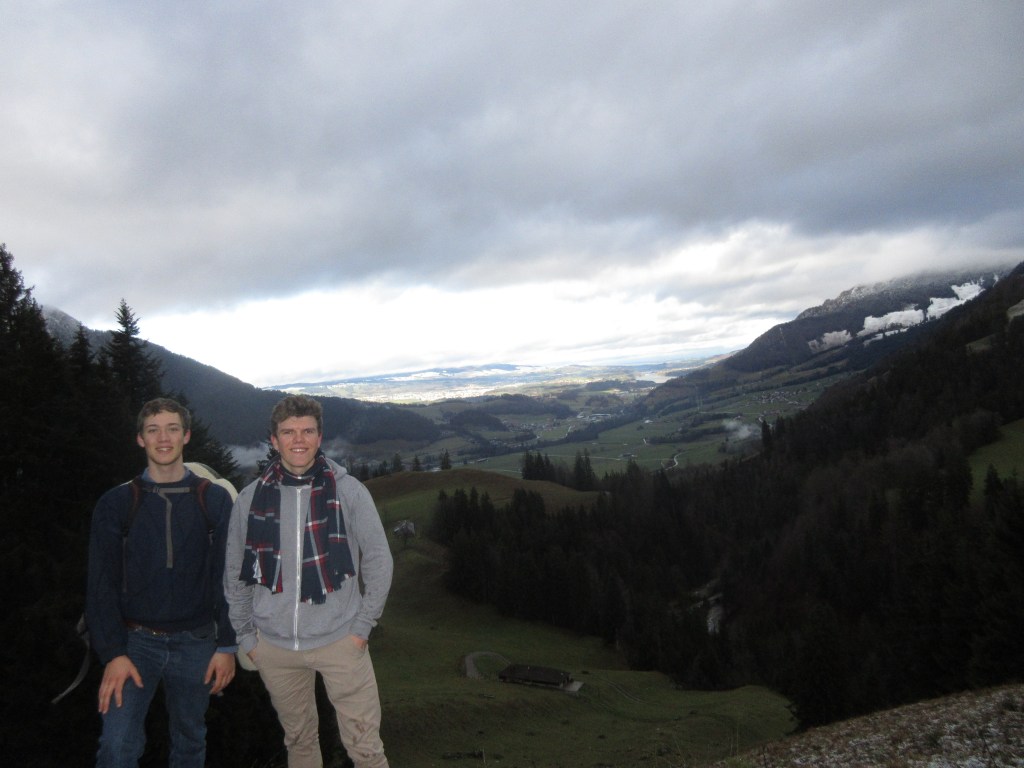
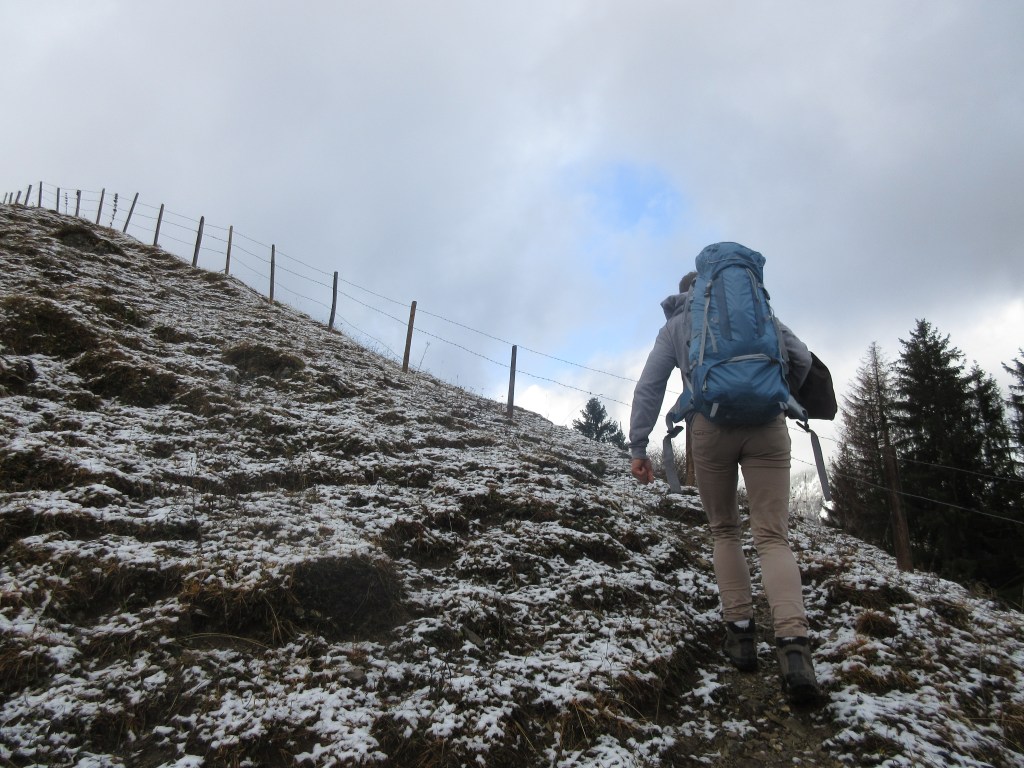
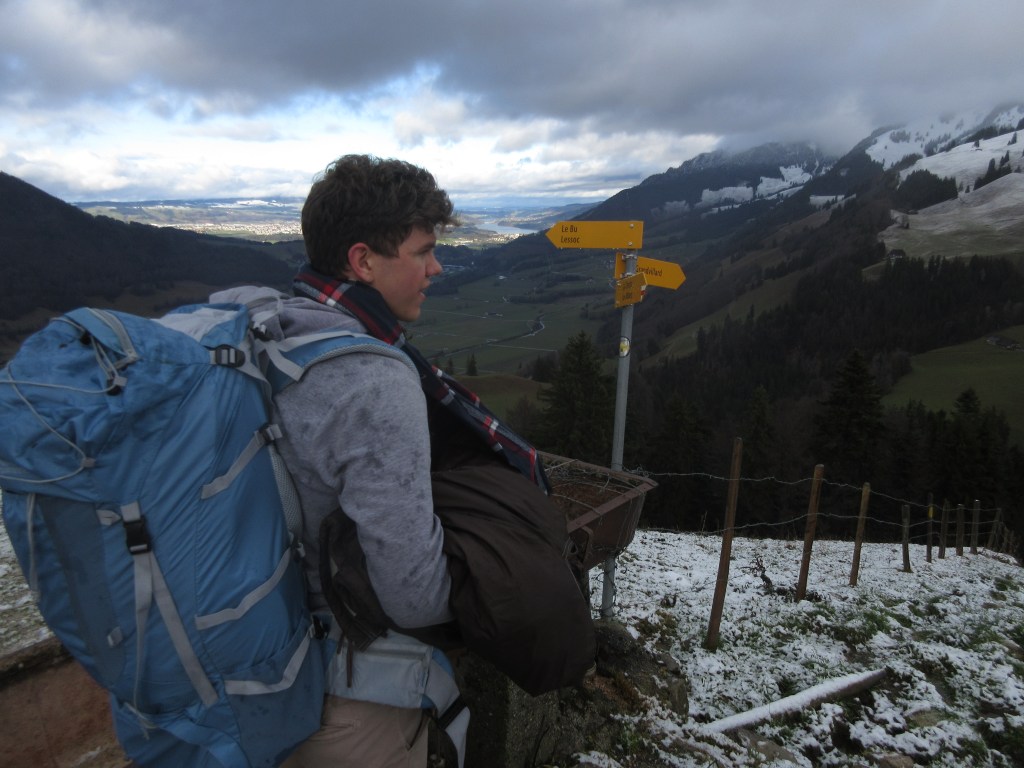
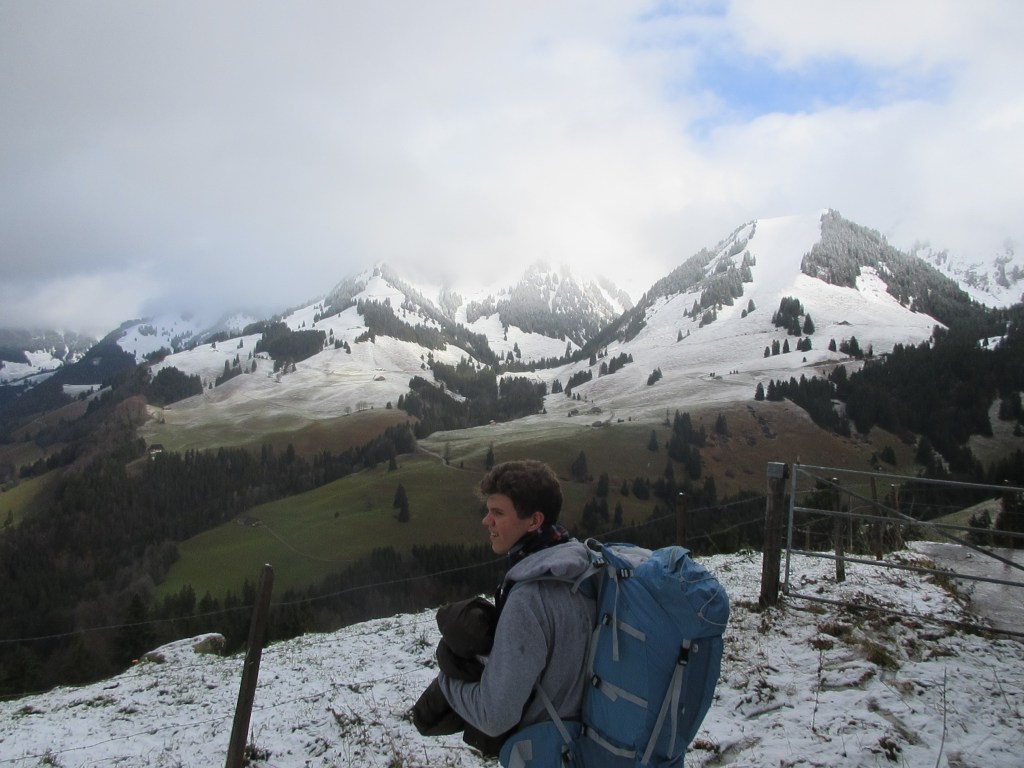
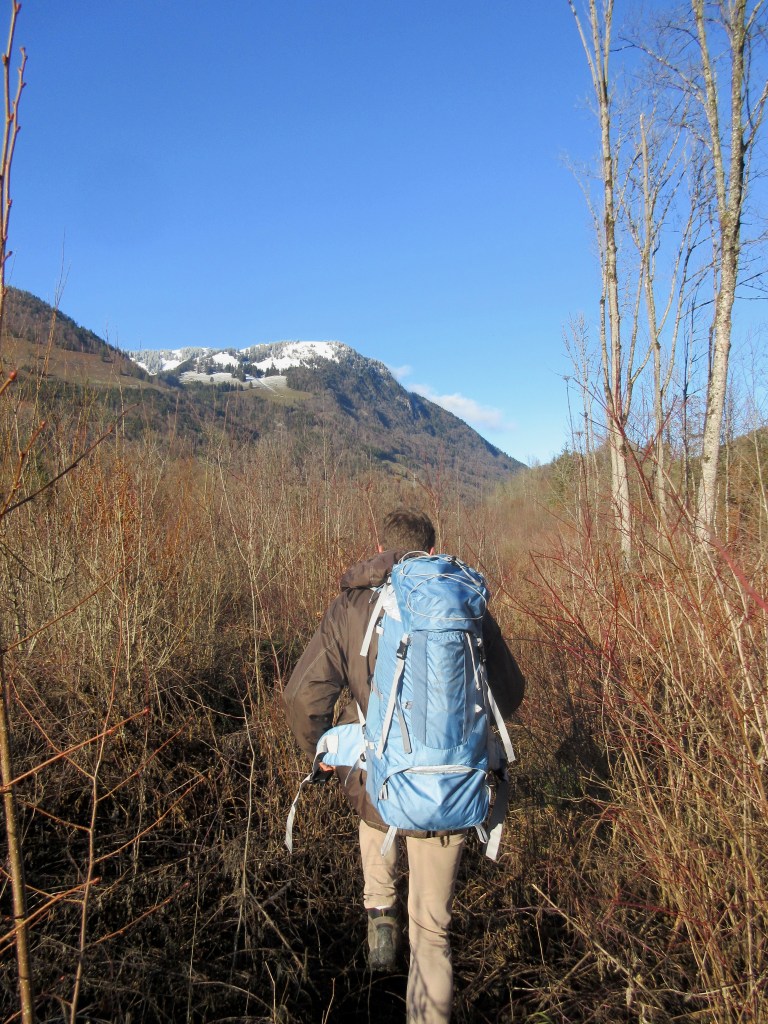
We had a 10k loop that we were planning to do, but on the ground the directions were not obvious, so we took our chances on the most likely looking trail posts that started up into the mountain forest on one side. For the next few hours we explored up and around that peak, nearly all the time making our own way underneath the cover of the forest: under the trees there was less snow to wade through, and the strong wind was whipping around far above our heads. With at least 8 inches or so of snow on everything, everything was beautiful, made even better by our complete freedom to explore anywhere we chose (with the tracks we left plus the orientation of the mountain, we had no doubt of easily making our way back. In the end we exited the forest a few meters from our start point even without seeing our old tracks more than once). After working our way most of the way around and up that peak we stopped for a simple lunch in a sheltered corner of the hill, and enjoyed the juxtaposition of enjoying dried banana and mango in their environmental opposite. A robust loaf of bread, bell peppers, and some sliced meat filled out the fare.
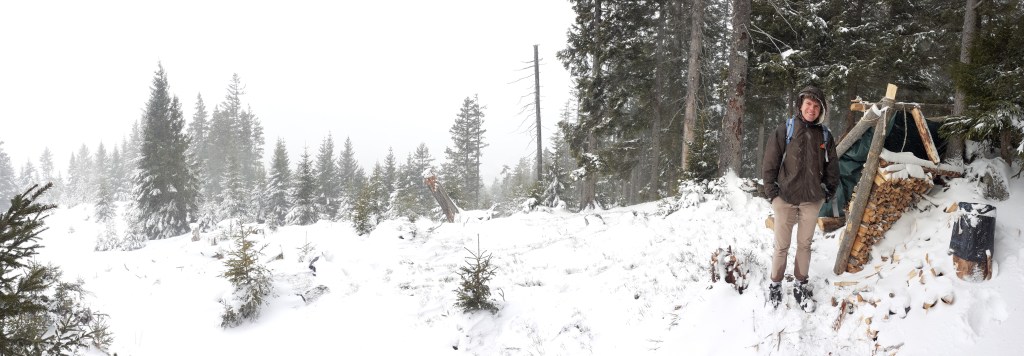
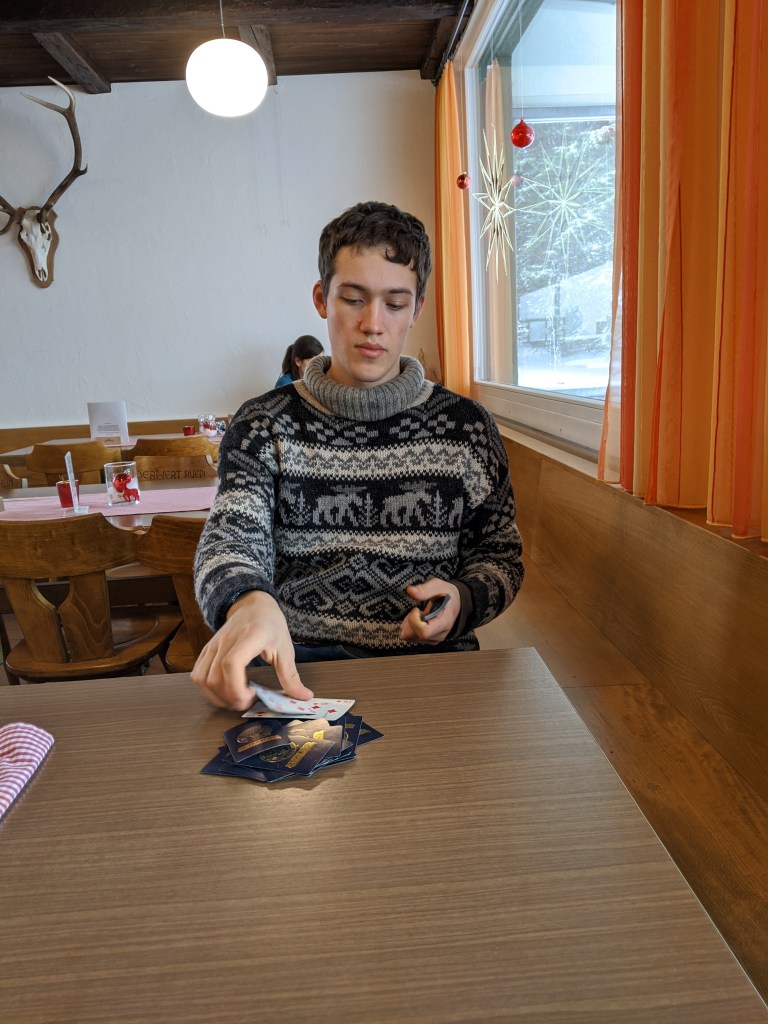
We emerged at a high open point on the mountain finally and after wading through the wind and deeper snow layered across the open space, we found a very solid little structure of logs that had collapsed when the tarp roof had filled in with water. Along with, no surprise, a VERY neatly Swiss-stacked pile of firewood (even at a few thousand meters they are consistent) we found waterproof bags with camping supplies as well as some sheep skins when I pulled back the tarp to look under. Anselm and I both baptized the hike by consecutively stepping by accident into the puddles in the tarp by accident, and then with Anselm’s feet getting a bit damp and cold after all the trailblazing, we headed back “from whence we came.” It was a little while yet until the bus back down came, so since I had cards along we played for a while, remembering “Egyptian Ratscrew,” “Spit,” and a few others that had been so popular when we were both at the American Boychoir.
It seemed like with all the snow and wind the valley MUST have been whitened while we were up under the clouds, but although we followed a snowplow for a few minutes, the snow line came like a straight edge, and so we entered back into the wetter, greener, warmer half of Switzerland again.
A few hours by train, and we were back in Geneva again: a very satisfactory trip!
Below the snow lineA few minutes later and a few hundred meters higher: first real snow I’ve been in this winter!Anselm, near the start of our hike-10 minutes through the forest from the roadAll wrapped up and toastywinter wonderland–just the two of us in the forestThis is perhaps the most representative picture of the day.here’s a panorama of where we had lunch–if you look closely you can see Anselm in the middle under the trees
I’m really enjoying my Pendelton wool jacket, which I got for free thanks to the Liberty High School Textile drive. If you live nearby and have any extra clothes you would like to be put to good use, I recommend checking it out!
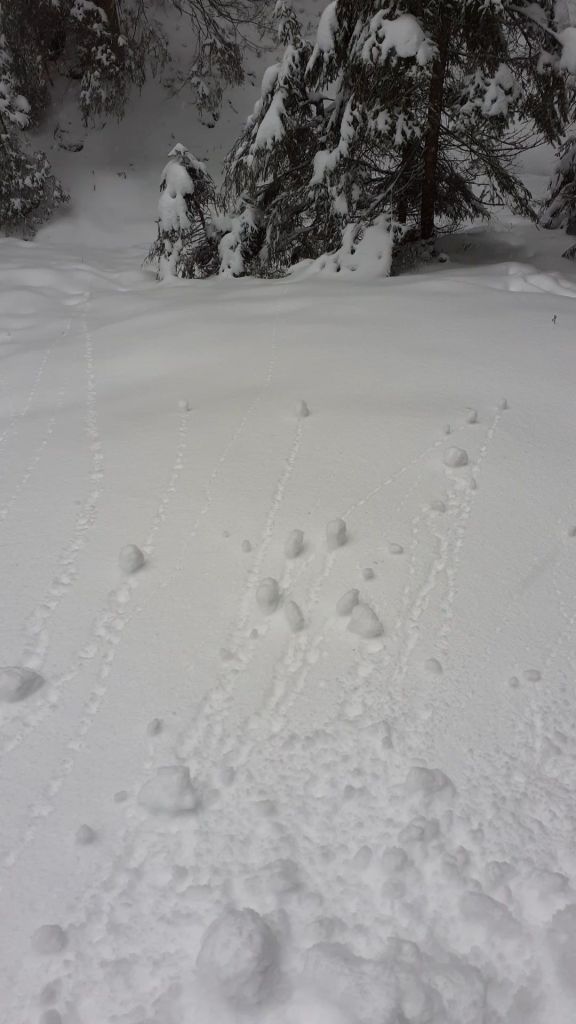
up at the top! You can see the shelter that we found, including the characteristic Swiss-stacked firewood.I hadn’t seen this snow-phenomenon before: as we walked, the clumps of snow we kicked up would roll down the hill and form little snowballs as they went.Anselm got a picture of me trudging through the wind and snow as we made our way back to the lodge. My coat turned white just from going across this stretch.Cards, indoors most importantly. (this sweater, like my coat, I also have thanks to the LHS textile drive, and being put to good use!)Back to the train, and on to Geneva. As I learned from Anselm and experienced myself, unlike “German trains”, the Swiss ones are always punctual. Also, the whole timetable system is designed so well that there is the perfect amount of time to make a train change without any extra waiting time.
Obviously I’ve had quite a gap in posts, but with the definitely extra time this Christmas break, I’ll see what I can do to update for the past few months. My plan is to work backwards and take advantage of the saying, “A picture is worth a thousand words.”
I reached out to Anselm Lohmann, an old classmate of mine from the American Boychoir School who I haven’t seen since 2014. He and his family live in Geneva, and when he offered to host me for Christmas and show me around Switzerland, I jumped at the offer.
I flew up from Budapest on the 20th. The whole airport process took a fraction of the time as it would have in the US. Although I had no bags to check and could go straight through security (which took 5 minutes tops) with my pre-printed out ticket, I WAS surprised that NO ONE requested to look at my passport, at all.
The investments in this study year in Europe go a long way: this flight from Budapest to Geneva cost around $25.
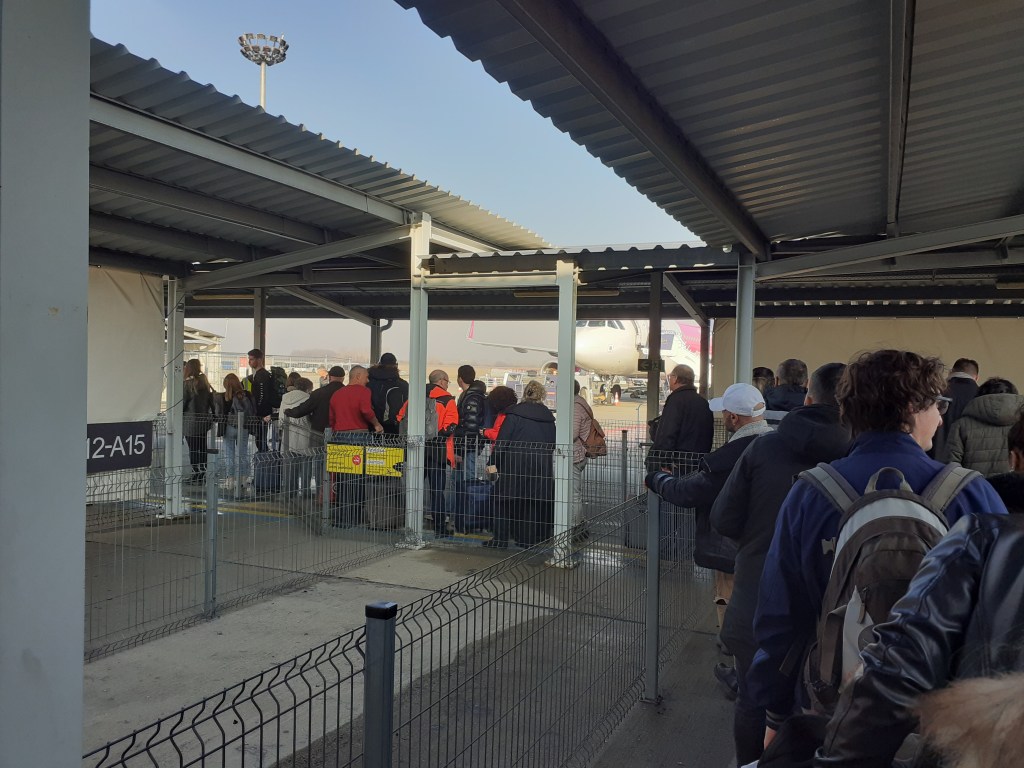
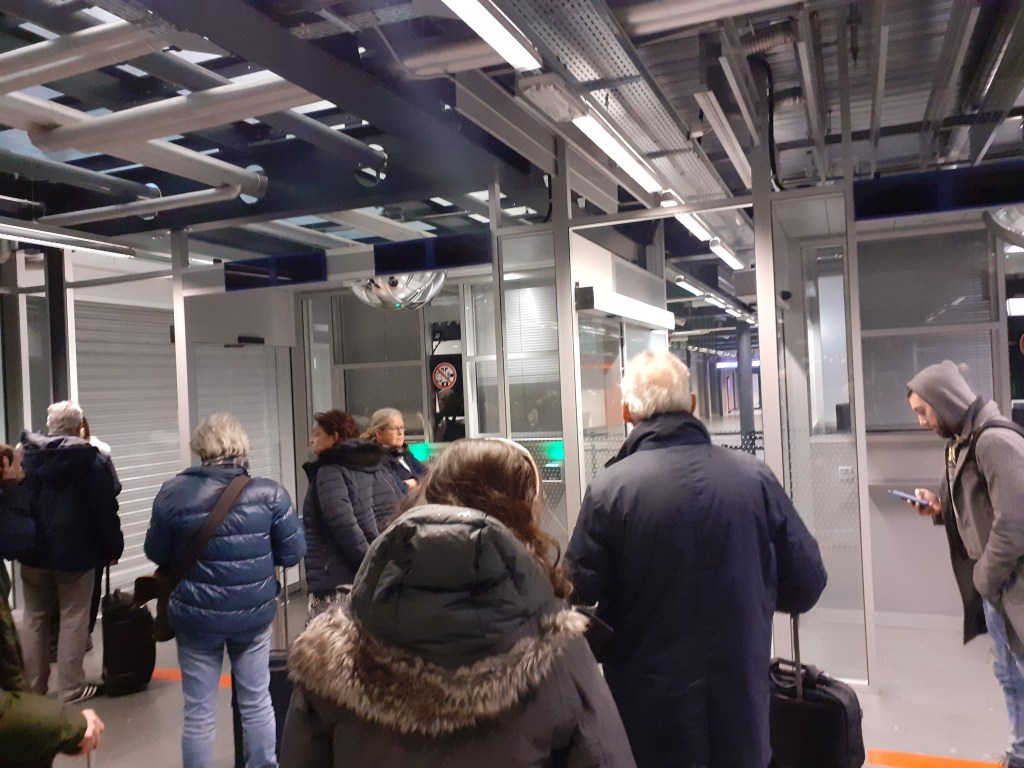
In Geneva the staff for our entrance into the airport (we walked across the tarmac from the plane) was nowhere in sight. Perhaps they had just forgotten about this whole flight, but the whole plane of people had to wait behind the closed glass doors for 20 minutes before word got through to some security people, and one to another staff member who ended up just opening a side door and letting everyone through.
I met Anselm, and spent the night at his family’s apartment. I realized that I had assumed several things about the weather in Geneva because I was surprised by the relatively warm temperature and the rainy weather. It was relatively similar to the winter weather at home around Seattle.
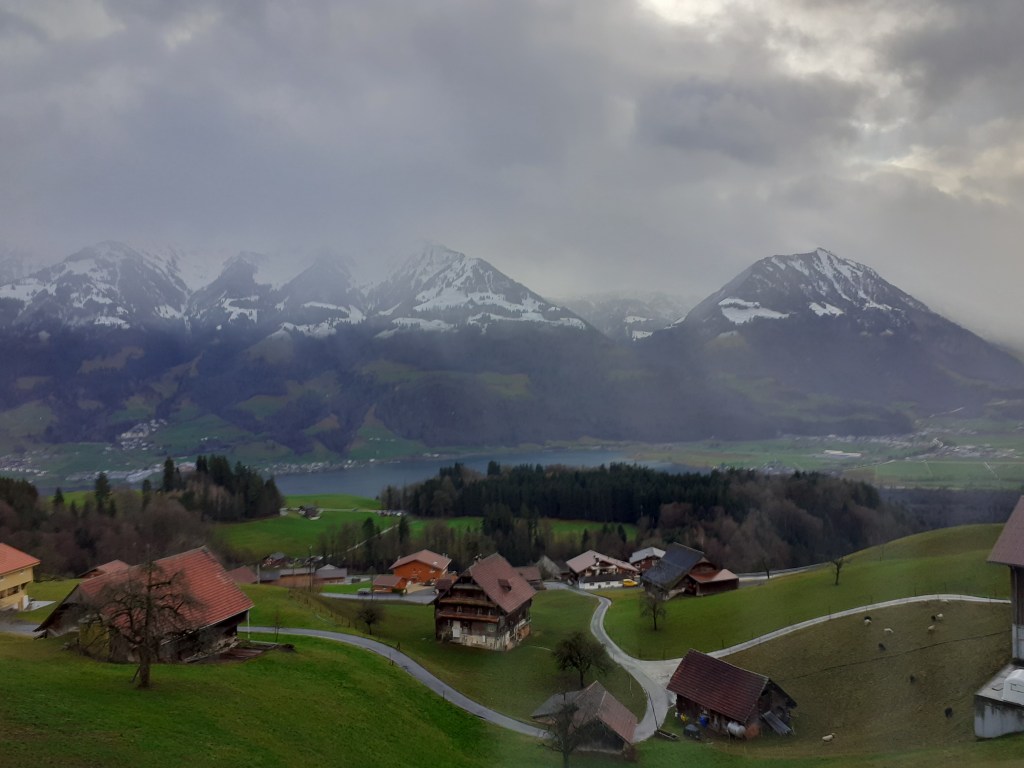
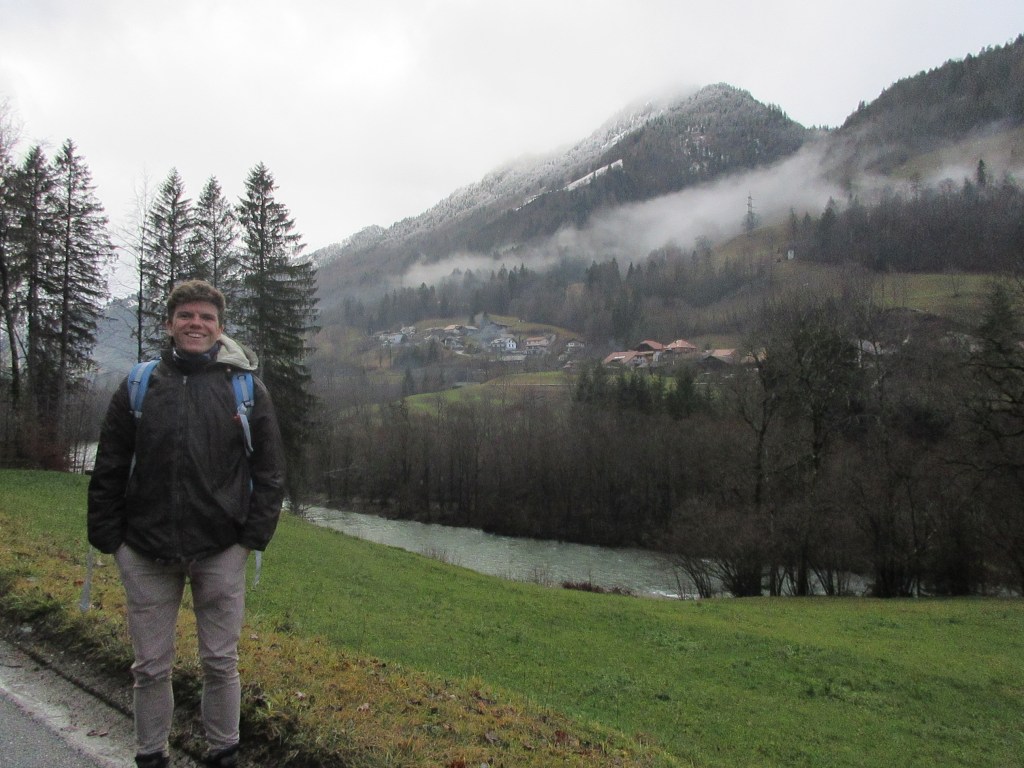
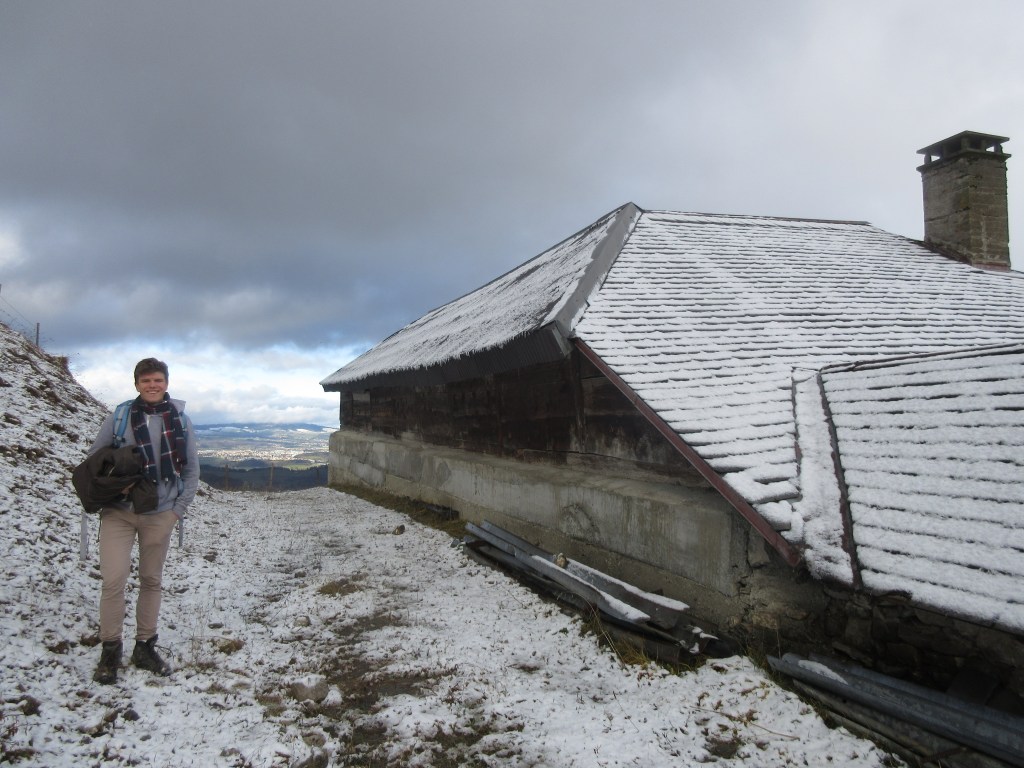
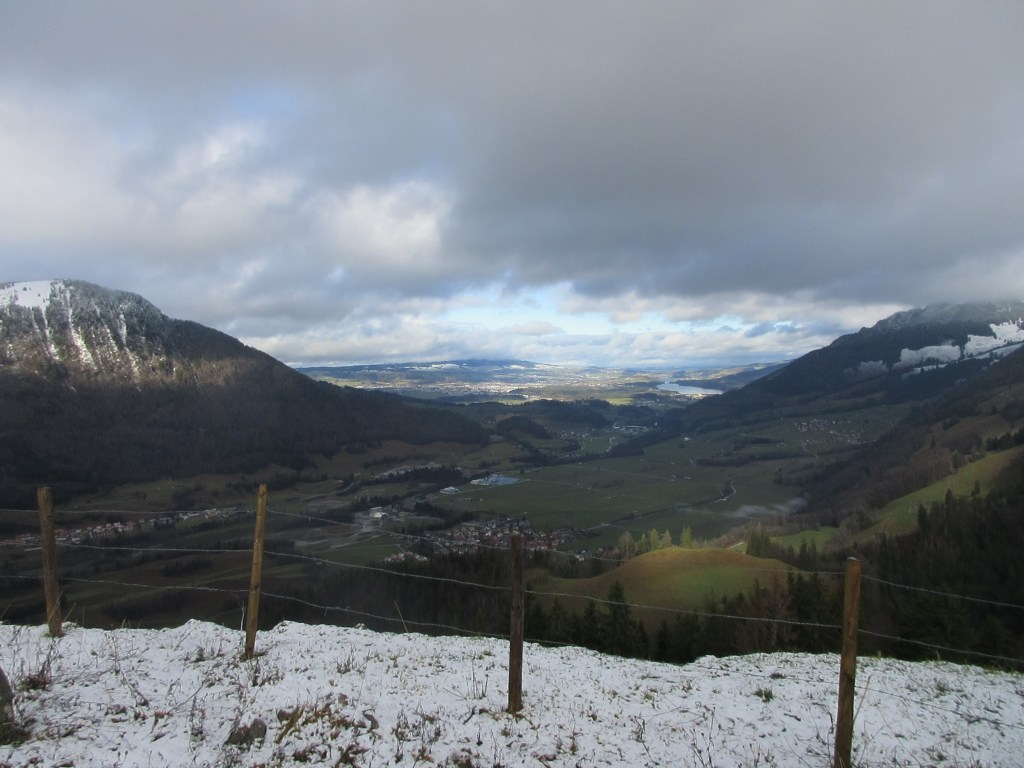
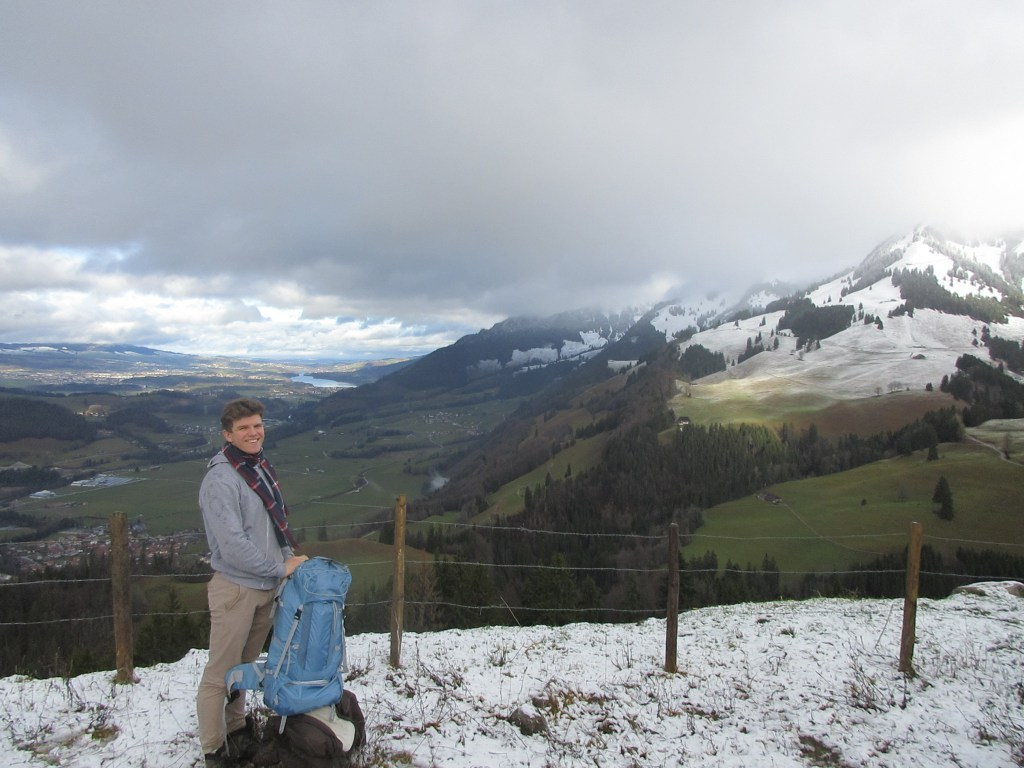
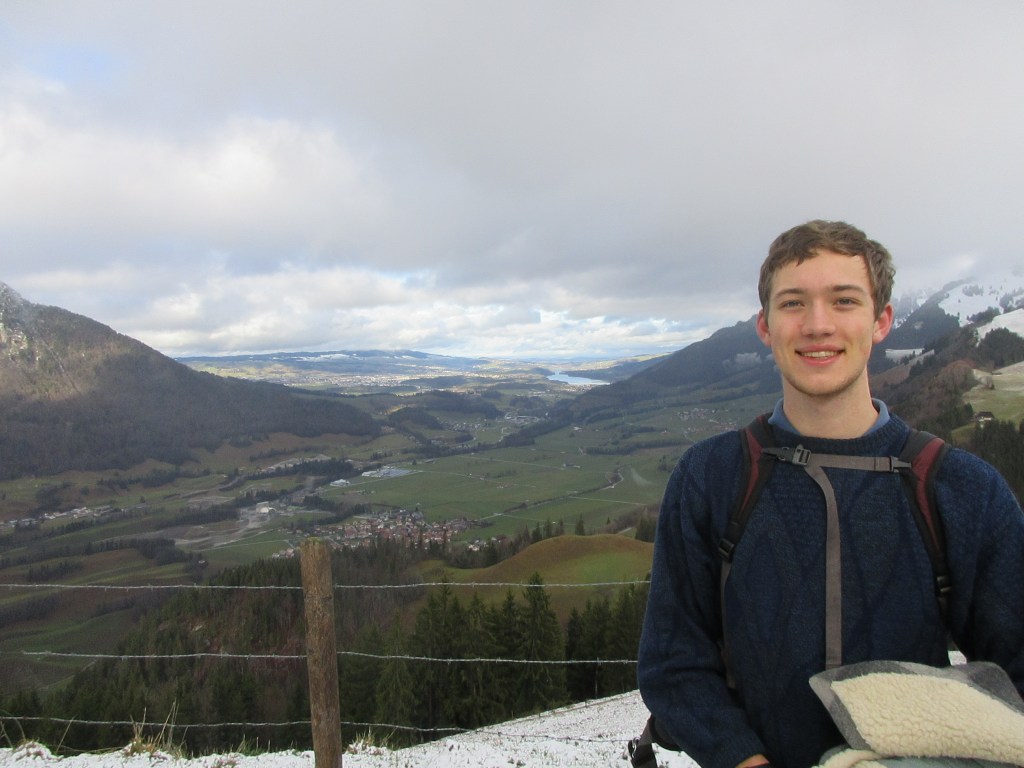
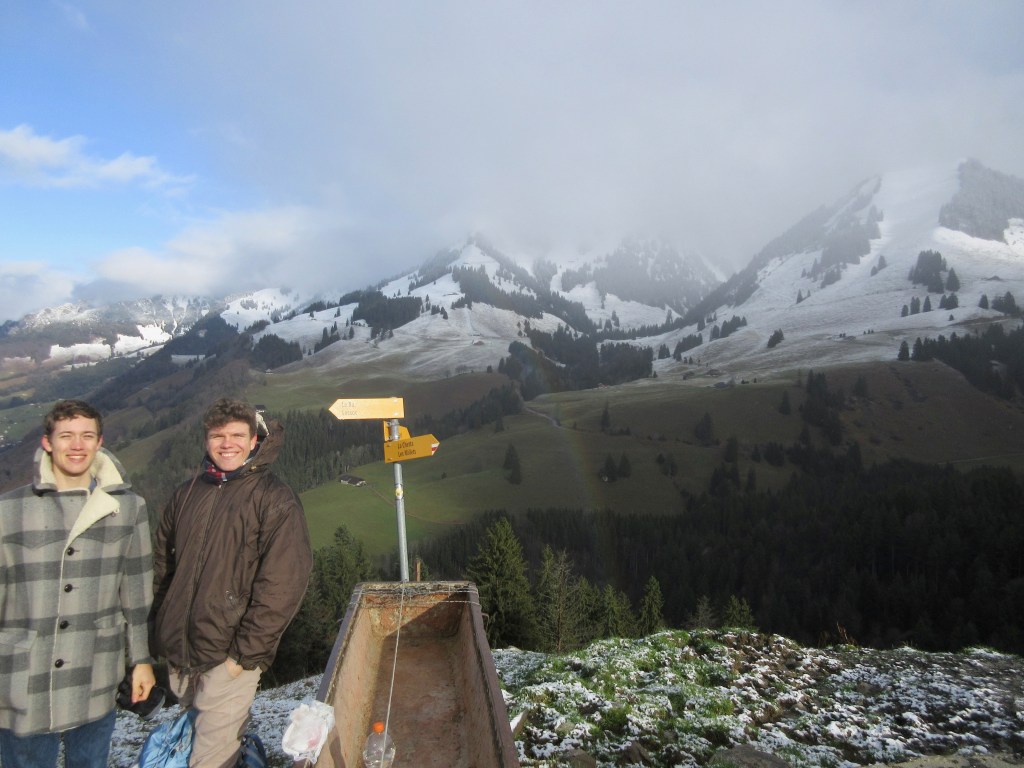
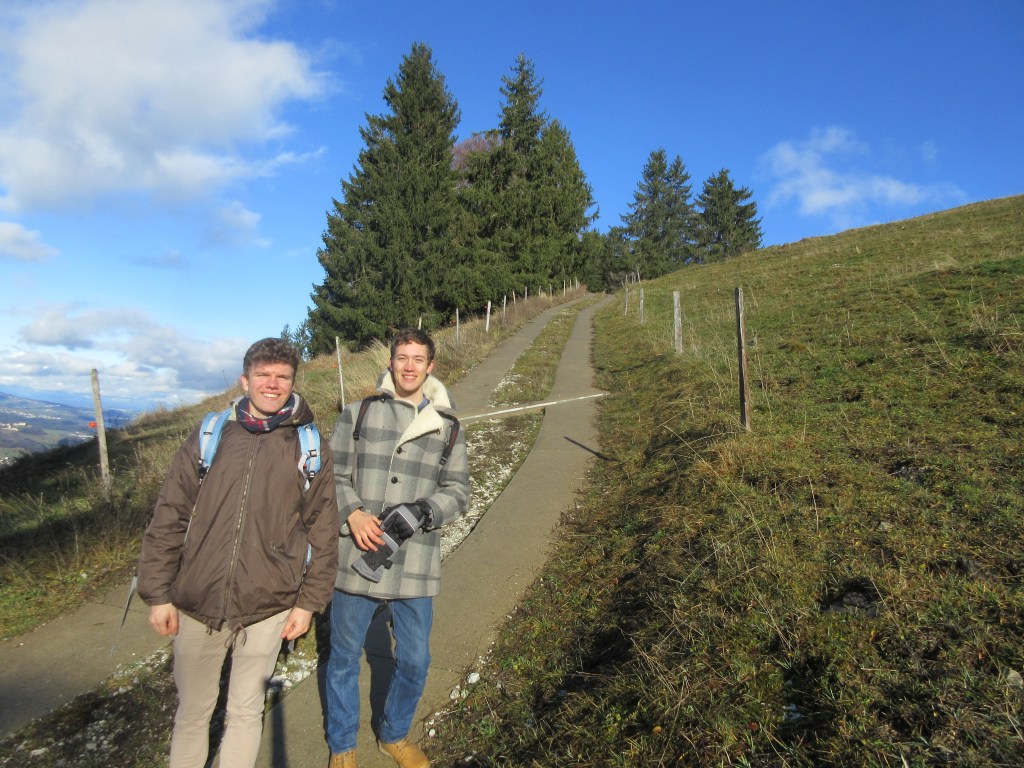
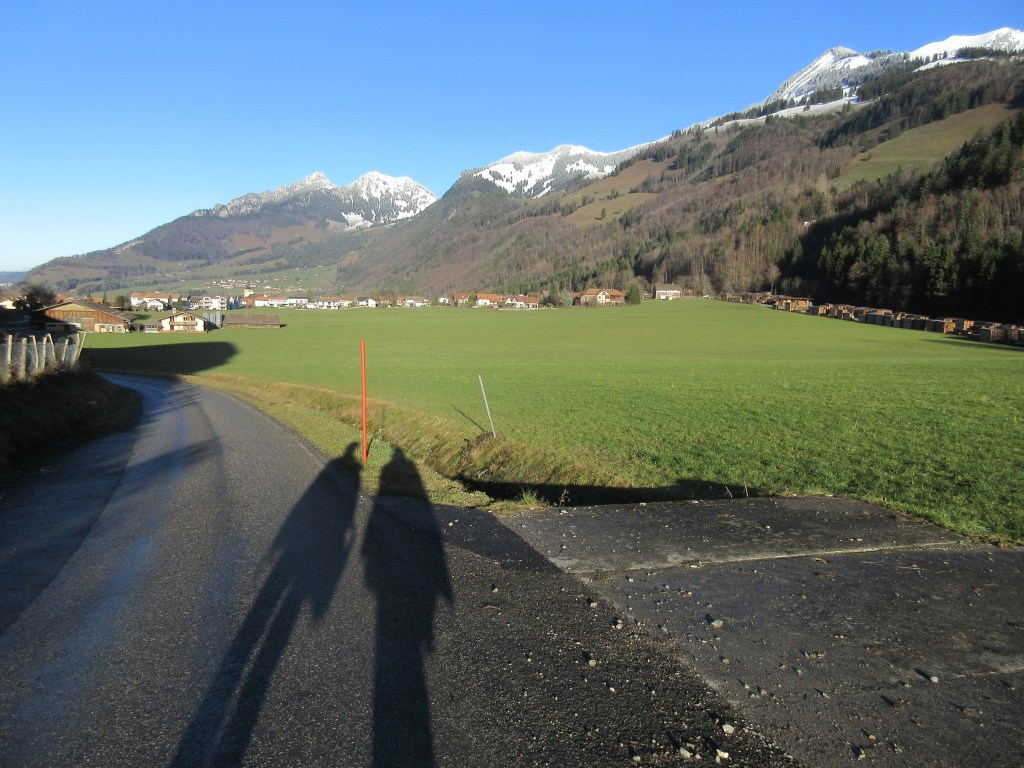
The next day we took a train to a small, non-touristy village in the mountains called Grandvillard, by Gruyères (like the cheese), and hiked up to a high point, starting on a small road, and eventually continuing up over a fence at the dead end of a steep path. We had lunch up on a watering trough for the cattle which are herded up in these mountains during the summer, and got a quite good view as the clouds cleared completely out. The stars (or rather, sun, clouds, and snow/rain) aligned, and we even got a rainbow added to the already beautiful scene.
We headed back on the road going down a different way from where we’d had lunch, and ended back at our origin point after 1.5 hours or so (we had a bit of an adventure and detour trying to find a bridge over the river, which included some bushwacking). We both agreed that this all was much better than any museum visit: exploring around on the ground really gives a nice, direct taste of a country.
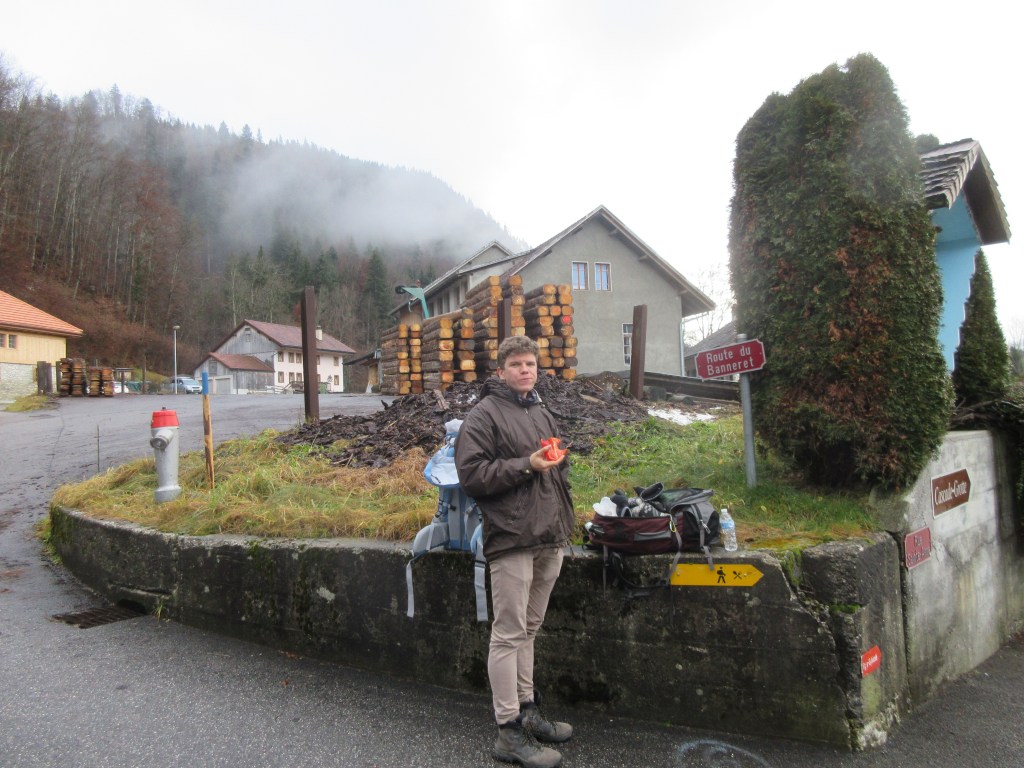
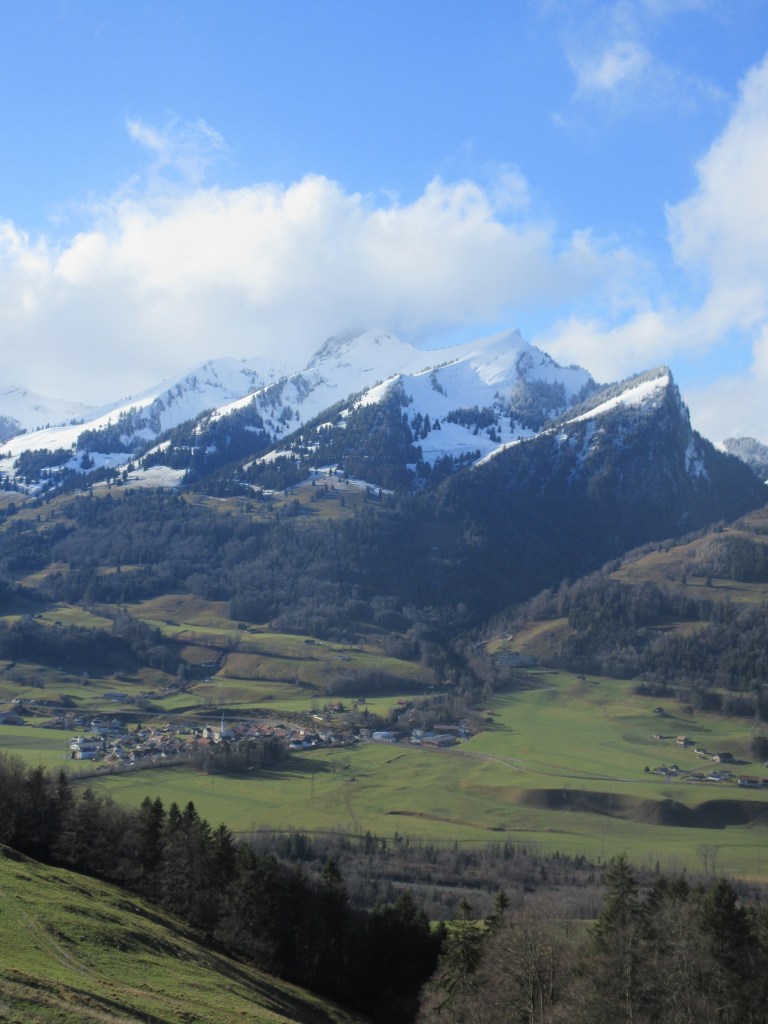
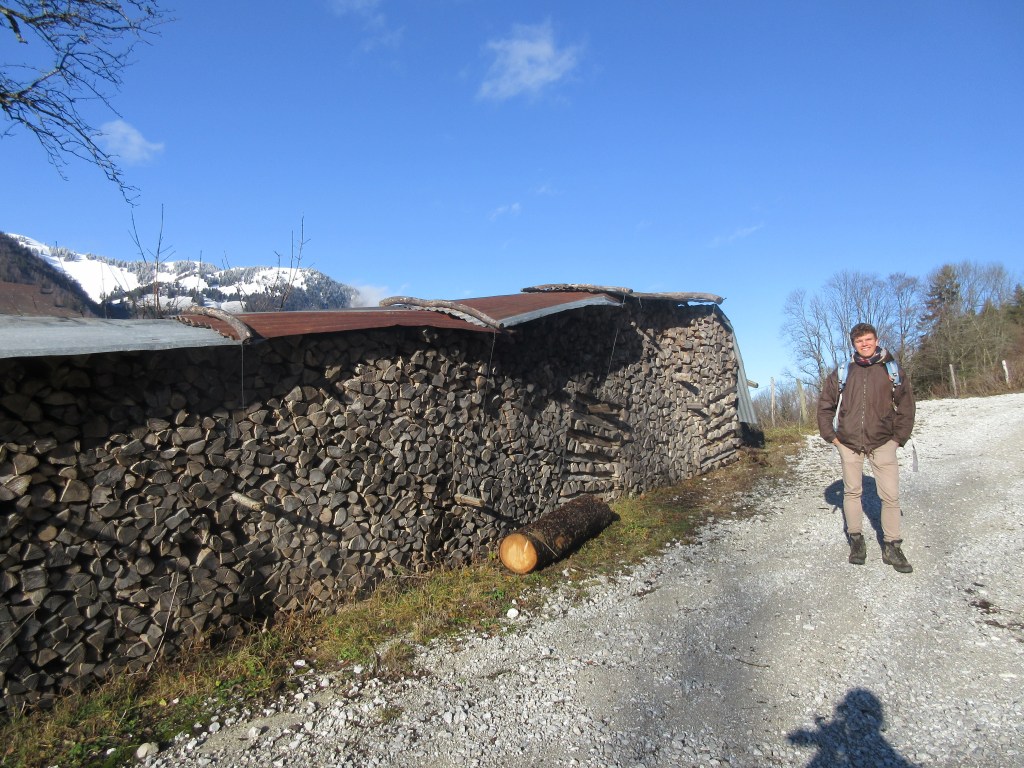
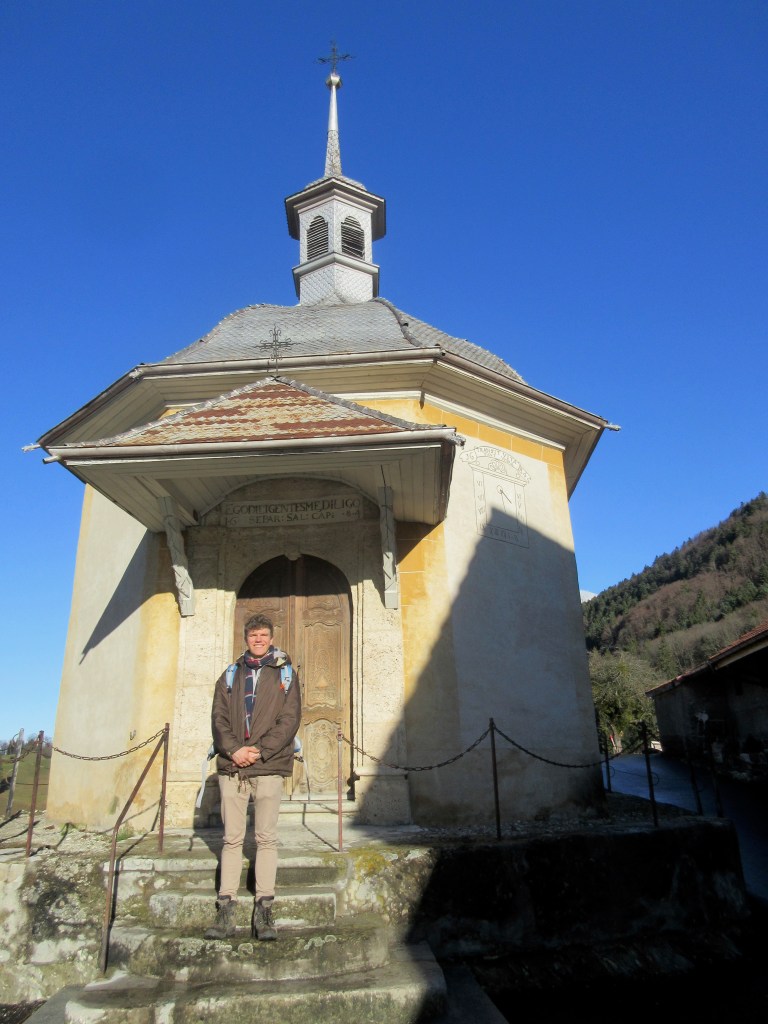
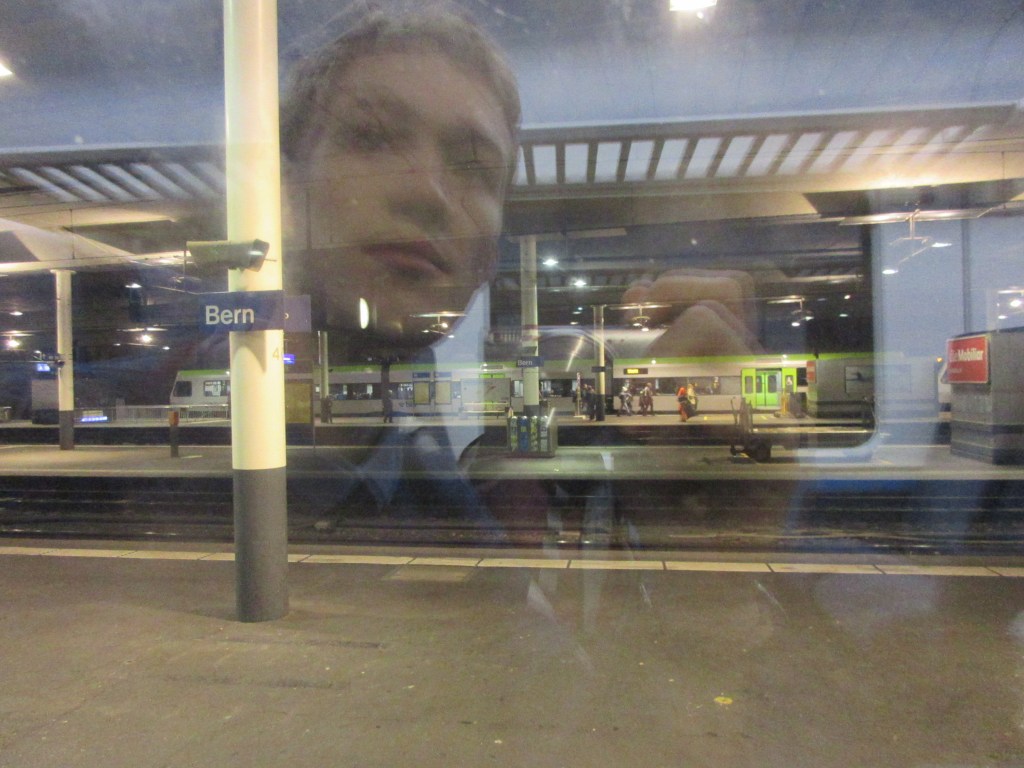
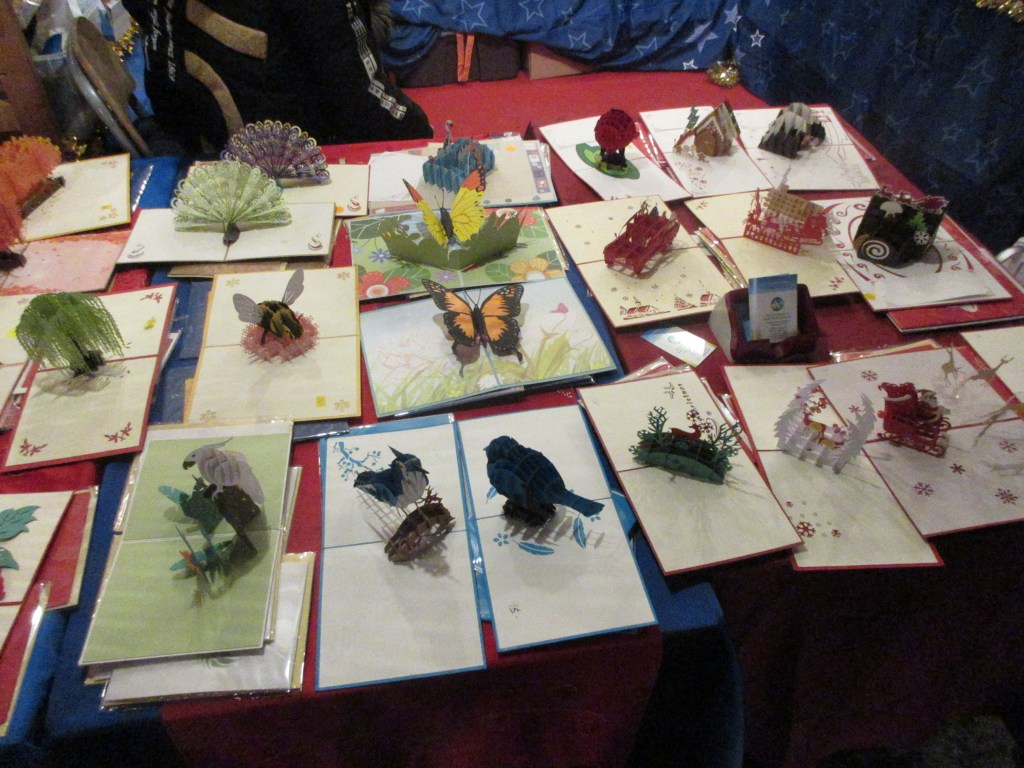
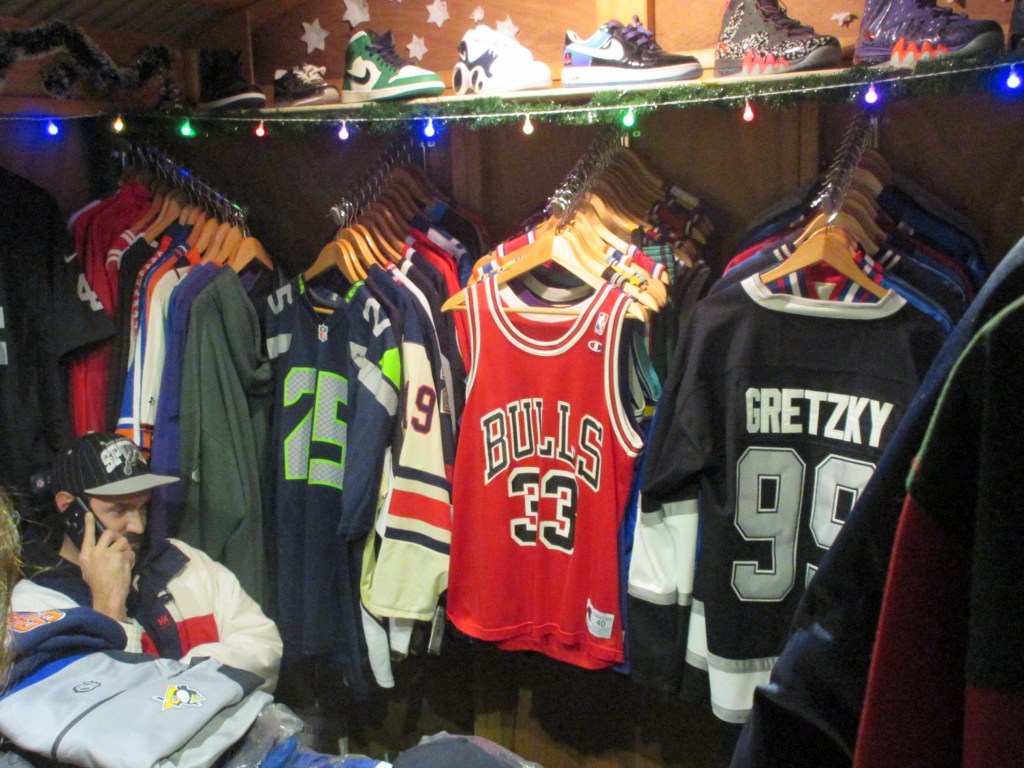
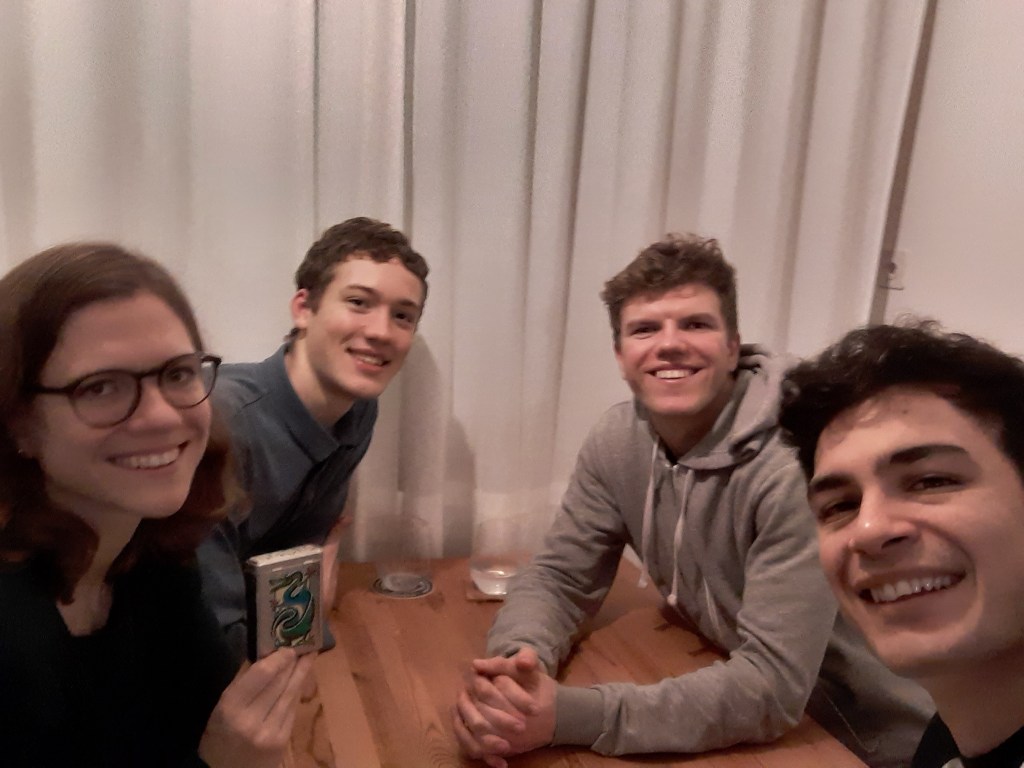
Had a very nice lunch, with Anselm’s favorites: dried whole bananas and sweet whole bell peppers. I got to fill up my water bottle (which I realized was the one I’d crunched up with to a gallon jug and brought from the US) from a water trough/spring in the village with pure Swiss mountain water.This little shepherd’s hut was at our highest point for the day.See the rainbow! It was 10 times stronger in real life. This is where we had lunch.This is looking down at one of the villages in the valleyI could do a whole separate post on the universal impeccability of Swiss firewood stacking. This is DEFINITELY an indicator of their cultural priorities. Another thing that Anselm pointed out is that the roads, even service roads up in the mountains do not have any cracks, and are all very well maintained (unlike the French roads “across the border 🙂 ) ALL the firewood I saw was this neat, whether it was out in a field, 1000 meters up in an isolated mountain forest, seen in someone’s garage, etc. Note the way that they build the ends of the stack (which is a bit different than my family does at home. There’s more of an arc leaning into the rest of the pile)Here’s a very old little chapel in one of the mini-villages on the way down the mountain. The date on the door is 1778; 1684 above the door.going across the fields and bushwacking trying to find a bridge across the riverThe bridge we were looking for was nonexistent, so we looped back, went down a steep hill, hopped over the fence onto the road, and got back soon to Grandvillard. Note the, again, impeccably stacked and organized lumber at the right of the picture. Everything is organized in this way: even where there is a mass of various things (as we saw in some warehouses from the train), when you look closer everything is neat.We stopped in Bern, and saw the Christmas market for 20 minutes, on the way to Basel, where we stayed with Clarissa Anselm’s sister and her boyfriend Daniel.These are some amazingly detailed and elaborate pop-up cards that were at the Christmas market in Bern.For all those Seattlites… 🙂 I wasn’t expecting to see a Seahawks jersey in SwitzerlandFrom left to right: Clarissa (Anselm’s sister), me, Anselm, and Daniel. They taught us TICHU, a swiss card game (a very good one), after being treated to the Swiss dish Raclette (basically melted cheese poured over potatoes). Liking cheese as much as I do, I’ve basically made something like Raclette this past semester: now I’ll be replicating it on purpose when I get back to Hungary.
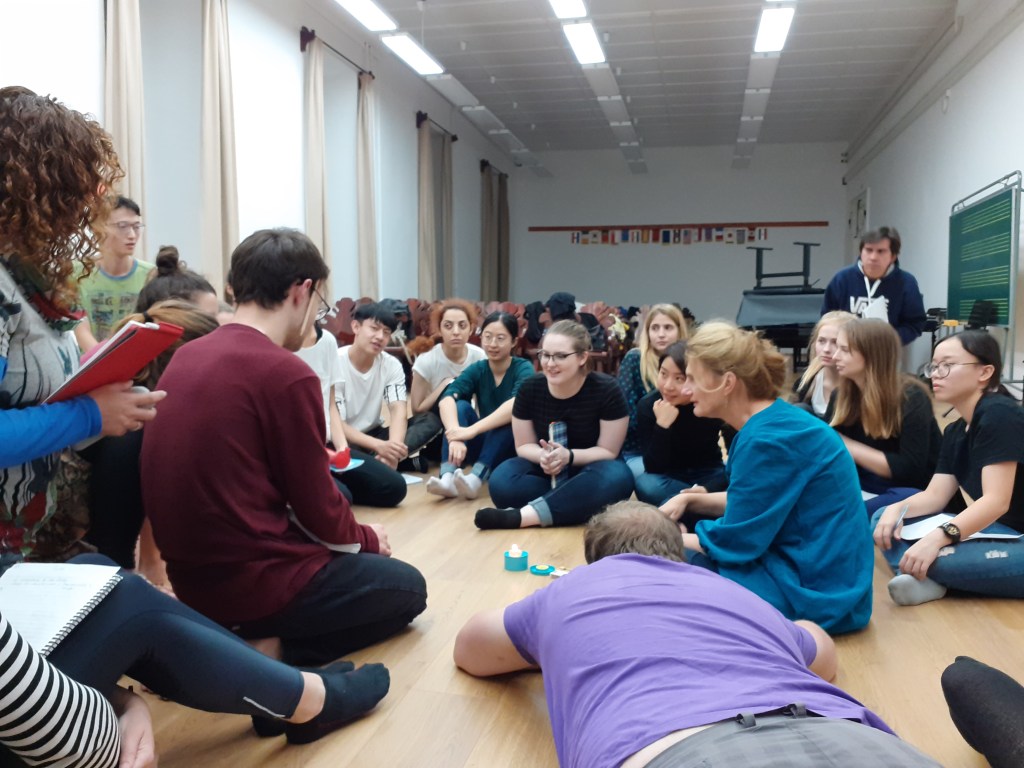
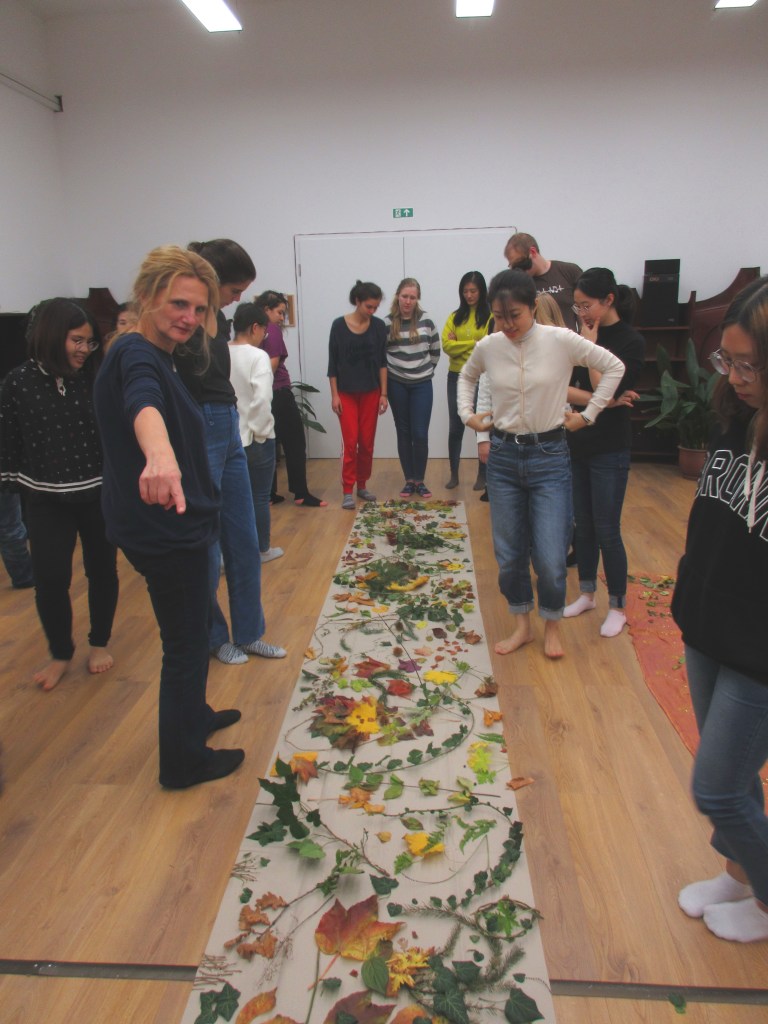
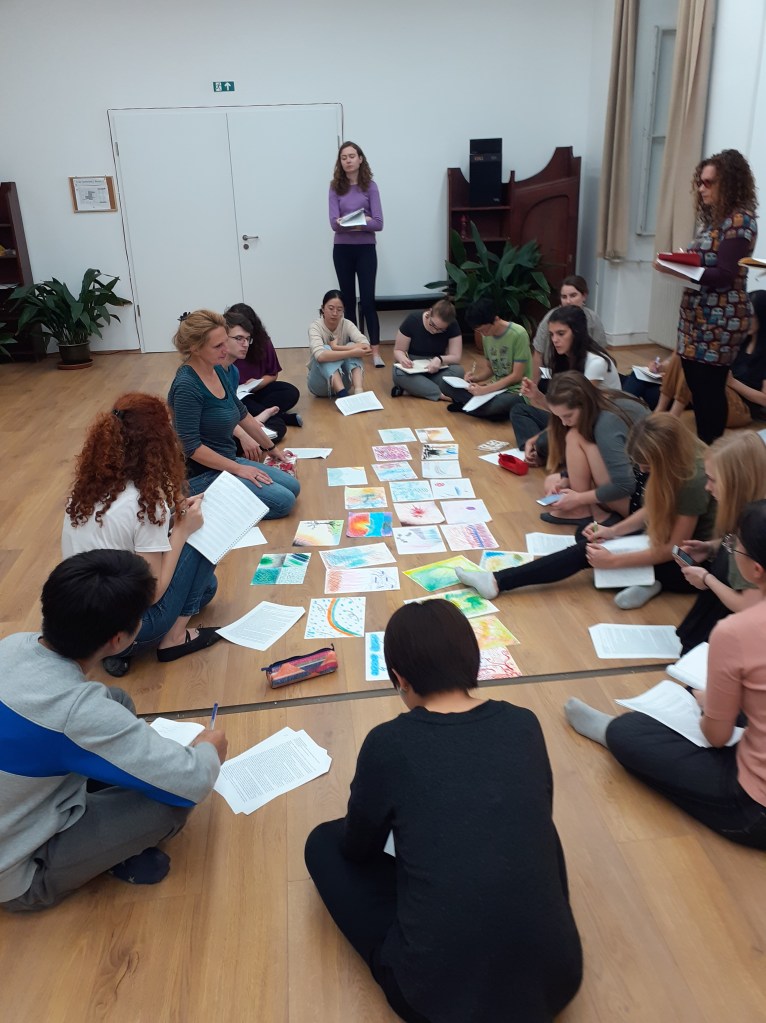
Every Monday at 5pm about twenty-five of us gather in the Concert Hall, take our shoes off, and spend an hour and a half with Katalin Körtvési (also my Solfege teacher) immersed in Kokas pedagogy. What is “Kokas”? Klára Kokas, one of Kodály’s students, “saw the need of children for movement and self expression” in the music education programs she saw. She developed a mode of interacting with music that for us has melded spontaneous creativity, music listening, free improvised movements, and profound self expression, all generally through the underrated avenues of non-verbal communication. Kokas said “I could use the children’s imagination to help their movement…the movement is a tool [that] helps us to absorb the music. You can observe the deepest, heaviest music if you listen to it that way.” Specifically, she was looking for movement not for the “beauty of the move or look of the movement,” but for “the wish, the dream, the longing for self expression.”
When I was asking one of the second-year students about Kokas, she said that it is not uncommon for people to drop the class in the second semester, from something like “creativity overload.” The class definitely doesn’t allow for any sort of calcified grownup-ism (I think of The Little Prince by Antoine de Saint-Exupéry). I think it is brilliant.
Here are a few stories of the classes from the summaries I’ve submitted, and a few pictures.
This past Monday Kata paired the music listening portion with a bag of leaves and a blank slate.Another pairing with music listening. Notice how many different experience of the same music there are.
7 October 2019
“We came together as a class physically at the beginning with the Bluebird Through the Window song, during which we joined hands and created a “snake” that wrapped in and out of itself. We all got tied up in a knot, which then gave us all the opportunity to solve the puzzle together and unwind the knot.
For the second part of the
lesson we played another naming game, where each person spoke their name in
whatever character and with whatever movement that they chose. It was
impressive to see how perfect the connection was between the person and the
performance of their name. Each seemed like a symbol that encapsulated the
essence of each person. After one person spoke their name, everyone else would
repeat it as accurately as possible. We were practicing putting on another
character, as well as appreciating each individual through their name. Kata
emphasized the importance of imitating the facial expression as well as the
sound of the name and the movement of the body. We were encouraged to notice
every detail that made up the aura of the person. When I think about it, this
sort of game is a profound way of getting to know other people, because instead
of labeling ourselves with words after words, and facts about ourselves, the
form of self-expression through one’s name gives a window straight into who a
person is. Each name is like an excellently written short story.
After one time around doing
this with the names, we continued around again, but this time all silently, and
replicating each person’s name by memory. Considering how appropriate to each
person their “name” was, perhaps I should not have been surprised at how easily
we had immediately memorized the “name” of each of the 25 or so people around
the circle. In the next two repetitions (an important element in each of the
classes), we played around with different ways that we could change the
expression of the “names” while still keeping the character: faster and slower
tempos, and silently. For this Kata instructed us to do our name at whatever
was the natural ending transition point of the previous person’s. We were not
to explicitly change our “name” to pass it along to the next person, but just
be aware of the people around us, and connect the continuity of their name to
the continuity of our own.
The last segment of the class
was of course music listening with movement. For this Kata told us all to find
a partner and choose an “A” person and “B” person. The excerpt of the music was
repeated several times as usual with occasional changes of Kata’s input for our
movements. First the instructions were for the “A” person to lead, and then the
“B” person the next time. As Kata reminded us, leading did not have to mean
mirroring. Then over a few more repetitions it was for both people to lead and
follow each other in an organic way. For the last times Kata opened up the
parameters so that we could either choose to stay with our partner or move to
others as we pleased. All of this for us was done without language, so all our
communication was based on a heightened sensitivity and awareness of ourselves
and of the intents of those around us.
Afterwards, Kata put forward
several ideas and questions inspired by the exercise. Really, they were
questions that each of us had engaged with and come to terms with just by participating.
In my opinion, to have such profound questions at the core of something is a
testament to its value. What we were doing in Kokas was not just music
listening or moving, but in many ways an exploration of philosophy and self
knowledge.
Which is better for you, to be a leader or to be led, or to
lead and follow together with another person?
How well are you able to give up the leadership role or
remain always the boss?
How well can you change yourself in this way and remain
confident?
Were you really able to listen to the music with your whole
body, or just come up with a movement and stick to it?
Did you build your movement to to music yourself, or just
imitate someone else?
Which is better, to be with one person (lead & follow),
or to work with others?
Were you able to lead someone without touch?
What does it mean to touch someone? With your soul, heart,
eyes?
Are your fingers, hands, eyes, head, etc. strong enough to
lead someone? Even without physical touch?
Which is stronger: physical touch, or the non-physical ways of touching?”
14 October 2019
“As so many of the Kokas classes have begun, this one started organically with no explicit directions. Without language, we all simply saw what Kata was doing, and followed all the non-verbal cues. It is a good reminder of all that can be “said” and done even without, or better without speaking. We were all in a circle, with Kata in the middle. She began walking around and got one person to join her. Gradually those in the middle drew in more and more people from the outer ring until the whole group turned upon the last few that remained and engulfed them. The activity had developed and formed an identity in the way that the first few people walked, looked, and expressed themselves in the center. First it was two or three doing the same thing, and as Kata and the others added little impulses and motifs into the drama, more complex relationships and unspoken narratives appeared. These included the expression of many emotions, moods, body percussion, singing, etc.
Once this all had run its
course and everyone was milling about in the room, Kata began singing, and
transitioned everything over to “Oh how Lovely is the Evening.” As she teaches
the song, she plays around with what character she (and then we) sing the
phrases in. We are constantly molding ourselves into different characters and
exploring how these different characters shape what we are doing. In a very
short time we had all learned the song, and were singing it together. We all
began to walk in a big circle, with nearly all of the people going the same
way. It was interesting to see who were the small minority that walked the
opposite direction, or even sometimes moved outside the circle pattern. Kata
initiated canon singing be starting in canon herself, upon which a subset of
the students joined her. An even smaller subset started and sang a third part
to the canon.
As this reached a point of
completion (with us all following Kata’s lead as she slowed and quieted her
singing), Kata began a naming game, where she performed her name in both speech
and action. Soon we all were doing the same with our names, at which point she
added the impulse of sometimes imitating someone else’s name. This developed
through all the students. As we ended, there were 4-5 “name” groups of varying
sizes. Again, it was interesting to see whose names these were centered on, as
well as the kind of expression that each had. Kata mentioned that it was “good
that it wasn’t just one” group!
Kata asked what kind of
building would go with the song, and after someone said “church!” we
incrementally built one with ourselves. Some were the doors, some chairs, some
windows, some the organ, alter, etc. Both Kata and students suggested what they
could be, and once everything was in place she brought in every character set
by set until we all were singing (in some cases characters were shifted: chairs
to congregation, etc., so that they could sing). We then sat down, and had an
imaginary meal, food suggested by all. It was a very realistic representation.
Some people wouldn’t have liked the food in real life, or would have been
allergic to it, so they acted accordingly. The fish chowder put forward by Lara
got mixed reviews, even by Kata. We stayed authentically ourselves.
Then, we had to form a bridge
because Kata looked out the doors, and “saw” that we were surrounded by water
(instantly populated by some students as alligators as soon as they heard
this). We all had turns going under this
bridge, where we sang the song again in the way that each person went through.
At the end, music listening
and dramatization. As usual, we listened to the segment multiple times, and had
several “goes” at it. However, the instructions from Kata were to move opposite
to the music, and then after a few repetitions, that we could choose to move
with it or still against. At the end, Kata observed how some experimented with
different kinds of opposition that paired with different aspects of the piece,
and that moving contrary to the music really required us to concentrate it, to
determine its particular aspects to go against. We “maybe don’t have to focus
so much on what is in the music when we move with it,” said Kata. I found it in
many ways easier than moving with the music, although this also depended which
section of the music I was in. I found that the calm section was easier to pick
up and appose than the second bit, which was quicker and had more moving parts,
and more possibilities for segmentation.
A few student “performance”
of what they had done concluded this session of Kokas.
Theresa and Despina were
polar opposites, one calmly apathetic and the other frantic, who switched roles
when the music changed in the middle.
Clodagh and April found
themselves shut in glass boxes, and tried to get out. Clodagh broke out, but
neither she or April combined could open the box that April was in. Clodagh
tried an ax and a key, but neither worked. However, April eventually stopped
struggling to get out and fell asleep, upon which the box became unlocked. The
symbolism here is interesting to consider. The drama ended with a tea party.
I (Samuel) had the last performance. To the pacific music at the beginning, I acted contrary as an awakening butler of sorts who briskly and bruskly prepared my toilet and dressed. As the music changed to a faster tempo, I became calm and in my element, unlocking doors and straightening curtains: I was preparing the room. However, near the end I realized that something was wrong with my shirt, and after much debate with myself, hid behind a floor plant.
16 September 2019
Reflection on four
open expression dances
While the
subject matter in each of the dances performed at the first Kokas class was
varied, each seemed to have similar thematic complexity as those in folk
stories. The psychologist Carl Jung
believed in a “collective subconscious,” and I would argue that as we
put on our “childish skin again” (Kokas) and reconnected with our innate
creativity, the motifs of our humanity from this so called “collective
subconscious” rose to the surface in the same way that they did for folk tales.
In Teresa’s
dance, she appeared to take out materials for food, and to start mixing the
ingredients together on the ground, while showing another girl how to help.
This transitioned into motions like kneading dough. The climax of the music was
reflected as the two attempted to carry the huge weight of what they had been
making. They seemed to have created more than they could handle, because there
was a degree of tension over the division of the labor, and in the end their
level of cooperation could not really match the weight of their load.
In his dance, Gareth appeared to wake up into
consciousness in a world of fantasy, with a few sprites moving around him,
blowing something sparkling out of their hands and then eagerly watching it as
it floated away on the air. Gareth’s character appeared at first to be glad to
join the sprites, but his joy in what they all were doing seemed to transition
into selfishness. He seemed to want to keep some of that beautiful material all
to himself, although it was not his to keep to himself but only to enjoy
without ownership. The climax in the music coincided with his efforts to snatch
the spangles from the other sprites as they continued playing with it.
In my
dance, my character woke to consciousness in a strange and empty room, without
any sense of the time or place, and with his feet stuck to the floor. After
struggling to free himself on his own and calling for help, Despina arrived to
the rescue. With our combined efforts she was able to help me out of the area
where I was stuck. Although my feet were then free, my hands had become stuck
to hers while we worked together. At the last moment, we pulled apart from each
other.
In Franklin’s dance, his
character met Alvaro’s. They shook hands and were very cordial to each other.
However, they shifted over to the window, where it soon became clear that
Franklin’s character was trying to get behind Alvaro without his knowing it, to
push him out. Alvaro began to sense something wrong, and as the climax of the
music got closer and closer, they both began to try to slyly push the other out
of the window. The other would look back at just the wrong moment, and so the
antagonist would put on a sweet face and pretend nothing was happening. This
dance of dishonesty continued until finally at the end of the piece, Franklin indicated
that he had successfully pushed Alvaro out the window, to his apparent death.
Each of these dances dealt with different forms of human relationships and how they play out. The situations were different as well as the outcomes, but the core to each story was the interaction between the central individual and the secondary character. The representations of these interactions were surprisingly complex and true to real life. The solo beginnings (and often endings) to the dances portrayed the isolation for individual that exists even through cooperation. Theresa never could perfectly meld with her partner to equally cooperate in carrying the load. Gareth was born into a peaceful, wonderful world, but this was ultimately corrupted by individual selfishness. In my dance I was alone in the beginning but was only able to move through the relationship with Despina: “No man is an island entire of itself” (John Donne). Relationships were necessary for each of the stories, but for each there was the complexity in the interaction of individuality and cooperation.
TILL NEXT TIME! (Expect lots of good pictures from Budapest and Croatia)
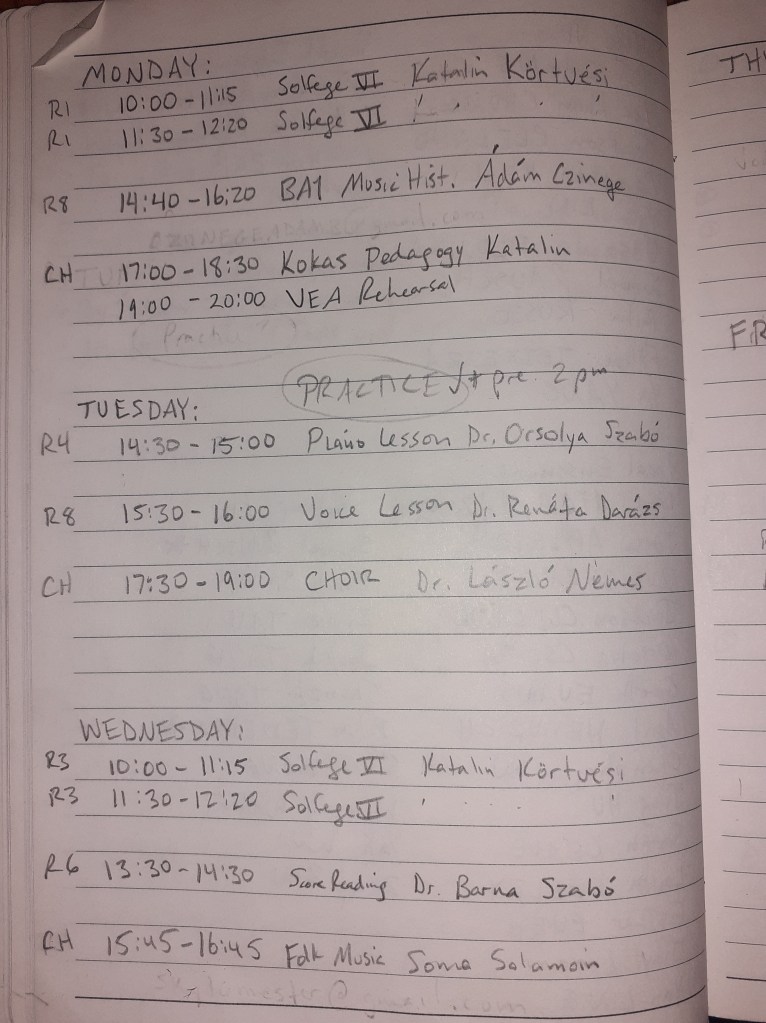
I placed into Solfege VI, which is the highest regular solfege class this quarter. There are six level, but Solfege V is specially for the Chinese students, and is taught in Chinese. It is nice because two of my roommates placed into Solfege VI as well, and the third moved up this past week, so all four of us are going to be doing the same things there. There are 11 students in the class, and it’s fun to think that our flat makes up a third of that. I’m glad that I’ve gotten roommates who are at a similar level as me.
We have 5 hours of Solfege every week. Of all the classes it is probably the most overarching musicianship development class, with many threads woven together. It is impressive to see how every part of Katalin’s lessons fit with all the other parts, and seamlessly build and transition from beginning to end. In the Institute I think it is relatively common for the more senior students to sit in on a class just to observe the teaching style of the professor. There are definitely some very good role models on the faculty.
I think homework assignments tell a lot about a class, so I’ll include some of mine here.
Sing and play a canon learned in class in canon with yourself, in solfege syllables (do, re, mi, etc.) and then letter names (C, Cis, D, Dis, etc.). Do this in the original major key, then in minor, then in locrian (the mode that practically no one composes in because it sounds unstable). Do this all 2-3 times, with the same starting pitch for each set. Be musical
Play the beginning chord progression of the Schubert in several keys in both major and minor
Sing and play the first page of the Pergolesi Stabat Mater by memory (just the two vocal lines with the chord outline in the bass), and then continue by playing the walking bass and soprano lines on the second page while singing the alto part.
European Music History class with Ádám Czinege is very good. Although there is a similar class with a larger group of the diploma students, I have one with just the other two BA1 students, Teresa (Portugal) and Jae-eun (South Korea). Ádám has said that we will do a sort of spiral learning: we’ll go over the history timeline several times, each time with greater definition. I think this structure will be very good for getting an understanding of the overall progression into long term memory.
Listen to two pieces of music per week and write up a short response to each. The purpose of this is largely just to develop a broad palette of repertoire. (This brings to mind all the professional musicians I have known to say how important active listening is)
Give an end of the semester presentation–topics TBD
Kokas is fascinating, and a bit crazy compared to the other classes–it is a method to interact with music and develop creativity (among other things) in a largely kinesthetic way. I’ll post my homework for that in a separate post (a reflection on the first class). Katalin (my solfege teacher) is the teacher for this.
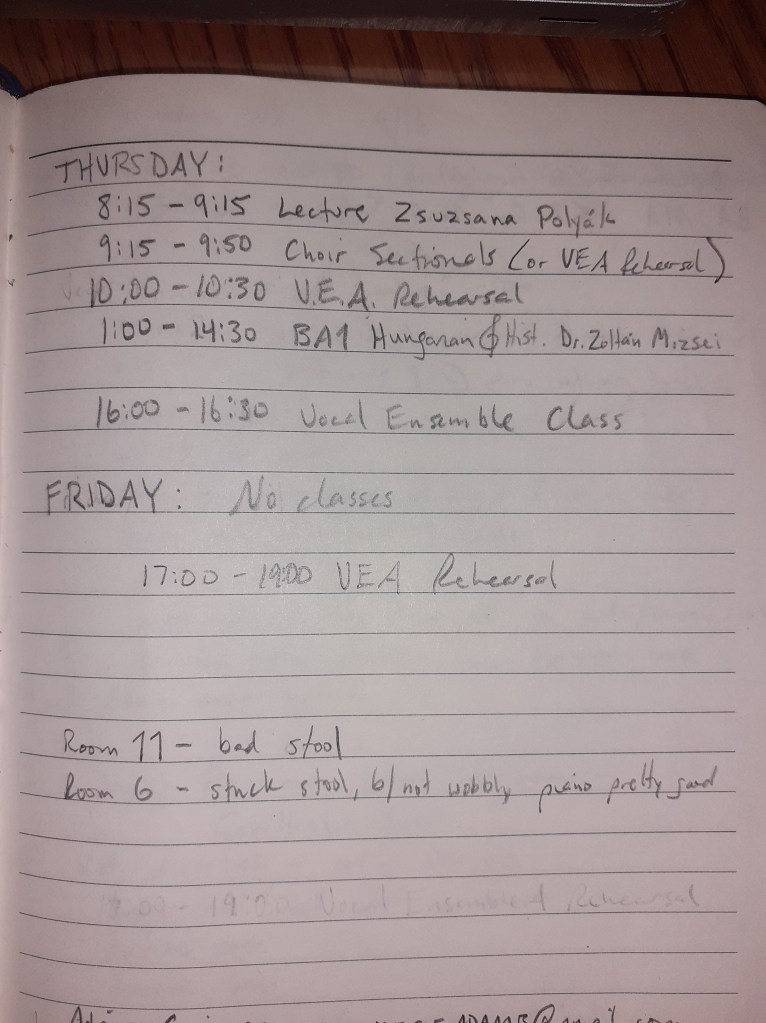
“VEA” stands for “Vocal Ensemble A”. I’m in a group of 5 (SSATB): we were the first group to get put together on the first day (hence, VEA). We set up a few hours of rehearsal every week, and then have 30 minutes of training with the wonderfully energetic and eager Dr. Árpád Tóth. This has already been a lot of fun, especially because all our five voices fit together well, and we all are able to handle the music. It was funny because Árpád told us right away that he could tell we had all pretty much just sung in choirs, just by each of our approaches of where we tried not to breath (i.e. to a certain extent, our attempts to do stagger breathing on an individual basis!). We sound good already, he said, and I am really looking forward to learning more and more about the stylistic aspects of good ensemble singing.
Another thing when we were rehearsing on our own: we confirmed a suspicion that not all of our tuning forks matched. Our tenor had an A442 (what?!), instead of the regular A440. Of course the first thing we did on finding this out was to stick both up to our ears at the same time and cringe.
My piano lesson is fantastic. The slightly eccentric Orsolya Szabó is wonderful at creating a focused but non-stressful atmosphere to her teaching. I’ve memorized Il Penseroso (Liszt), have started in on Bach’s 3-part invention No. 2 in C minor, and also have the Beethoven Sonata in c-minor, Bartók Hungarian Dance No. 1, and a Kodály piece on the list.
The “projects for the semester” in choir are a Christmas concert, and Faure’s Requiem. It has been interesting and informative to see how Laszlo Nemes applies solfege to the score. One of the purposes of “movable-do” solfege is to inherently reveal the harmonic structure of the piece, and Laszlo’s way of applying the solfege does this better than anything else I’ve done.
Score reading is an individual lesson: it is not easy, but so far the most fun. My assignment this week was to read through 30 excerpts of music that use at least one C clef (to learn the clef), and to play BWV 628 (Bach), but with the alto and tenor lines switched: alto line played down an octave in the same hand as the bass, and tenor played up an octave in the same hand as the soprano. It’s a very satisfying mind game.
That’s all for now! The folk music class had an amount of tangents in the discussion that require more time, and another post. Also, there’s the class on Zoltan Kodaly and his philosophy.
Also, there’s the non-academic things that have been going on, including a folk music festival!
As I promised in the intro to this website, here is the brief explanation of the Kodály Concept put out by the Kodály Institute.
The first class we all started at the Institute is one on Kodály and his philosophy, so I am starting to gain a more explicit appreciation for and understanding of the Kodály Concept. Here are a few insights from my notes.
As the article below mentions, using a country’s folk songs to teach music is a central aspect of the Concept. I was flipping through a book of Kodály’s writings that has just been translated into English, and my eye caught one part where he talks about starting music education with the simple little musical threads that young children are exploring with. This is the original capital that the teacher begins to draw out and mold. This made the logic of using folk songs much clearer, for folk songs would be the next “closest to home” form of music.
“Folk songs…mirror the Hungarian soul.”
Zoltan Kodály
I really like this philosophy of starting with the musical motifs already in a child’s soul, rather than teaching only in some sense by imposing music onto a student. It respects the divine individuality of each human soul, where a student is not a mere minion of the teacher. I would argue that only when this relationship between teacher and student is in place can true synergy take place.
If music is a Muse, she would not be represented by a single figure with many limbs.
Nor is the Muse lifeless. Kodály believed that theory must be linked to practice: theory not for theory’s sake, but only that which is supports practice.
I’ve told my mom that my preference is to teach middle school age students because I think we could make more progress than starting the clock with older, say college, students. Having been in the American Boychoir, I know that if taught well, 9-15 year olds are capable of a professional level of music making. This all meant that I enjoyed seeing a quote from Kodály’s 100 Year Plan: “The future can be shaped only by children.”
As the article below states, it is the Kodály Concept, not method, and should be translated into other countries and cultures (America, cough, cough) as such. If it is a “mode of production” it will become rigid, which is where criticism of the “Method” really latches on. It can be “evolved and developed” without being sacrilegious.
Zoltán Kodály’s ideas on music education are usually mentioned under the name Kodály Method. It is more accurate to say Kodály Concept because the composer himself did not work out any complete and detailed methodological process of teaching music. He formulated principles rather than teaching techniques or a step-by-step process or advice for teachers. The adaptation of the principles to the reality was elaborated and developed by his disciples and his followers. The basic principles of the concept were formed, articulated and gradually put into practice after the composer’s attention had turned to music pedagogy, especially in the frame of general schooling around 1925.
An educational philosophy
Kodály’s ideas on reform are rooted in the problems and opportunities of the historical, social and cultural circumstances of Hungary of that time. Several of his ideas are connected with other theories or methods of music-education. However, Kodály’s music educational philosophy can be recognized as his own. It is rooted in Hungarian soil, nevertheless the Kodály Concept can be adapted to other musical-cultural situations.
Music is part of universal human knowledge
While standing up for the rightful place of music education in the school curriculum, Kodály also fought for the appreciation of music among the arts in society. “There is no sound spiritual life without music.” “Music is an indispensable part of universal human knowledge.” This is why he formulated a slogan: “Let music belong to everyone!” Then “it is only natural that music has to be made part of the school curriculum.”
When to start?
Once when Kodály was asked about the right time to start music education, he answered: “Nine months before the birth of the child,” moreover “nine months before the birth of the mother.” Within the school-system “music teaching should be started in the kindergarten, so that the child can grasp the fundamentals of music at an early age” since the development of musical hearing can only be successful if started early before the age of six in a playful way.
Not a torture but a joy
The first task for the teacher is to “teach music and singing in school in such a way that is not a torture but a joy for the pupil; instill a thirst for finer music in him, a thirst which will last for lifetime.”
Train good teachers first
According to Kodály’s concept “teaching in schools will improve if we first train good teachers who develop the student’s ear and give a general musical knowledge.” For this reason “we also need good music which is available for children and for beginners in ear training”. But this “technical” demand is only one important aspect.
Active understanding through singing
In the century of audiovisual technology it has been quite obvious that Kodály emphasized that “only activity can lead someone to a real understanding and appreciation of music. Simply listening to music is not enough.” Several times he emphasized that “if one were to attempt to express the essence of this education in one word, it could only be – singing.” He explained his opinion with two arguments: First, the human voice is the only “instrument” which is available for everyone. Second, “our age of mechanization leads along a road ending with man himself as a machine; only the spirit of singing can save us from this fate.”
Valuable art for children: folksongs as starting point
As Kodály pointed out, “music is intellectual food that cannot be replaced by anything else”, therefore it is essential that “only art of intrinsic value is suitable for children!” Where can we find good material which represents the “art of intrinsic value” and, at the same time, is suitable for musical activity based on vocalism? Kodály’s answer to this question is that “each nation has a great many songs which are especially suitable for teaching. If we select them well, folk songs will become the most appropriate material thought which we can present and make conscious new musical elements.”
Open the soul to all peoples
These thoughts make Kodály’s ideas open towards more points: “If we want to understand other nations, we first must understand ourselves. There is no better means for this than folk music. Getting acquainted with the folk songs of other countries is the best way to get acquainted with other peoples. […] on this foundation can be built a musical culture which is national but which also opens the soul to the great works of all peoples.”
Musical literacy
All these factors are not enough to build an up-to-date musical culture: “The way to the understanding of music is available to all: it is musical reading and writing.” Through musical literacy “everyone may join in great musical experiences.” Of course, all the musical elements should be introduced and practiced. He suggested practicing rhythm “much earlier and much more thoroughly than is customary today.”
Relative solmization – fluent sight-reading
Help should be given to the students to establish a conscious ability of musical reading and writing: “with solmization […] one reaches fluent sight-reading faster. This is, naturally, true for relative solmization only, since here, by singing the name of the tone, we have already defined its function in the tonality.”
Part singing: hear and appreciate music
Musical abilities and skills should also be developed by “part singing, which develops the capacity to hear and appreciate music and opens up the masterpieces of world literature even to those who do not play any instrument at all.” This is why Kodály composed hundreds of two-part and dozens of three-part singing exercises for all levels of music education.
Creativity
Today, creativity is known as an important factor of pedagogy. Zoltán Kodály, as early as in 1929, wrote in one of his articles: “all healthy children would improvise if they were allowed to” […], but “they cannot be left to their own resources in forming their concept of music”. He also did not forget another field very close to music.
Dance
According to him, “folk dances must be given a place in physical education in the schools.” Of course to preserve the complexity of folk tradition does not mean to go “backwards towards an archaic state but forwards from civilization towards culture.”
Vocal music first, then instrumental
His pedagogical concept determined a link between the vocal basis and instrumental teaching as well: “He who was taught vocal music first and then instrumental playing, will be more ready to grasp the melos of any kind of music […] Through singing the student acquires a reading ability which makes it easier for him to get close to the work of great spirits.”
Constant practice required
To carry out all these tasks and the whole complexity of the aims of music teaching in the school, a certain number of music lessons should be given in the frame of general education as well. Kodály himself always fought for a minimum of two singing lessons a week both in elementary and high school. But “in the case of a subject requiring constant practice”, short everyday meetings with the teacher “would be worth more than two hours a week.”
The good musician’s features
Kodály’s music educational concept is known as a system for general schooling. It is true because he wanted to give real musical culture to everybody and also to educate a demanding audience as large as possible. But we cannot forget that, as a professor of the Academy of Music, he also did a lot for the training of would-be professionals and paid attention to highly gifted music students. In one of his speeches at the Academy of Music in Budapest (1953), he described a many-sided demand for professionals: “The characteristics of a good musician can be summarized as follows:
A well-trained ear,
A well-trained intelligence,
A well-trained heart,
A well-trained hand.
All four must develop together, in constant equilibrium. As soon as one lags behind or rushes ahead, there is something wrong […] Sol-fa and the science of form and harmony together teach the first two points. To complete this teaching, a musical experience as varied as possible is indispensable; without playing chamber music and singing in choirs, nobody can become a good musician.”
Just a short snippet on the past week–it’s late as I write this here, and classes start today.
Piano, Aural, and Written placement evaluations took place this past week.
Piano evaluation: this was mostly for the 1-year Diploma students and the exchange program students here for the semester. Since BA students had already done the audition and been accepted, we didn’t technically need to do this for placement. However, since my audition was irregular, being in California with just Laszlo Nemes, the plan was for me to play my piece (Bach 3-pt Invention No. 3), sing my aria (Gratias Agimus Tibi, BWV 235), and Folk song (Streets of Laredo) so the other professors could hear me. However, the schedule was running extremely late, so when my turn came, they waved me aside and went on to the next person.
The written test was very easy, except for the atonal melody at the end. There was a brief rhythmic dictation, melodic dictation (perhaps I should have waited and done it by memory, but I had the solfege written down by the time he finished playing it the first time). There was a two part dictation, and a short segment of a Bach chorale to dictate at least two parts, and then analyze. I managed to dictate all four parts (spending 24 hours transcribing the King’s Singers arrangement of Kelele sharpened up my ears quite a bit, thankfully), so analysis was not bad, although I forgot to label one chord. I think I might have gotten the atonal mostly down correctly, but I’m pretty sure I “corrected” myself into a mistake in the last two minutes. It was really a repetition of the same material that was in the BA audition, so on the whole, I was quite comfortable with it.
My aural test took only about 3 minutes, which was a surprise considering the average before me had been closer to 10. I think Laszlo Nemes was able to give me sight reading and sing-and-play exercises right at my level, having taught me over some previous summers in Oakland, CA at Holy Names University. There was a bit of figured bass I muddled through (although I did get some right), which I am particularly looking forward to learning more of. “We’ll teach you how to play that.”
Classes and placements were posted this evening, so there was a rush to the Institute to see, and to sign up for times (voice lessons, piano lessons, and score reading for me). I am in Solfege VI, the highest level, which I am quite happy about. It is also nice, because two of my three roommates (Jackson and Filipe) are also at that level and in that class. I am glad that the Kodály background I have been given by my mom, middle school teachers and directors at the American Boychoir, and those during my high school years have allowed me to start off this well. It confirms the worthwhile benefits of long term investment with compound interest. I am the happy beneficiary.
I’ll post my classes soon.
We also had two choir sessions with the music director of the institute, László Nemes, to learn and memorize a short piece for the opening ceremony (we got another piece as well as the Hungarian National Anthem that morning which we used music for).









 Hungary4Harmony